
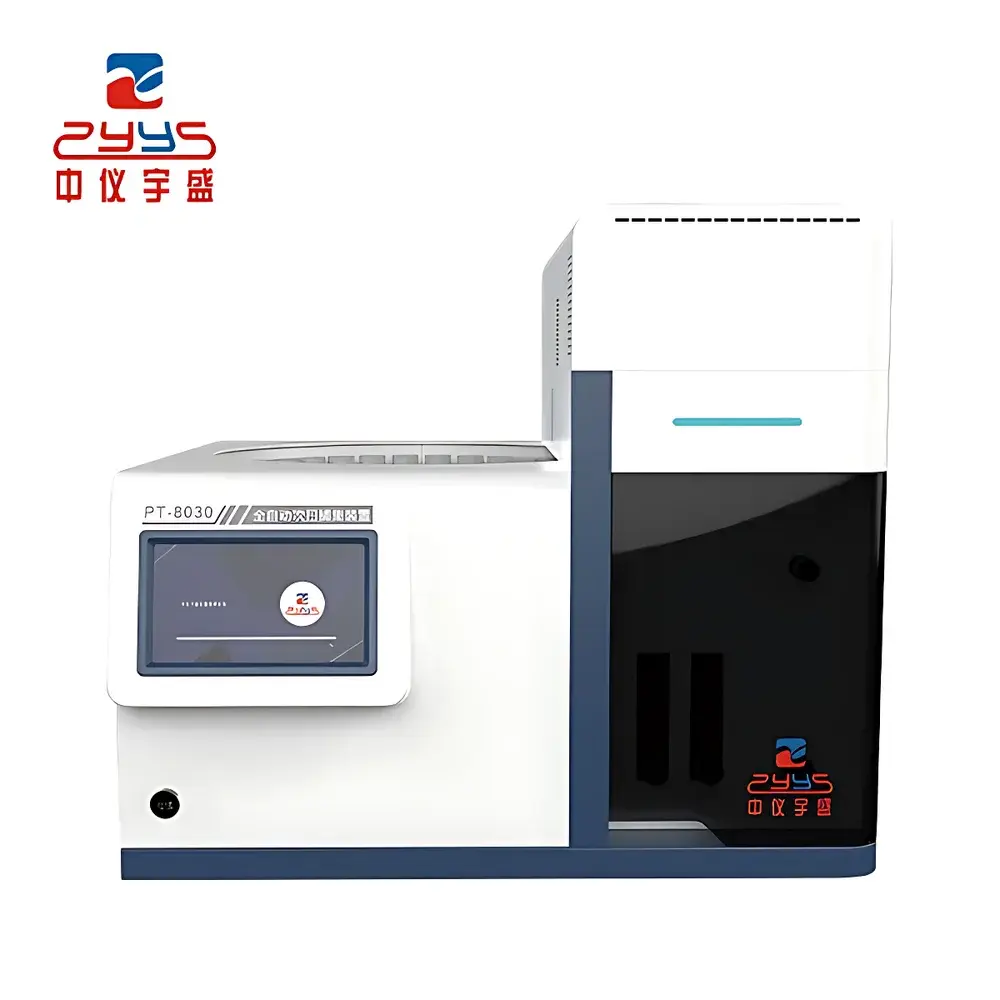
Zhongyi Yusheng PT-8030 Automated Purge and Trap Concentrator
| Brand | Zhongyi Yusheng |
|---|---|
| Origin | Beijing, China |
| Manufacturer Type | Direct Manufacturer |
| Instrument Category | Domestic (China-made) |
| Model | PT-8030 |
| Sample Tray Capacity | 30 positions |
| Instrument Type | Water & Soil Dual-Mode Purge and Trap System |
Overview
The Zhongyi Yusheng PT-8030 Automated Purge and Trap Concentrator is a fully integrated sample preparation system engineered for the quantitative enrichment and introduction of volatile organic compounds (VOCs) from aqueous, soil, and sediment matrices into gas chromatography (GC) or gas chromatography–mass spectrometry (GC–MS) systems. Based on standardized purge-and-trap methodology—where inert gas purging volatilizes target analytes from the sample matrix, followed by their adsorption onto a sorbent trap and subsequent thermal desorption—the PT-8030 delivers high reproducibility, low carryover, and robust automation for regulated environmental testing laboratories. Its dual-mode design supports both liquid-phase (water) and solid-phase (soil/sediment) sample introduction without hardware modification, aligning with method requirements for EPA Method 502.2, 524.4, 8260D, and corresponding Chinese national standards including HJ 605–2011, HJ 639–2012, and GB/T 5750.8–2023.
Key Features
- Unattended operation for up to 30 samples per batch, with automatic tray initialization, position calibration, and fault diagnostics at startup
- Independent temperature control across four critical zones: purge valve, sample transfer line, water removal trap, and trap desorption zone—each programmable within ±0.1 °C stability
- Integrated sample agitation mechanism for heterogeneous soil and sediment samples, ensuring consistent analyte release during purge cycles
- Electronically cooled trap and two-stage flash desorption architecture to minimize band broadening and yield narrow, symmetrical chromatographic peaks
- Automated back-flush functionality for both the sample transfer line and injection valve, significantly reducing cross-contamination between sequential analyses
- Dedicated moisture management via a cryogenically assisted water trap, preventing water vapor breakthrough that could impair GC column performance or MS detector sensitivity
- Hardware-level synchronization interfaces compatible with major GC and GC–MS platforms—including Agilent, Thermo Fisher, Shimadzu, and domestic OEM instruments—enabling trigger-based method coordination
Sample Compatibility & Compliance
The PT-8030 accommodates standard 40-mL VOC vials (with septa), 25-g soil/sediment jars, and custom containers meeting ASTM D3694 and ISO 15083 mechanical interface specifications. It is validated for use in laboratories operating under GLP and ISO/IEC 17025 quality frameworks. The system supports full compliance with over 15 Chinese environmental analytical standards, including HJ 605–2011 (soil VOCs), HJ 639–2012 (water VOCs), HJ 735–2015 (halogenated VOCs in soil), and GB/T 5750.8–2023 (drinking water testing). All thermal and timing parameters are logged with timestamped audit trails, satisfying documentation requirements for regulatory submissions and internal QA/QC reviews.
Software & Data Management
Controlled via an embedded industrial-grade microcomputer with a graphical user interface, the PT-8030 allows method development through intuitive time-segment programming—defining purge duration, trap conditioning, desorption ramp rates, and back-flush intervals. Methods are stored locally with version control and exportable in CSV format. The system supports external triggering via TTL or RS-232 protocols, enabling seamless integration with LIMS environments and chromatographic data systems (CDS). Audit logs record all operator actions, error events, and temperature deviations—supporting traceability under FDA 21 CFR Part 11–aligned electronic record practices when deployed in regulated settings.
Applications
The PT-8030 is routinely deployed in municipal water quality monitoring, contaminated site assessment, drinking water safety verification, and regulatory compliance testing for petrochemical, pharmaceutical, and agrochemical manufacturing facilities. Typical analytes include BTEX (benzene, toluene, ethylbenzene, xylenes), chlorinated solvents (e.g., trichloroethylene, vinyl chloride), halogenated hydrocarbons (e.g., chloroform, carbon tetrachloride), acrylonitrile, acrolein, and C6–C9 petroleum hydrocarbons. Its soil compatibility extends utility to landfill leachate characterization, sediment toxicity screening, and remediation endpoint verification—particularly where low detection limits (<10 ng/L in water; <1 µg/kg in soil) and high inter-batch precision (<5% RSD) are required.
FAQ
Does the PT-8030 support both water and soil analysis without hardware changes?
Yes—the system includes configurable sample handling modules and method templates optimized for liquid-phase purge (via sparging needle) and solid-phase purge (via heated agitation chamber), requiring only software selection and vial/jar loading.
How is moisture managed to prevent GC column damage?
A Peltier-cooled water trap operates at −10 °C to −15 °C, condensing >99.5% of water vapor prior to trap adsorption; residual moisture is further removed via a secondary desiccant stage before desorption.
Can the PT-8030 be integrated into an existing LIMS or CDS workflow?
Yes—through RS-232 serial communication and TTL-level hardware triggers, it supports automated job queuing, status reporting, and result metadata exchange with compliant laboratory informatics platforms.
Is method validation documentation available for regulatory submissions?
Zhongyi Yusheng provides IQ/OQ documentation templates, system suitability test procedures, and performance verification reports aligned with HJ and GB standard requirements upon request.
What maintenance routines are recommended for long-term reliability?
Daily: Visual inspection of transfer lines and septa integrity; Weekly: Trap regeneration and water trap cleaning; Quarterly: Calibration verification of temperature zones and purge flow rate accuracy using certified mass flow meters.




