
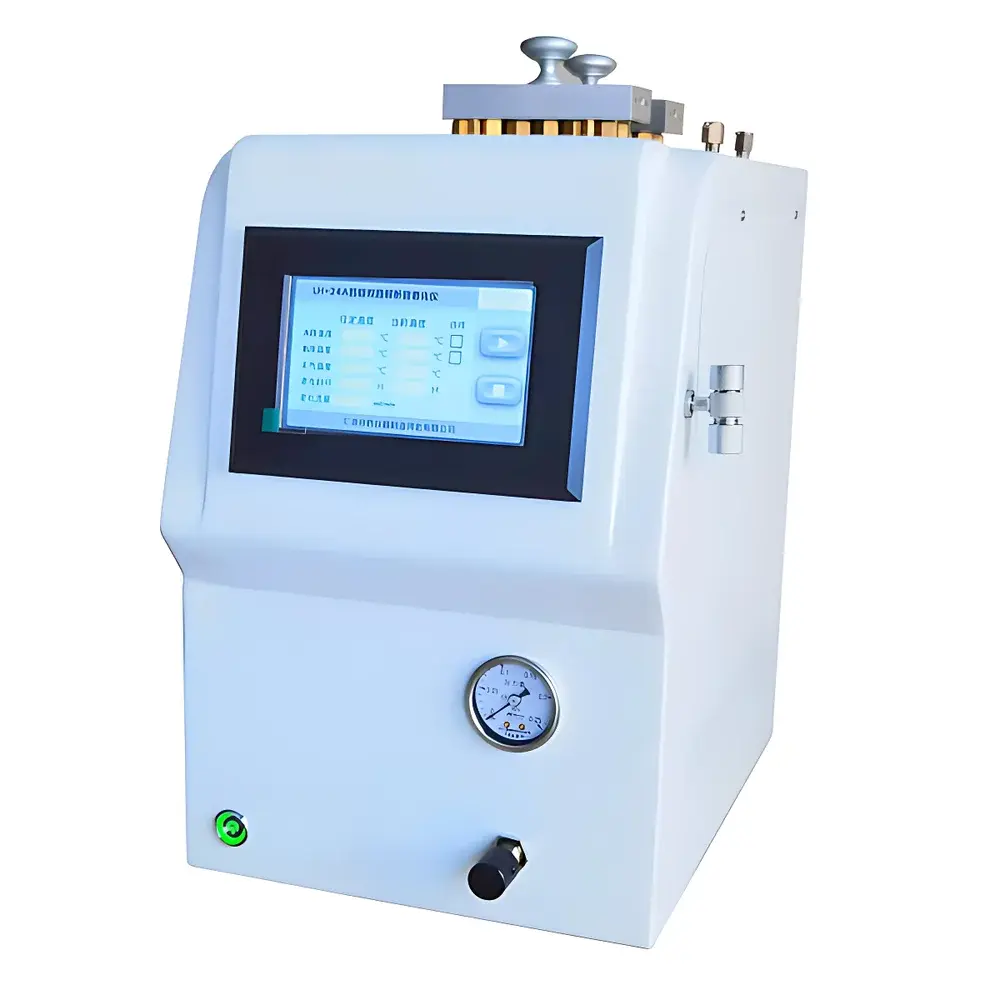
Beifen Sanpu LH-24A Intelligent Adsorption Tube Aging Instrument
| Brand | Beifen Sanpu |
|---|---|
| Origin | Beijing, China |
| Manufacturer Type | Direct Manufacturer |
| Product Category | Domestic |
| Model | LH-24A |
| Temperature Control Range | Ambient to 400 °C |
| Gas Flow Rate | 0–500 mL/min (expandable to 0–1000 mL/min per specification) |
| Tube Capacity | 24 adsorption tubes |
| Control Accuracy | ±1 °C |
| Max Aging Duration | >999 h |
| Dimensions (H×W×D) | 350 mm × 230 mm × 330 mm |
| Net Weight | ~12 kg |
| Power Supply | 220 VAC, 50 Hz |
| Power Consumption | <200 VA |
Overview
The Beifen Sanpu LH-24A Intelligent Adsorption Tube Aging Instrument is a purpose-built thermal conditioning system engineered for the controlled activation and decontamination of sorbent-packed sampling tubes used in thermal desorption–gas chromatography (TD–GC) workflows. It operates on the principle of programmed high-temperature purging under inert or conditioned carrier gas flow, enabling the removal of residual volatiles, moisture, and manufacturing impurities from Tenax®, Carbopack™, Carboxen®, and other polymer- or carbon-based sorbents. Designed as a dedicated auxiliary unit for laboratories performing EPA Method TO-17, ISO 16017-1, HJ 644–2013, and GB/T 5750.8–2023 analyses, the LH-24A ensures batch consistency, trace-level cleanliness, and long-term tube reusability—critical prerequisites for low-part-per-trillion (pptv) VOC quantification in ambient air, workplace breathing zone, and indoor air quality monitoring.
Key Features
- 24-position parallel aging configuration with independent dual-zone temperature control—enabling simultaneous conditioning of two distinct tube batches at different setpoints (e.g., 250 °C for Tenax TA, 320 °C for Carbopack B).
- 5-inch capacitive touchscreen interface with intuitive menu navigation, real-time temperature/flow monitoring, and editable aging protocols—including ramp-hold-cool sequences with programmable cooling termination logic.
- Integrated safety architecture: over-temperature cutoff (triggered >405 °C), auto-shutdown upon reaching user-defined end temperature, and gas-flow interlock that terminates purge gas supply when cooling completes below 50 °C.
- Quick-connect tube interface compatible with standard 6 mm OD × ≥110 mm or 1/4″ OD × 3.5″ adsorption tubes—eliminating threaded fittings, reducing leak risk, and accelerating tube loading/unloading cycles.
- Energy-efficient thermal management: active forced-air cooling post-aging; automatic gas shutoff upon reaching target cooldown temperature, minimizing argon/nitrogen consumption without manual intervention.
- Optional simulated sampling module supports calibrated vapor-phase spiking of aged tubes with certified VOC standards (e.g., benzene, toluene, naphthalene), facilitating system suitability verification prior to TD–GC analysis.
Sample Compatibility & Compliance
The LH-24A accommodates industry-standard adsorption tubes including but not limited to: stainless steel or quartz-lined tubes packed with single- or multi-bed sorbents (e.g., Tenax GR/Tenax TA, Carbopack C/B/X, Graphitized Carbon Black). Its design conforms to critical requirements outlined in US EPA Method TO-17 (Section 7.2.1: “Tube conditioning must be performed at temperatures sufficient to remove all contaminants without degrading the sorbent”), ISO 16017-1:2000 (Clause 6.3: “Pre-conditioning shall be conducted under inert atmosphere at elevated temperature”), and Chinese standard HJ 644–2013 (Section 6.4.2: “Activation temperature shall be no less than 300 °C for carbon-based sorbents”). All firmware operations retain full audit trail metadata (user ID, timestamp, parameter settings, runtime logs), supporting GLP-compliant documentation and FDA 21 CFR Part 11 readiness when deployed within validated laboratory information management systems (LIMS).
Software & Data Management
The instrument embeds non-volatile flash memory storing up to 100 customizable aging methods, each containing up to five sequential segments (heat-up ramp, dwell, cool-down ramp, hold, gas shutoff delay). Each method record includes operator ID, start/end timestamps, actual vs. setpoint temperature profiles (logged every 10 seconds), and cumulative gas flow volume. Exportable CSV logs support integration with enterprise LIMS via USB 2.0 port. No proprietary software installation is required—data files are human-readable and compatible with common spreadsheet and statistical analysis platforms. Firmware updates are delivered via encrypted USB stick, maintaining integrity and version traceability across instrument fleets.
Applications
- Ambient and indoor air monitoring programs requiring reproducible tube blank levels ≤50 pg for C2–C12 hydrocarbons.
- Occupational health and safety assessments per OSHA Method 52, NIOSH Method 1501, and GBZ/T 160 series standards.
- Building material emission testing (e.g., formaldehyde, TVOC) in accordance with ISO 16000-6 and JIS A 1912.
- Reference material certification and inter-laboratory comparison studies where tube-to-tube variability must remain <3% RSD for surrogate recovery.
- Method development labs optimizing sorbent stability, breakthrough capacity, and thermal desorption efficiency across temperature gradients.
- Third-party environmental testing facilities maintaining ISO/IEC 17025 accreditation—leveraging automated aging logs for objective evidence of equipment qualification and preventive maintenance records.
FAQ
What sorbent types are validated for use with the LH-24A?
Tenax TA, Tenax GR, Carbopack B, Carbopack C, Carbosieve S-III, and mixed-bed configurations (e.g., Carbopack B + Carbosieve S-III) have been verified across the full 50–400 °C operating range.
Can the LH-24A be integrated into an automated TD–GC workflow?
Yes—the instrument supports dry-contact relay outputs for external system synchronization (e.g., triggering TD autosampler start upon aging completion) and accepts TTL-level start signals from compatible GC data systems.
Is calibration certificate included with shipment?
A factory-issued temperature calibration report (traceable to NIM, China) is provided; optional UKAS-accredited calibration services are available upon request.
Does the unit meet electromagnetic compatibility (EMC) requirements for laboratory environments?
Complies with GB/T 18268.1–2010 (IEC 61326-1:2012) for Class A industrial environments, with conducted and radiated emissions tested per CISPR 11.
What maintenance intervals are recommended?
Visual inspection of heating elements and gas manifolds every 6 months; annual verification of thermocouple accuracy and flowmeter linearity using NIST-traceable references.




