
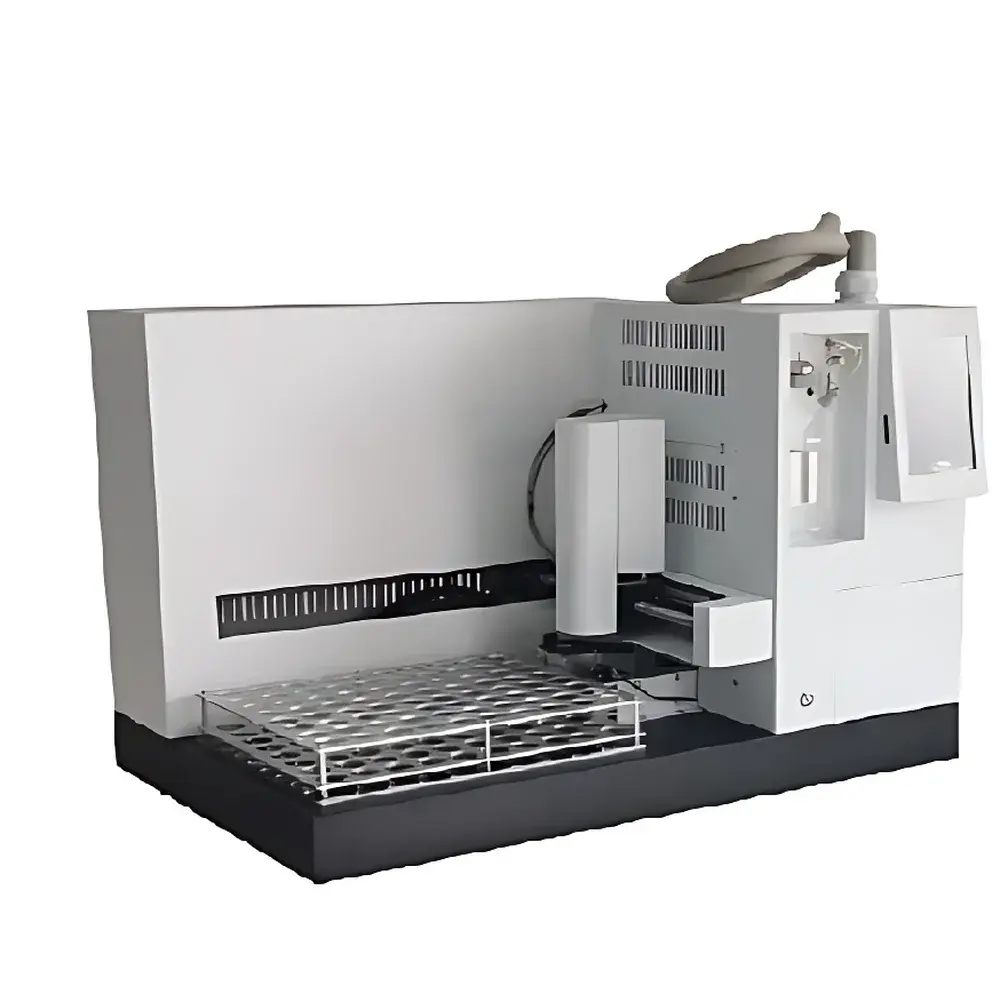
Beifen Sanpu PT-80A Fully Automated Purge and Trap Concentrator for Water and Soil Samples
| Brand | Beifen Sanpu |
|---|---|
| Origin | Beijing, China |
| Manufacturer | Beifen Sanpu Instrument Co., Ltd. |
| Model | PT-80A |
| Sample Capacity | 80 positions (40 mL VOA vials) |
| Injection Precision | RSD ≤ 3% |
| Trap Desorption Temperature Range | Ambient to 380 °C |
| Cooling | 250 °C → 35 °C in ≤ 90 s |
| Purge Heater Temperature | Ambient to 95 °C |
| Sample Chilling | Ambient only |
| Cold Trap Temperature Range | −40 °C to ambient (Peltier + air cooling) |
| Purge Flow Rate | 0–150 mL/min |
| Tube Heating Zone | Ambient to 220 °C |
| Water Removal Trap Temp | Ambient to 400 °C |
| Distilled Water Rinse Temp | Ambient to 90 °C |
| Solid Sample Vial Heater | Ambient to 100 °C |
| Foam Sensor | Integrated |
| System Pressure Rating | ≤ 0.6 MPa |
| Synchronization Outputs | 2 digital TTL triggers (1–2 s delay) |
| Power Supply | AC 220 V, 50 Hz |
| Power Consumption | 800 W |
| Dimensions | 750 × 500 × 550 mm |
| Weight | ~50 kg |
Overview
The Beifen Sanpu PT-80A is a fully automated, dual-mode purge and trap concentrator engineered for high-throughput, trace-level analysis of volatile organic compounds (VOCs) in both aqueous and solid environmental matrices—including drinking water, groundwater, soil, sediment, and food samples. It operates on the principle of dynamic headspace extraction: inert gas purges VOCs from the sample matrix into a cooled trap where analytes are adsorbed onto sorbent material; following desorption, the concentrated analytes are transferred directly to a coupled gas chromatograph (GC) or GC–mass spectrometer (GC–MS) for separation and detection. Designed to meet stringent regulatory requirements for environmental monitoring, the PT-80A supports method-compliant workflows aligned with U.S. EPA Method 524.2, 502.2, 624, and 8260, as well as Chinese national standards HJ 605–2011, HJ 639–2012, and HJ 686–2014.
Key Features
- 80-position autosampler accommodating standard 40 mL VOA vials—enabling unattended overnight operation and batch processing of large sample sets;
- High-speed thermal management: Peltier-based cold trap achieves −40 °C (at 20 °C ambient), eliminating the need for liquid nitrogen; trap desorption heating rate exceeds 2000 °C/min, ensuring sharp, efficient transfer and minimal band broadening;
- Integrated foam detection sensor prevents carryover and system contamination by automatically halting purge upon foam formation in the sparging tube;
- Independent purge and backflush gas pathways isolate trap eluate from the purge stream, eliminating cross-contamination between samples;
- Heated zones throughout the entire flow path (including transfer lines, six-port valve, and desorption tube) eliminate cold spots and minimize analyte loss or condensation;
- Chemically inert fluidic architecture: PEEK tubing and silanized stainless-steel components reduce surface adsorption and memory effects;
- Hot-water rinse capability (up to 90 °C) for thorough cleaning of purge tubes and internal lines between runs;
- Two TTL synchronization outputs provide precise timing control for coordinated GC injection and data acquisition initiation;
- Full PC-based software control with remote instrument reconfiguration, method scheduling, audit trail logging, and real-time status monitoring via intuitive GUI interface;
- Dual-mode sample handling: Supports direct aqueous injection and solid-phase extraction via heated vial (ambient–100 °C) with integrated vortex mixing using 5 mL distilled water.
Sample Compatibility & Compliance
The PT-80A is validated for use with diverse sample types: raw and treated drinking water, wastewater, soil slurries, sediment homogenates, and food extracts. Its water removal trap (heatable to 400 °C) effectively eliminates moisture interference prior to GC injection—critical for maintaining column integrity and detector sensitivity in electron ionization (EI) MS systems. The instrument complies with ISO/IEC 17025 quality management requirements for testing laboratories and supports GLP/GMP-aligned data integrity practices through timestamped method logs, user access controls, and electronic signature-capable software. While not pre-certified for FDA 21 CFR Part 11, its architecture permits configuration to meet electronic record and signature requirements when deployed with validated LIMS integration.
Software & Data Management
The proprietary Beifen Sanpu Control Suite provides comprehensive method development, sequence definition, real-time diagnostics, and event-driven reporting. All temperature setpoints, timing parameters, purge flows, and rinse cycles are programmable with 1 °C or 0.1 s resolution. The software maintains a complete operational history—including run timestamps, operator ID, calibration events, and error flags—for traceability. Audit trails are exportable in CSV format and support third-party validation protocols. Remote desktop access enables off-site troubleshooting and method optimization without physical presence.
Applications
- Regulatory compliance testing per HJ 605–2011 (VOCs in soil and sediment) and HJ 639–2012 (VOCs in water);
- Drinking water safety monitoring under GB/T 5750.8–2023 (Standard Methods for Examination of Drinking Water – Organic Indicators);
- Volatile halocarbon analysis (e.g., chloroform, carbon tetrachloride, vinyl chloride) in environmental matrices;
- Acrylonitrile quantification in industrial effluents using GC-FID;
- Flavor and aroma profiling in beverages and agricultural products;
- Method development and validation studies requiring high reproducibility (RSD ≤ 3%) across heterogeneous sample batches.
FAQ
Can the PT-80A be used with non-Beifen GC systems?
Yes—the instrument features universal pneumatic and electrical interfaces compatible with all major GC and GC–MS platforms, including Agilent, Thermo Fisher, Shimadzu, and PerkinElmer systems.
Is liquid nitrogen required for cold trapping?
No—the integrated Peltier cooler achieves −40 °C at 20 °C ambient without cryogens, reducing operational cost and logistical complexity.
How is carryover minimized between solid and liquid samples?
By combining independent purge/backflush gas routing, hot-water rinsing, heated transfer lines, and programmable needle wash cycles—validated via blank-run testing per EPA guidance.
Does the system support unattended operation over weekends?
Yes—80-position capacity, robust thermal stability, and fault-tolerant software enable multi-day autonomous sequences with email alert notifications on completion or error.
What maintenance is recommended for long-term reliability?
Quarterly inspection of trap integrity, annual replacement of O-rings and sorbent traps, and routine verification of purge flow accuracy using calibrated mass flow meters.



