
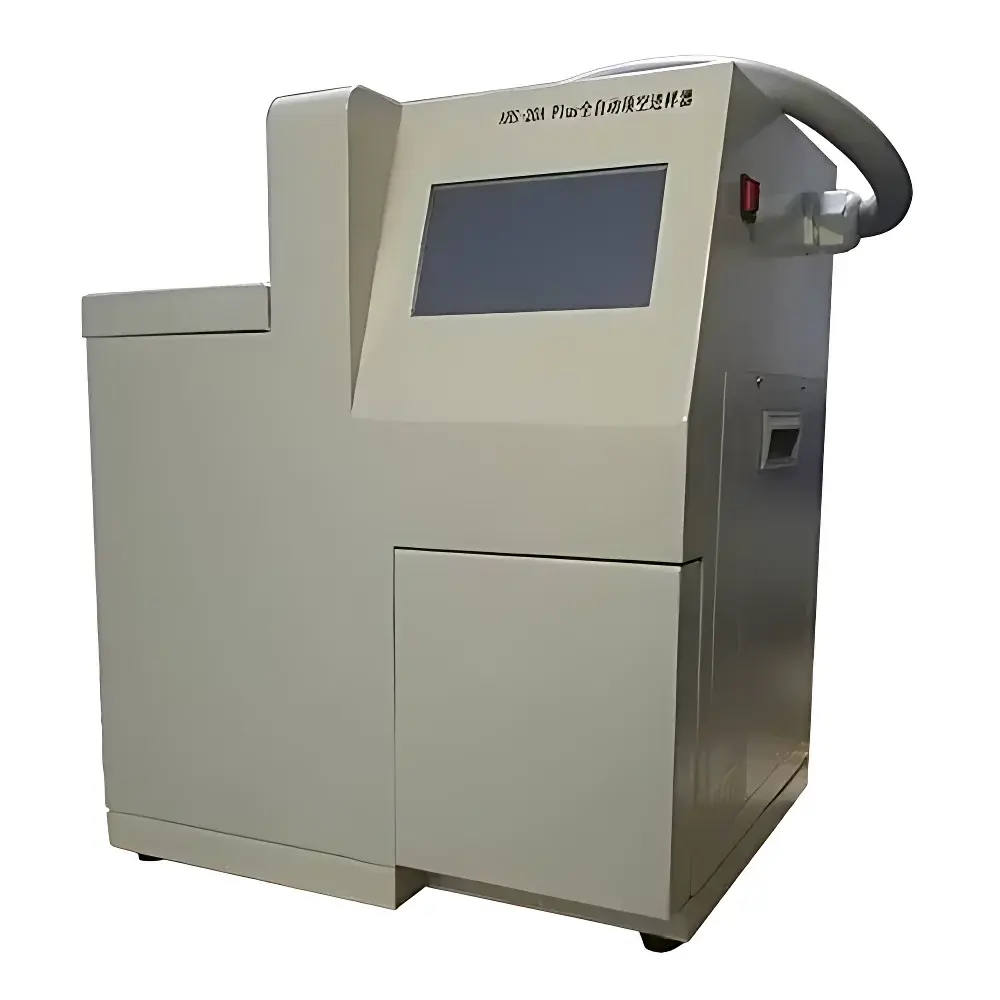
Beifen Sanpu RAHS-20A Plus Fully Automated Headspace Sampler
| Brand | Beifen Sanpu |
|---|---|
| Origin | Beijing, China |
| Manufacturer Type | OEM Manufacturer |
| Product Origin | Domestic (China) |
| Model | RAHS-20A Plus |
| Pricing | Upon Request |
| Sample Capacity | 20 positions |
| Vial Sizes Supported | 10 mL and 20 mL (customizable up to 100 mL) |
| Quantitative Loop Volume | 1 mL (optional: 0.5 mL, 2 mL, 5 mL) |
| Oven Temperature Range | 40–220 °C (configurable up to 300 °C), accuracy ±1 °C, stability <±0.5 °C |
| Valve & Transfer Line Temp Range | 40–220 °C (configurable up to 300 °C), accuracy ±1 °C |
| Pressure Control | 0–0.25 MPa (continuously adjustable) |
| Pressurization Time | 0–999 s |
| Sampling Time | 0–30 min |
| Injection Time | 0–999 s |
| Bake-out/Flush Time | 0–30 min |
| Time Resolution | 1 ms |
| Carrier Gas Flow Control | EPC optional |
| RSD | <1.0% (for 100 ppm ethanol in water) |
| Interface | USB |
| Inert Flow Path | Deactivated fused-silica tubing throughout |
| Valve Configuration | Six-port rotary valve with low-dead-volume design |
| Operation Mode | Positive-pressure sampling |
Overview
The Beifen Sanpu RAHS-20A Plus Fully Automated Headspace Sampler is an engineered solution for precise, reproducible, and unattended volatile compound extraction prior to gas chromatographic analysis. Based on the well-established principle of equilibrium headspace sampling—where volatile analytes partition between a solid or liquid sample matrix and its overlying vapor phase—the RAHS-20A Plus thermally equilibrates sealed vials under controlled temperature and pressure conditions, then introduces the vapor phase quantitatively into the GC inlet via a pressurized, inert flow path. This methodology eliminates matrix interference, minimizes carryover, and ensures high sensitivity for trace-level volatiles—including residual solvents, environmental contaminants, flavor compounds, and pharmaceutical impurities—without derivatization or solvent extraction. Designed for routine QC laboratories, method validation environments, and regulated research settings, the system adheres to core analytical principles outlined in USP , ICH Q3C, ASTM D7217, and ISO 11843-2, supporting data integrity requirements through deterministic timing, hardware-level fault detection, and synchronized instrument control.
Key Features
- 20-position autosampler carousel with automatic vial recognition and positional error avoidance—mechanically detects empty slots and skips them to prevent collision or misalignment.
- Triple-zone independent temperature control: sample oven, six-port valve, and transfer line—all heated to 220 °C standard (upgradable to 300 °C) with ±1 °C accuracy and <±0.5 °C stability over 8-hour operation.
- Positive-pressure headspace injection using electronically regulated pressure (0–0.25 MPa), eliminating reliance on external gas cylinders and enhancing lab safety and footprint efficiency.
- Low-dead-volume six-port valve coupled with a 1 mL quantitative loop (customizable); all internal surfaces lined with high-inertness deactivation treatment to suppress adsorption and cross-contamination.
- Full thermal integration: valve and loop housed inside the heated oven compartment—no cold spots along the vapor path—to preserve analyte integrity during transfer.
- Real-time system diagnostics: power-on self-test, motor position verification, heater continuity monitoring, and fault-triggered emergency stop with on-screen alert and event logging.
- Flexible operational modes: single-vial multi-injection, single-vial single-injection, and multi-vial sequential injection—programmable per vial via PC or front-panel interface.
- USB-based bidirectional communication with full parameter configuration, method storage, run scheduling, and GC start synchronization—including support for legacy and modern GC systems from Agilent, Thermo Fisher, Shimadzu, and PerkinElmer.
Sample Compatibility & Compliance
The RAHS-20A Plus accommodates standard 10 mL and 20 mL crimp-top or screw-cap headspace vials, with mechanical adaptability for custom formats (e.g., 50 mL, 100 mL). It supports both liquid samples (aqueous solutions, organic solvents, suspensions) and solid matrices (polymers, soils, pharmaceutical tablets, food products) without modification. All wetted components—including the sampling needle, quantitative loop, and transfer lines—are constructed from fused silica with proprietary silanized deactivation, verified by blank testing per ASTM D6866-22 protocols. The system complies with GLP/GMP documentation prerequisites through timestamped audit trails, user-accessible method logs, and non-editable run history. Optional EPC (Electronic Pressure Control) module enables compliance with FDA 21 CFR Part 11 when paired with validated chromatography data systems (CDS).
Software & Data Management
Control is executed via a dedicated Windows-compatible application supporting method creation, sequence building, real-time status visualization, and post-run report generation (PDF/CSV). Each method stores complete thermal profiles, timing parameters, pressure setpoints, and GC trigger configurations. All user actions—including login, parameter edits, and sequence starts—are logged with operator ID, timestamp, and IP address (when networked). Raw control data is stored locally in encrypted binary format; export functions support LIMS integration via ODBC or direct file transfer. No cloud dependency or mandatory telemetry—data sovereignty remains fully under laboratory control.
Applications
- Residual solvent analysis in APIs and excipients per ICH Q3C guidelines.
- Volatile organic compound (VOC) profiling in drinking water, wastewater, and soil extracts (EPA Method 502.2, 624).
- Flavor and fragrance release kinetics in beverages, dairy, and confectionery products.
- Leachable and extractable studies for packaging materials (ISO 10993-12, USP ).
- Quality control of ethanol content in pharmaceutical tinctures and disinfectants.
- Stability-indicating assays for oxidation-prone compounds (e.g., terpenes, unsaturated lipids).
FAQ
Is the RAHS-20A Plus compatible with third-party GC data systems?
Yes—via hardware TTL triggers and software-defined COM/USB commands, it integrates with OpenLab CDS, Chromeleon, Empower, and custom LabVIEW or Python-based acquisition platforms.
Can the system be validated for regulated environments?
Yes—IQ/OQ documentation templates are provided; PQ execution requires lab-specific reference standards and performance qualification protocols aligned with your internal SOPs.
What maintenance intervals are recommended?
Vial septa replacement every 100 injections; quantitative loop cleaning every 500 runs; annual calibration verification using NIST-traceable temperature sensors and certified pressure gauges.
Does the sampler support dynamic headspace or purge-and-trap configurations?
No—this model implements static equilibrium headspace only. Dynamic headspace functionality requires separate instrumentation.
Is remote monitoring or unattended overnight operation supported?
Yes—sequence-driven operation with auto-shutdown, temperature hold, and fault-recovery logic enables 72+ hour unattended runs under stable ambient conditions (15–30 °C, <70% RH).




