
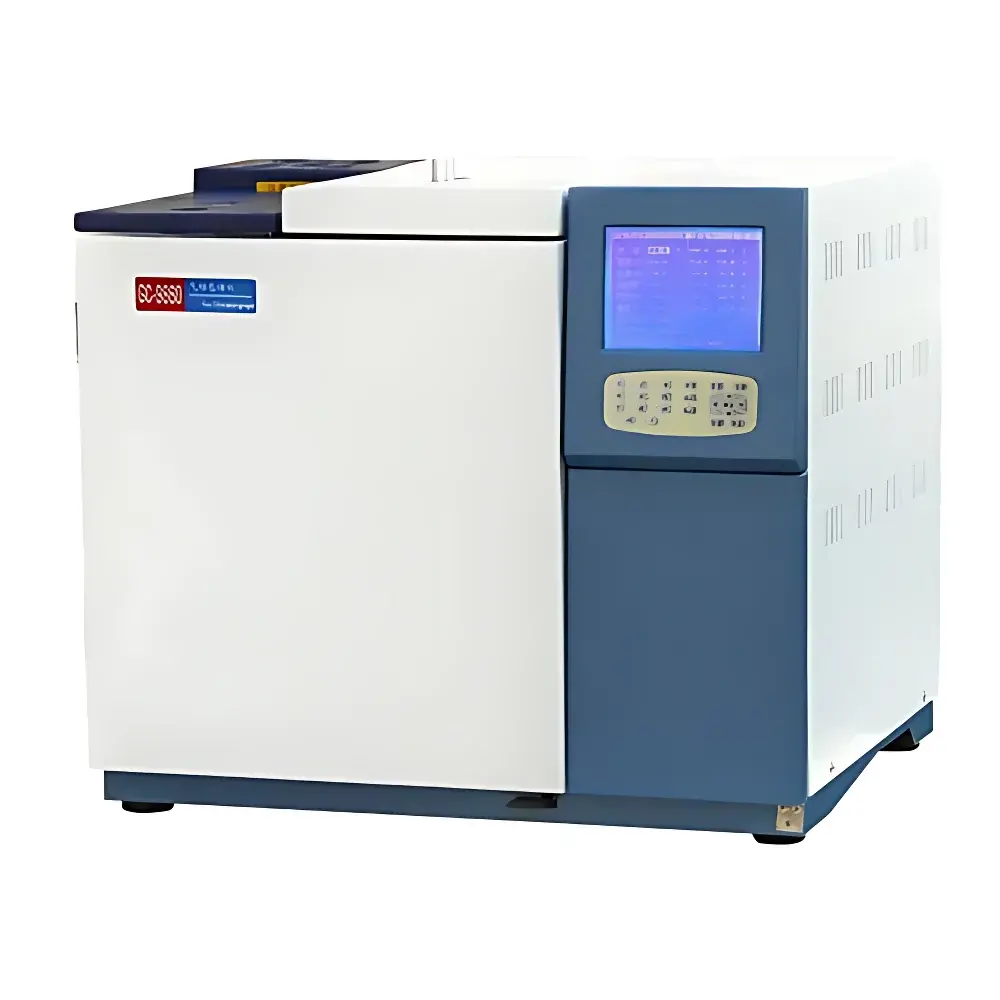
Sanpu GC-9860 Food Safety Gas Chromatograph with Electron Capture Detector (ECD) for Organochlorine Pesticide Residue Analysis
| Brand | Sanpu |
|---|---|
| Origin | Beijing, China |
| Manufacturer Type | Direct Manufacturer |
| Instrument Type | Laboratory Gas Chromatograph |
| Application Field | Food Safety & Pesticide Residue Testing |
| Oven Temperature Range | 100–350 °C |
| Heating Rate | 0.1–40 °C/min |
| Cooling Rate | ~6 min from 350 °C to 100 °C |
| Carrier Gas Flow Range & Control | 0–1200 mL/min |
| Carrier Gas Pressure Range & Control | 0–970 kPa |
| Injector Maximum Temperature | 100–350 °C |
| Injector Pressure Setting Range | 0–970 kPa |
| Injector Total Flow Setting Range | 0–1000 mL/min |
Overview
The Sanpu GC-9860 is a dedicated laboratory gas chromatograph engineered for high-sensitivity, regulatory-compliant analysis of organochlorine pesticide residues in food matrices. It operates on the principle of capillary gas chromatography coupled with electron capture detection (GC-ECD), a method widely recognized and standardized for trace-level halogenated compound quantification. The system is optimized for multi-residue determination of persistent organic pollutants—including hexachlorocyclohexane (HCH) isomers (α-, β-, γ-, δ-), DDT and its metabolites (p,p′-DDE, p,p′-DDD, o,p′-DDT), chlordane, heptachlor, endosulfan, dieldrin, aldrin, endrin, pentachloronitrobenzene (PCNB), and mirex—across complex biological samples such as meat, dairy, eggs, edible oils, and plant tissues. Its thermal stability, precise pressure/flow control architecture, and ECD-compatible inlet design ensure reproducible retention times and sub-μg/kg detection capability under validated analytical protocols aligned with national food safety standards.
Key Features
- Robust oven system with programmable temperature ramping (0.1–40 °C/min) and rapid cooling (~6 minutes from 350 °C to 100 °C), enabling high-throughput multi-method sequence execution.
- Independent, digitally controlled pressure and flow regulation for carrier gas (N₂), auxiliary gases, and split/splitless injection—critical for ECD stability and peak shape reproducibility.
- High-temperature injector (up to 350 °C) with selectable split/splitless modes and precise volume injection (1 μL typical), supporting both volatile and semi-volatile organochlorine analytes without thermal degradation.
- Integrated hardware compatibility with standard 30 m × 0.32 mm ID × 0.25 μm DM-5 or equivalent non-polar fused-silica capillary columns, ensuring method transferability across laboratories.
- Modular detector interface designed for certified ECD units operating at 300 °C, delivering low-noise baseline performance and linear dynamic range >10⁴ for electronegative compounds.
- Full compliance with mechanical and electrical safety requirements per IEC 61010-1, including overtemperature protection, gas leak monitoring, and emergency shutdown logic.
Sample Compatibility & Compliance
The GC-9860 is validated for use in workflows compliant with GB 23200.11–2018 (China National Standard for organochlorine pesticide residue determination in food) and technically harmonized with AOAC Official Method 991.23, ISO 14501:2005, and EPA Method 8081B. It supports sample preparation protocols involving solvent extraction (acetone, petroleum ether, ethyl acetate, cyclohexane), gel permeation chromatography (GPC) cleanup using Bio-Beads SX-3, and nitrogen-assisted concentration—all essential for removing lipids, pigments, and co-extractives from animal and plant matrices. The instrument’s thermal and pressure control fidelity ensures consistent chromatographic resolution of critical isomer pairs (e.g., cis-/trans-chlordane, α-/γ-HCH) and metabolite interferences (e.g., DDE vs. DDT), meeting minimum data quality requirements for GLP and GMP-aligned food testing laboratories.
Software & Data Management
The GC-9860 is operated via a dedicated chromatography data system (CDS) supporting full audit trail functionality per FDA 21 CFR Part 11. Software modules include method development wizard, automated calibration curve generation (external standard mode), peak integration with retention time locking, and customizable report templates aligned with CNAS (China National Accreditation Service) reporting formats. Raw data files are stored in vendor-neutral .cdf format, enabling long-term archival and third-party reprocessing. System suitability checks—such as resolution between α-HCH and β-HCH peaks, ECD baseline noise (<0.5 pA), and retention time repeatability (RSD <0.1%)—are programmable and logged with user authentication. Electronic signatures, role-based access control, and secure database backup are configurable to support ISO/IEC 17025 accreditation requirements.
Applications
This instrument serves as the core analytical platform for accredited food safety testing laboratories performing routine surveillance and regulatory compliance testing. Primary applications include: quantification of HCH and DDT isomers in infant formula and dairy products; screening of chlorinated hydrocarbon contaminants in edible oils and fried snacks; verification of pesticide clearance in raw agricultural commodities prior to export; and forensic analysis of legacy contamination in environmental food chain studies. Its robustness in handling dirty extracts—without column fouling or detector quenching—makes it especially suitable for high-volume QC labs processing hundreds of samples weekly under strict turnaround time constraints.
FAQ
What detection limit can be achieved for α-HCH in meat samples using this system?
Under standard GB 23200.11 conditions (2 g sample, 5 mL final volume, 1 μL injection), the method detection limit (MDL) for α-HCH is 0.038 μg/kg, verified through signal-to-noise ≥3 and replicate precision (n=7, RSD <12%).
Is the GC-9860 compatible with automated GPC sample preparation systems?
Yes—the instrument accepts standard 1 mL autosampler vials and supports external trigger signals for synchronized injection following GPC fraction collection (e.g., 7.5–15 min window).
Does the system meet international regulatory data integrity requirements?
The bundled CDS implements full 21 CFR Part 11 controls, including electronic signatures, immutable audit trails, and secure user authentication—validated for use in laboratories seeking ISO/IEC 17025 or BRCGS certification.
Can the oven accommodate longer capillary columns (e.g., 60 m) for enhanced resolution?
The oven chamber dimensions and gas flow management support columns up to 60 m × 0.25 mm ID; however, optimal ECD sensitivity for organochlorines is typically achieved with 30 m × 0.32 mm configurations per GB and AOAC guidelines.
What maintenance intervals are recommended for ECD cell longevity?
With proper sample cleanup and nitrogen carrier gas purity (≥99.999%), the ECD filament life exceeds 12 months under routine operation; quarterly bake-out cycles (300 °C for 2 hours) and annual cell cleaning with phosphoric acid vapor are advised.





