
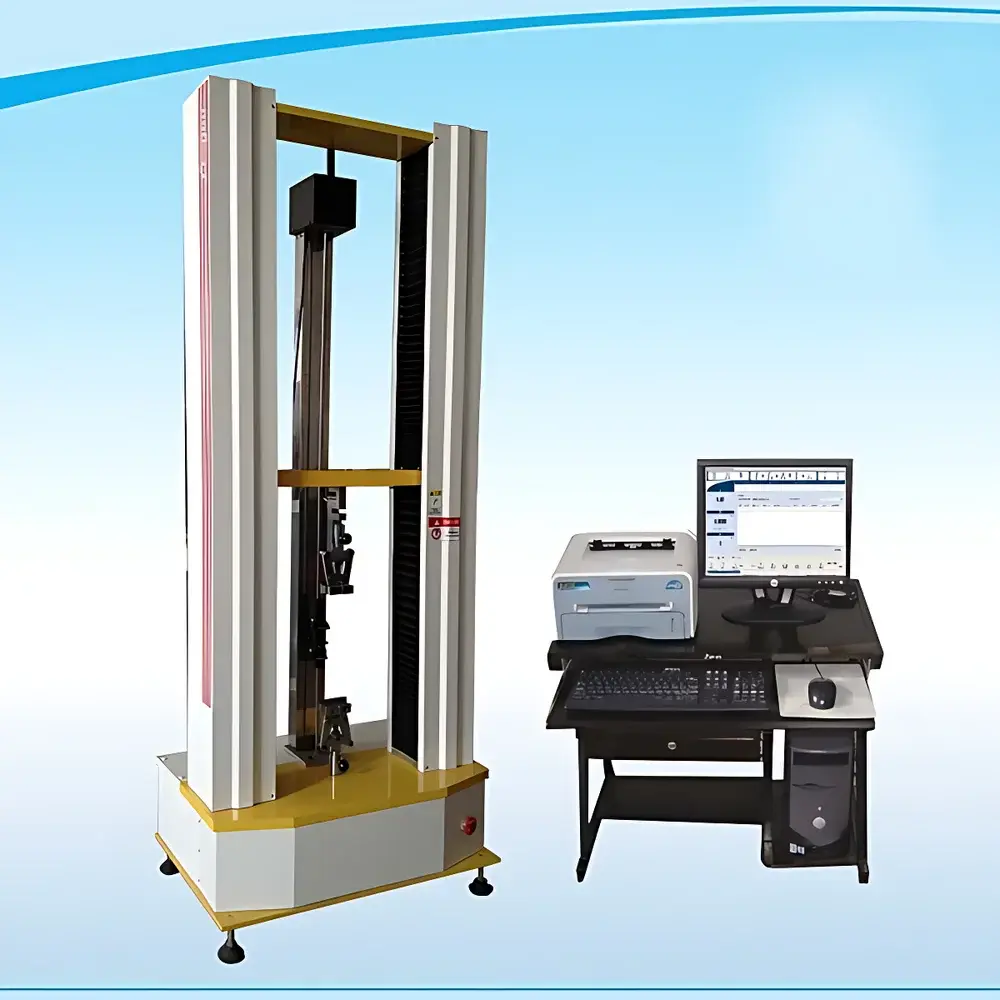
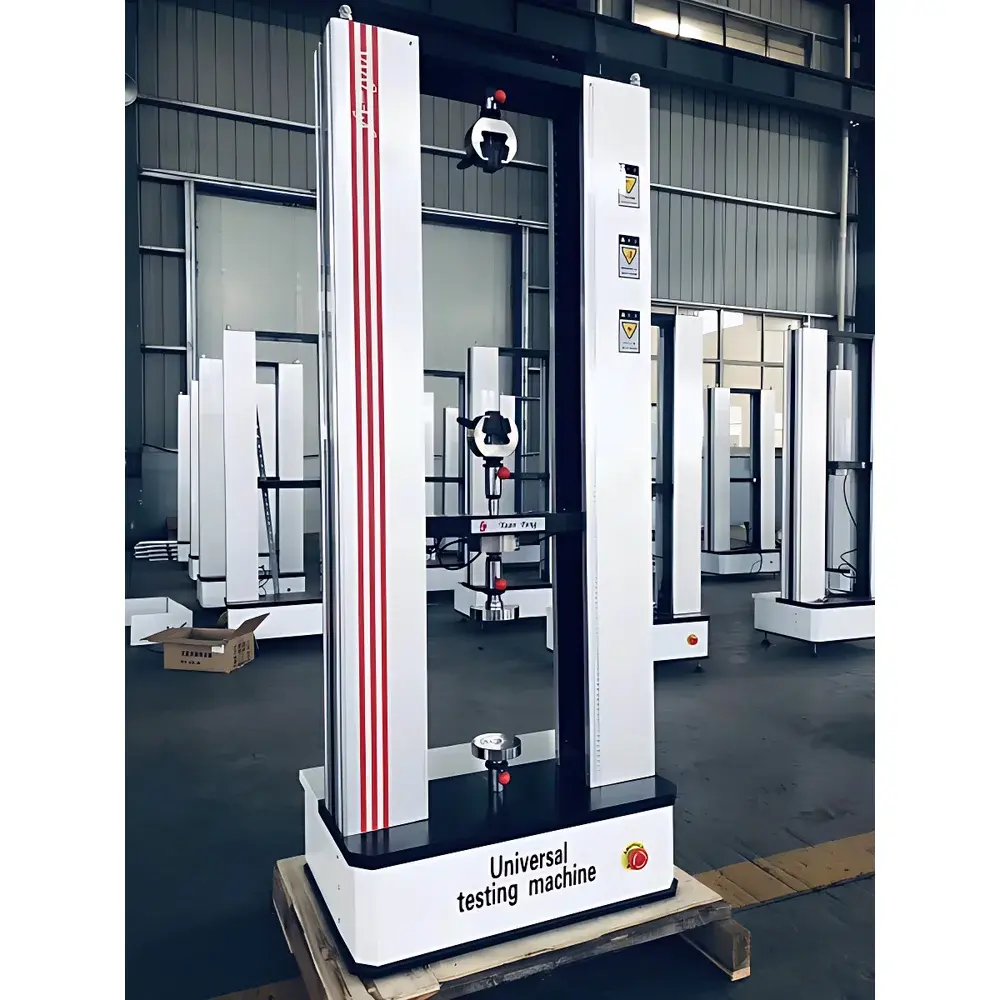
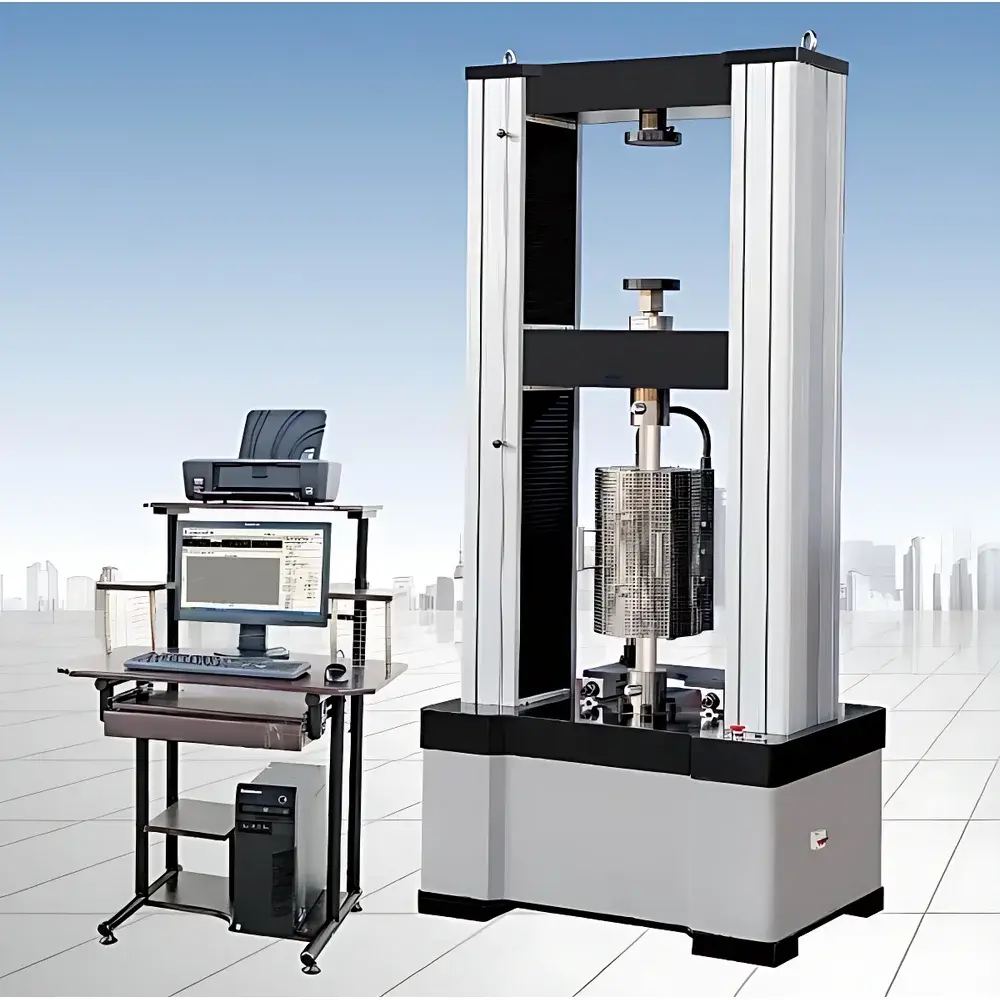
Beiguang Jingyi BWN-2KN Mechanical-Electronic Tensile Testing Machine
| Brand | Beiguang Jingyi / All Precision Instrument |
|---|---|
| Origin | Beijing, China |
| Manufacturer Type | Direct Manufacturer |
| Model | BWN-2KN |
| Maximum Test Load | 2 kN |
| Force Accuracy | ±1% of reading |
| Force Measurement Range | 2–100% of full scale (FS) |
| Resolution | 1/300,000 of full scale |
| Crosshead Speed Range | 0.05–500 mm/min (infinitely variable) |
| Speed Accuracy | ±1% of set value |
| Force Control Rate Range | 0.05–5% FN/s |
| Force Control Accuracy | ±2% at ≤0.05 FN/s |
| Displacement Resolution | 0.001 mm |
| Displacement Accuracy | ±1% of reading |
| Effective Travel | 700 mm (tension/compression) |
| Effective Test Width | 400 mm |
| Operating Environment | 10–35 °C, 20–80% RH |
Overview
The Beiguang Jingyi BWN-2KN Mechanical-Electronic Tensile Testing Machine is a precision-engineered universal testing system designed for static mechanical property evaluation of solid materials under uniaxial loading conditions. Based on the fundamental principles of Hooke’s law and standardized force-displacement transduction, the instrument applies controlled tensile, compressive, flexural, peel, tear, and shear loads to specimens while continuously acquiring high-fidelity load and displacement data. Its dual-column structural architecture ensures axial alignment stability and rigidity, minimizing parasitic bending moments during high-force testing. The system complies with core mechanical testing standards including ASTM E4, ASTM D638, ISO 6892-1, GB/T 228.1, and ISO 179 for impact-modified plastics—enabling traceable, repeatable, and auditable test execution in R&D labs, QC departments, and third-party certification facilities.
Key Features
- High-resolution force measurement system with 1/300,000 internal resolution and ±1% accuracy across 2–100% FS—validated per ISO 7500-1 Class 1 requirements.
- Infinitely variable crosshead speed control from 0.05 to 500 mm/min, with closed-loop feedback ensuring ±1% speed fidelity independent of load or travel position.
- Real-time force-rate control mode supporting ramp-to-load, ramp-to-strain, and hold-at-load protocols—essential for creep, stress relaxation, and modulus determination per ASTM D2990.
- Integrated overload protection, end-of-travel limit switches, and automatic test termination logic—meeting IEC 61000-6-2 electromagnetic compatibility and functional safety expectations.
- Modular fixture interface compatible with standardized grips (pneumatic, wedge, vise), peel fixtures (90°, 180°), tear fixtures (trouser, crescent), and compression platens—enabling rapid reconfiguration between test types without recalibration.
- Zero-point floating compensation and real-time peak force retention—supporting dynamic offset correction during thermal drift or grip slippage scenarios.
Sample Compatibility & Compliance
The BWN-2KN accommodates specimens ranging from thin polymer films (≥25 µm) to metallic rods (≤12 mm diameter) and composite laminates (≤10 mm thickness). Standardized test geometries include dog-bone tensile bars (ASTM D638 Type I–V), dumbbell specimens (ISO 37), puncture discs (ASTM D3776), and bonded lap joints (ASTM D1002). All mechanical measurements are traceable to national metrological standards via factory calibration certificates (NIST-traceable load cells and encoder systems). The system supports GLP-compliant operation through user-accessible audit trails, electronic signature fields, and password-protected parameter locking—aligning with FDA 21 CFR Part 11 requirements when paired with validated software modules.
Software & Data Management
The machine operates with embedded LCD controller firmware and optional PC-based analysis software (Windows 10/11 compatible). Raw data streams are recorded at ≥100 Hz sampling rate and exported in CSV or XML formats for post-processing in MATLAB, Origin, or QDA platforms. Software features include automated calculation of tensile strength, yield point, Young’s modulus, elongation at break, tear resistance (kN/m), and peel adhesion (N/mm)—all aligned with ASTM D882, ISO 527-3, and EN 1392. Calibration parameters, operator ID, environmental logs, and test metadata are embedded within each dataset file. Exported reports include digital signatures, timestamped calibration history, and configurable headers compliant with ISO/IEC 17025 documentation frameworks.
Applications
This system serves as a foundational tool for mechanical characterization across regulated and non-regulated sectors. In polymer R&D, it quantifies melt strength, film toughness, and hot-tack performance under controlled thermal profiles. In wire & cable manufacturing, it verifies conductor tensile integrity and insulation jacket elongation per UL 1581. Aerospace composites undergo interlaminar shear strength (ILSS) validation using short-beam bending fixtures. Medical device manufacturers employ it for suture tensile failure analysis (ISO 10993-12) and catheter shaft burst testing. Additionally, it supports packaging qualification (ASTM F88 seal strength, ASTM F904 peel), textile yarn tenacity (ISO 2062), and rubber compound scorch resistance evaluation (ASTM D5963).
FAQ
What standards does the BWN-2KN comply with for force calibration?
It conforms to ISO 7500-1 Class 1 accuracy requirements, with factory calibration traceable to CNAS-accredited reference standards.
Can the system perform cyclic loading tests?
No—the BWN-2KN is configured for static monotonic testing only; fatigue-capable models require servo-hydraulic actuation and separate controller architecture.
Is software validation documentation available for GMP environments?
Yes—IQ/OQ protocols and 21 CFR Part 11 compliance packages are provided upon request for qualified installations.
What maintenance intervals are recommended for mechanical components?
Lubrication of lead screws and guide rails is advised every 500 operational hours; load cell verification is recommended annually or after 10,000 test cycles.
Does the system support multi-language UI and report generation?
The embedded display supports English and simplified Chinese; PC software allows customizable report templates in English, German, French, and Spanish.



