
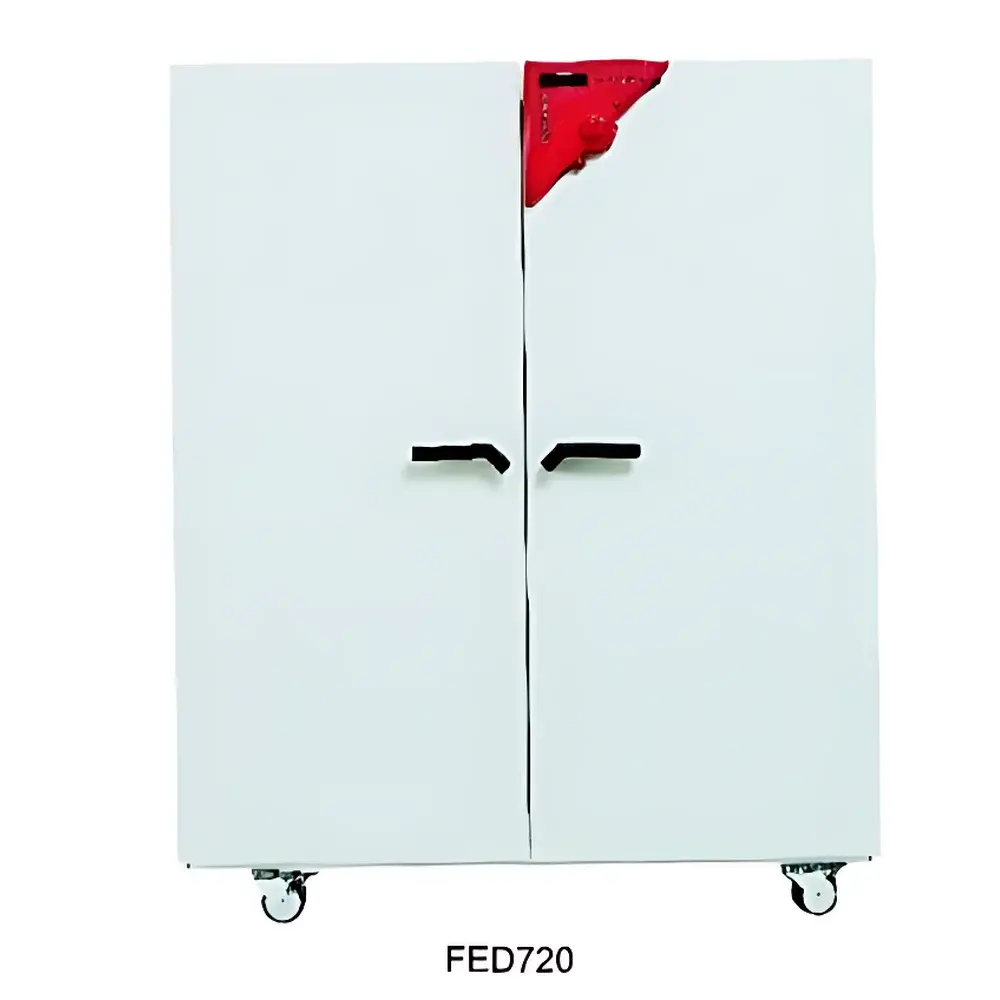
BINDER FED Series Forced Convection Drying Oven
| Brand | BINDER |
|---|---|
| Origin | Germany |
| Model | FED |
| Temperature Range | 5–300 °C |
| Temperature Uniformity | ±0.3 K (at 100 °C, load-free) |
| Temperature Fluctuation | ±0.03 °C (typical, at setpoint) |
| Internal Volume | 400–720 L (model-dependent) |
| Internal Dimensions (W×H×D) | 1000×800×510 mm (FED 400) / 1000×1200×610 mm (FED 720) |
| External Dimensions (W×H×D) | 1235×1025×765 mm (FED 400) / 1235×1530×865 mm (FED 720) |
| Net Weight | 145 kg (FED 400) / 195 kg (FED 720) |
| Interior Material | Electropolished Stainless Steel (1.4404 / AISI 316L) |
| Heating Method | Horizontal Forced Air Circulation (APT.line™ Preheating Chamber) |
| Fan Speed | Continuously Adjustable |
| Exhaust Valve | Manually Regulatable |
| Controller | Microprocessor-Based with Advanced Timer Functions & Optical Overtemperature Alarm |
| Safety | Dual-Stage Independent Temperature Limitation (DIN 12880 Class 2) |
| Interface | RS 422 Standard |
| Optional | Viewing Window, Interior LED Lighting, Lockable Door, Factory Calibration Certificate (ISO/IEC 17025), Validation Documentation Package, Portable Precision Thermometer Kit |
Overview
The BINDER FED Series Forced Convection Drying Oven is a precision-engineered laboratory oven designed for applications demanding high thermal stability, reproducible drying, conditioning, and preheating across academic research, pharmaceutical quality control, materials science, and industrial R&D environments. Built in Tuttlingen, Germany, the FED platform employs BINDER’s proprietary APT.line™ preheating chamber technology—where heating elements are fully enclosed behind the inner chamber wall—to eliminate cold spots and ensure rapid, uniform heat distribution. This architecture enables stable temperature maintenance from ambient +5 °C up to 300 °C with typical fluctuations of ±0.03 °C at setpoint and uniformity of ±0.3 K across the entire working volume (measured per DIN 12880 under no-load conditions). The horizontal airflow system delivers laminar, turbulence-minimized convection, minimizing sample disturbance during sensitive thermal treatments such as polymer annealing, moisture loss analysis, or residual solvent removal.
Key Features
- APT.line™ preheating chamber ensures homogeneous temperature distribution and eliminates thermal gradients caused by direct radiant heating
- Continuously adjustable fan speed allows precise optimization of air velocity for diverse sample types—from delicate biological specimens to dense metal components
- Manually regulatable exhaust valve enables controlled atmosphere exchange, critical for volatile organic compound (VOC) management or humidity-sensitive processes
- Dual-stage independent temperature safety system (DIN 12880 Class 2) with optical alarm provides redundant overtemperature protection—essential for unattended operation and GLP-compliant workflows
- Microprocessor-based controller with advanced timer functions supports multi-step programs, delayed start, and hold modes; RS 422 interface enables integration into centralized lab automation systems
- Electropolished stainless steel interior (AISI 316L) resists corrosion from aggressive solvents, acids, and cleaning agents—validated for repeated autoclave-compatible decontamination cycles
Sample Compatibility & Compliance
The FED series accommodates a broad spectrum of sample formats—including Petri dishes, crucibles, glassware stacks, powder trays, and component assemblies—within its spacious, vertically optimized chamber. Its robust construction and inert interior meet stringent requirements for ISO 17025-accredited calibration labs and FDA-regulated environments. Optional factory-issued calibration certificates traceable to national standards (e.g., PTB, NIST) support audit readiness under 21 CFR Part 11 when paired with compliant data logging software. The oven complies with EN 61000-6-3 (EMC emission), EN 61000-6-2 (immunity), and IEC 61010-1 (safety), and is suitable for use in laboratories operating under GLP, GMP, and ISO 9001 quality management systems.
Software & Data Management
While the FED operates via an integrated front-panel controller, its RS 422 port enables bidirectional communication with third-party SCADA platforms or BINDER’s optional C-Control software suite. When deployed with validated data acquisition hardware, the system supports electronic record generation with full audit trail functionality—including user ID, timestamp, parameter changes, and alarm events—meeting ALCOA+ principles (Attributable, Legible, Contemporaneous, Original, Accurate, Complete, Consistent, Enduring, Available). Optional validation documentation packages include IQ/OQ protocols aligned with Annex 15 (EU GMP) and ASTM E2500-13 guidelines.
Applications
- Gravimetric moisture content determination (ASTM D2216, ISO 11465)
- Thermal conditioning of composites and adhesives prior to mechanical testing
- Drying of filter papers, soil samples, and ceramic precursors in environmental and geotechnical labs
- Stabilization of reference standards and hygroscopic reagents in analytical chemistry suites
- Preheating of test fixtures and sensor housings in metrology and calibration laboratories
- Accelerated aging studies per IEC 60068-2-2 (dry heat) and MIL-STD-810G Method 501.6
FAQ
What is the difference between APT.line™ technology and conventional convection ovens?
APT.line™ relocates all heating elements behind the chamber wall, creating a thermally buffered preheating zone that supplies uniformly heated air—eliminating hot/cold zones near heaters and improving both uniformity and recovery time after door openings.
Can the FED oven be used for sterilization or depyrogenation?
No—the FED is not certified for sterilization (e.g., steam or dry-heat sterilization per ISO 17665 or USP ). For depyrogenation, dedicated Class B or Class S dry-heat ovens with validated HEPA filtration and tighter uniformity specifications are required.
Is the RS 422 interface compatible with modern LabVIEW or Python-based control systems?
Yes—RS 422 provides noise-immune, long-distance serial communication; protocol documentation and ASCII command sets are available upon request for custom integration.
Does the optional calibration certificate satisfy ISO/IEC 17025 requirements?
The factory certificate includes measurement uncertainty, traceability statements, and environmental conditions; however, end-user accreditation requires verification of in-situ performance using accredited secondary standards and documented procedures.
How does the dual-stage safety system function during power failure or controller malfunction?
The primary safety circuit is hardware-isolated from the main controller and remains active even if the microprocessor fails; it triggers optical and audible alarms and cuts power to heating elements independently of software state.
Related Products



