
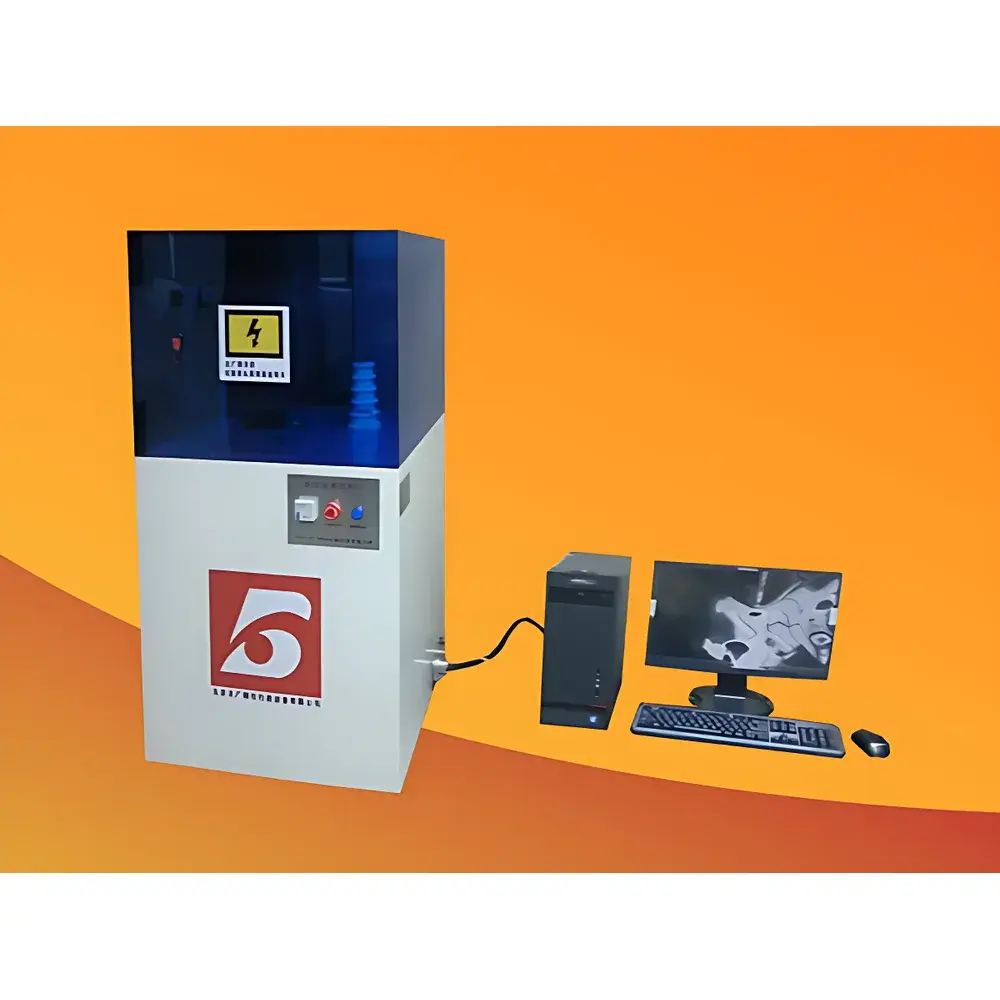
North Guang BDJC Series Voltage Breakdown Tester
| Brand | North Guang Precision Instrument |
|---|---|
| Origin | Beijing, China |
| Manufacturer Type | Manufacturer |
| Product Category | Domestic |
| Model | BDJC Series |
| Price | ¥10,000 (CNY) |
| Breakdown Voltage | 50 kV |
| Input Voltage | AC 220 V ±10%, 50 Hz ±1% |
| Output Voltage Range | AC/DC 0–50 kV (full-wave) |
| Power Rating | 3 kVA |
| Voltage Regulation | Stepless, 0–10 kV / 0–50 kV ranges |
| Voltage Ramp Rate | 0.1–50 kV/s (user-configurable) |
| Test Modes | DC — constant-rate ramp, stepwise ramp, withstand test |
| Test Medium | Air or insulating oil |
| Overcurrent Protection Response Time | ≤0.05 s |
| Voltage Measurement Accuracy | ≤±1% |
| Current Resolution | Milliampere-level real-time acquisition |
| Weight | ~87 kg |
| Compliance Standards | GB 1408.1–2006, GB 1408.2–2006, GB/T 1695–2005, GB/T 3333, HG/T 3330, GB 12656, ASTM D149 |
Overview
The North Guang BDJC Series Voltage Breakdown Tester is an engineered high-voltage dielectric strength testing system designed for precise determination of electrical breakdown characteristics in solid insulating materials. Based on the principle of controlled voltage escalation under standardized electrode configurations, the instrument applies either AC or DC high voltage across a specimen until dielectric failure occurs—enabling quantitative assessment of dielectric strength (kV/mm), tracking resistance, and insulation integrity. The system adheres to internationally recognized test methodologies including ASTM D149 and GB 1408 series standards, supporting both research-grade material qualification and routine quality control in polymer, rubber, composite, and electrical insulation manufacturing environments.
Key Features
- True dual-mode operation: Simultaneous AC and DC high-voltage generation (0–50 kV full-wave output) with independent control logic for each waveform type.
- Wireless Bluetooth 5.0 remote interface: Enables safe operator positioning up to 1000 meters from the test chamber—eliminating physical cable hazards during high-voltage stress testing and complying with IEC 61010-1 safety requirements for operator distance separation.
- Microprocessor-based digital control architecture: Integrates real-time voltage/current sampling at ≥10 kHz, closed-loop ramp regulation, and automatic arc detection via fast-response overcurrent cutoff (<50 ms).
- No-contact voltage regulation: Solid-state stepless ramp generator replaces legacy motor-driven variacs—ensuring stable, repeatable, and jitter-free voltage rise profiles per ASTM D149 Section 7.3.
- Integrated torque and friction measurement capability: Optional high-precision torque sensor (±0.2% FS) supports concurrent tribological evaluation—enabling correlative analysis of dielectric performance and surface wear behavior in composite laminates and filled polymers.
- Comprehensive data visualization suite: Real-time plotting of voltage, current, torque, time, and derived parameters (e.g., breakdown field strength, leakage current slope) on a calibrated GUI interface with export-ready CSV/PDF output.
Sample Compatibility & Compliance
The BDJC Series accommodates standard ASTM D149 and GB 1408-compliant electrode geometries—including brass disk electrodes (25 mm diameter), spherical electrodes (12.7 mm radius), and needle-plane configurations—for testing films, sheets, rods, molded parts, and cast specimens up to 10 mm thick. Compatible with air ambient and ASTM D877-specified insulating oils (e.g., mineral oil, silicone fluid). All test sequences are fully traceable and audit-ready, supporting GLP/GMP documentation workflows through timestamped metadata logging, user-access controls, and electronic signature fields aligned with FDA 21 CFR Part 11 principles. Calibration certificates are issued by CNAS-accredited national metrology institutes upon request.
Software & Data Management
The proprietary BDJC Control Suite (v4.2+) runs on Windows 10/11 platforms and provides ISO/IEC 17025-aligned test sequence definition, parameter validation, and result certification. Software features include: configurable pass/fail thresholds per standard clause; automated report generation with embedded test curves, tabulated raw data, statistical summaries (mean, SD, CV%), and compliance annotations; role-based user accounts with password-protected privilege levels; encrypted local database storage with daily auto-backup; and optional cloud sync via TLS 1.3-secured API endpoints. Firmware updates and software patches are provided free-of-charge for the instrument’s operational lifetime.
Applications
- Dielectric strength validation of polymeric insulators used in cable jackets, busbar coatings, and transformer barriers.
- Quality assurance of elastomeric gaskets, silicone rubber housings, and epoxy encapsulants in automotive and aerospace electronics.
- R&D screening of nanocomposite dielectrics (e.g., Al₂O₃-, SiO₂-, or BN-filled polymers) for high-voltage capacitor and bushing applications.
- Regulatory conformance testing per UL 746C, IEC 60243-1, and MIL-STD-202 Method 302 for military-grade printed circuit board substrates.
- Correlative study of aging effects—thermal, UV, or humidity-induced—on insulation degradation kinetics using sequential breakdown testing.
FAQ
What safety certifications does the BDJC Series comply with?
The system meets IEC 61010-1:2010 (Measurement, Control, and Laboratory Equipment Safety Requirements), including protection against electric shock, mechanical hazards, and fire risk. Interlocked HV enclosure doors and redundant ground-fault monitoring are standard.
Can the instrument perform pre-conditioned tests per IEC 60243-2?
Yes—humidity and temperature preconditioning protocols can be manually initiated prior to voltage application; environmental chamber integration is supported via RS-485 or Modbus TCP interfaces.
Is third-party calibration traceable to NIST or BIPM standards?
Calibration reports include uncertainty budgets and direct traceability to China National Institute of Metrology (NIM), which maintains bilateral recognition agreements with NIST, PTB, and NPL under the CIPM MRA framework.
Does the software support multi-user audit trails for regulated industries?
Yes—each action (test start, parameter change, report export) is logged with user ID, timestamp, IP address (if networked), and hash-verified data integrity markers compliant with 21 CFR Part 11 Subpart B.
What maintenance intervals are recommended for long-term reliability?
Biannual verification of HV transformer insulation resistance (>1000 MΩ @ 1 kV DC) and annual recalibration of voltage/current sensors are advised. Full service manuals and spare part schematics are supplied with delivery.



