
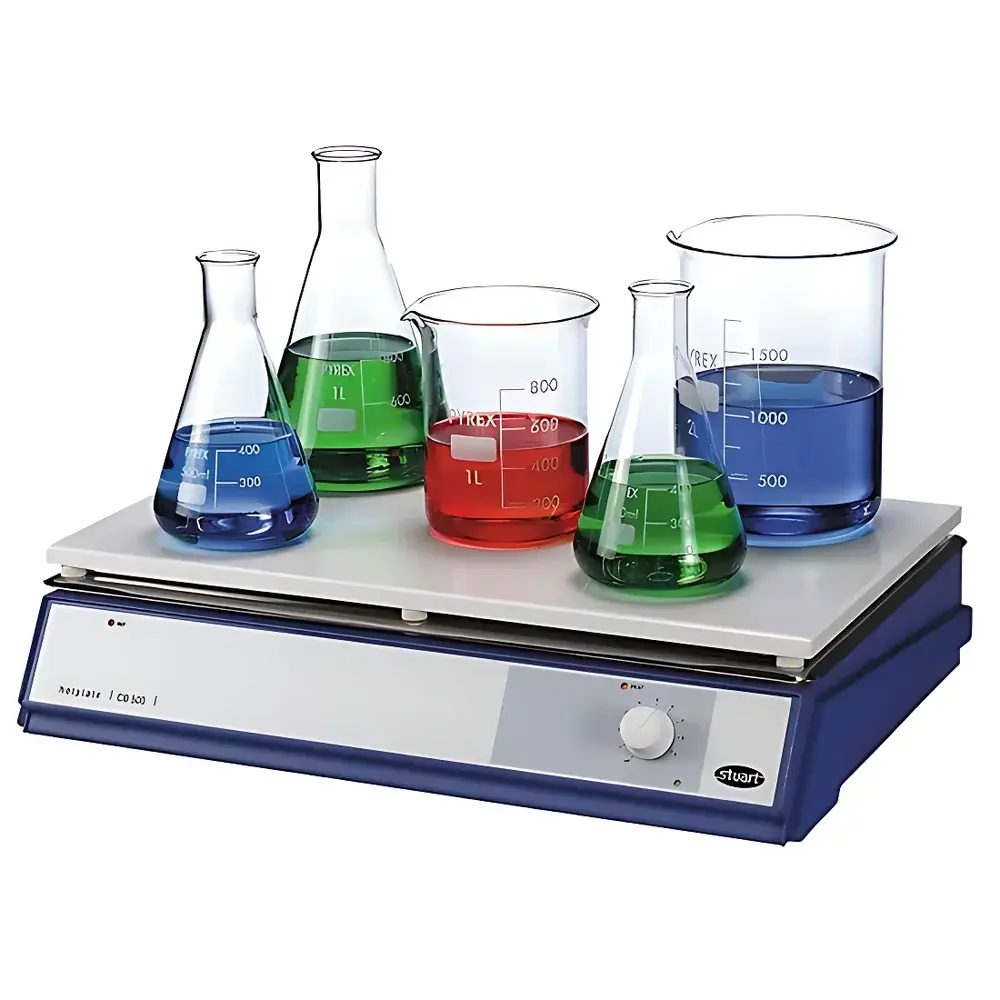
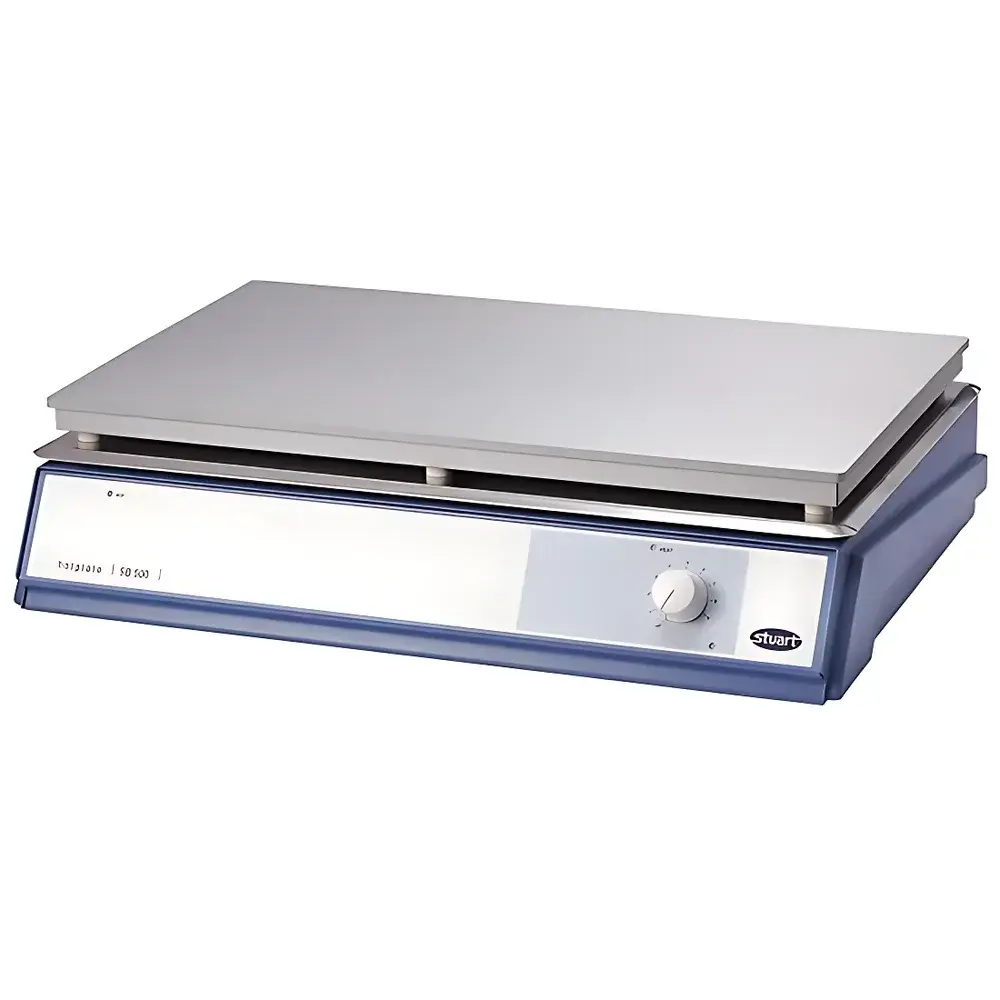
Stuart CB500 Analog-Controlled Large-Area Ceramic Hotplate
| Brand | Stuart |
|---|---|
| Model | CB500 |
| Heating Plate Material | Glass-Ceramic |
| Heating Area | 250 × 450 mm |
| Max Operating Temperature | 375 °C |
| Heating Power | 2250 W |
| Dimensions (W × D × H) | 520 × 360 × 130 mm |
| Net Weight | 12 kg |
| Electrical Supply | 230 V / 50 Hz |
| Compliance | CE, UKCA, RoHS |
Overview
The Stuart CB500 Analog-Controlled Large-Area Ceramic Hotplate is a robust, benchtop heating solution engineered for consistent thermal delivery across expansive sample arrays in teaching laboratories, quality control environments, and routine analytical workflows. Utilizing resistive heating embedded beneath a high-purity glass-ceramic surface, the CB500 operates on a continuous analog temperature regulation principle—offering stable thermal output without digital feedback loops or software dependency. Its 250 × 450 mm effective heating zone accommodates up to thirty 100 mL beakers simultaneously, making it particularly suited for standardized educational demonstrations, parallel sample digestion protocols, or multi-vessel evaporation procedures where uniformity and operational simplicity are prioritized over programmable ramping or data logging.
Key Features
- Large-format glass-ceramic heating surface (300 × 500 mm physical footprint, 250 × 450 mm active zone) enabling simultaneous heating of multiple vessels—including Erlenmeyer flasks, beakers, and round-bottom flasks—without spatial interference.
- Analog rotary temperature control with tactile feedback and linear response; no menu navigation or calibration required—ideal for rapid setup in high-throughput or training-intensive settings.
- High thermal stability at elevated setpoints: sustained operation up to 375 °C ensures compatibility with solvent reflux, controlled drying, and low-pressure distillation applications.
- Integrated safety architecture including an illuminated red “HOT” indicator that remains active until surface temperature falls below 60 °C—providing unambiguous visual status during cooldown phases.
- Thermally insulated housing and recessed heating element design minimize lateral heat loss and reduce ambient temperature rise around the unit.
- CE, UKCA, and RoHS certified construction meets essential EU/UK regulatory requirements for electrical safety and hazardous substance restriction in laboratory equipment.
Sample Compatibility & Compliance
The CB500 supports standard borosilicate glassware (e.g., Pyrex®-grade beakers, conical flasks, and crystallization dishes) as well as stainless steel and ceramic containers rated for continuous exposure to temperatures ≤375 °C. It is not intended for use with plastic or low-melting-point materials. While the device itself does not generate regulatory documentation per se, its analog control architecture inherently satisfies GLP-aligned operational simplicity requirements—eliminating software validation burdens associated with digital controllers. When deployed in GMP or ISO/IEC 17025-accredited laboratories, users may incorporate the CB500 into equipment qualification protocols (IQ/OQ) using external calibrated thermometers and documented thermal mapping procedures per ASTM E2251–22 guidelines for hotplate performance verification.
Software & Data Management
The CB500 operates entirely without embedded firmware, microprocessors, or connectivity interfaces. As a purely analog instrument, it requires no driver installation, network configuration, or cybersecurity assessment. Temperature setting and monitoring rely solely on mechanical input and visual indicators—ensuring deterministic behavior, zero risk of firmware corruption, and full traceability through manual logbook entries. This architecture aligns with institutions maintaining strict IT governance policies or operating in air-gapped laboratory networks where digital instrumentation introduces compliance complexity.
Applications
- Simultaneous heating of student samples in undergraduate chemistry and biology teaching labs.
- Preparative solvent evaporation across multiple vials in environmental or pharmaceutical QC workflows.
- Controlled warming of reagent stocks prior to titration or enzymatic assay setup.
- Support heating for water baths, steam traps, or jacketed reactor systems requiring auxiliary thermal input.
- Uniform pre-heating of metal or ceramic substrates in materials science sample preparation.
FAQ
Is the CB500 compatible with magnetic stirrers?
No—the CB500 is a dedicated heating plate without integrated stirring functionality. For combined heating/stirring, refer to Stuart’s SHM series hotplate stirrers.
Can the CB500 be used under a fume hood?
Yes, provided adequate ventilation is maintained and the unit is installed on a non-combustible, level surface within the hood’s operational envelope.
Does the CB500 require periodic recalibration?
Not in the conventional sense—its analog thermostat lacks user-adjustable calibration parameters. However, periodic verification using a NIST-traceable surface thermometer is recommended per institutional SOPs.
What is the expected service life under continuous operation?
With proper load management (avoiding repeated thermal shock from cold vessel placement), the glass-ceramic surface and heating element typically exceed 10,000 hours of cumulative operational duty.
Are replacement heating plates available?
Stuart supplies OEM-certified glass-ceramic top assemblies (Part No. CB500-PLATE) for field replacement by authorized service technicians.



