
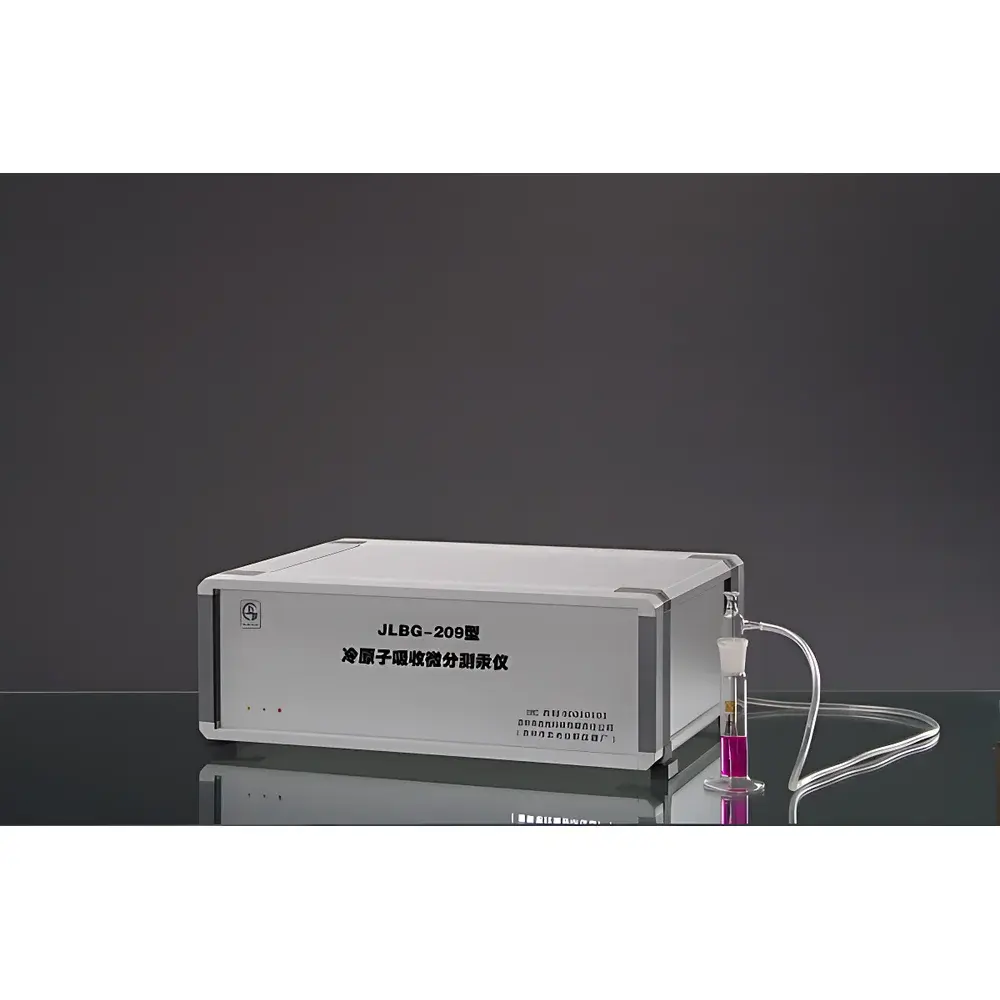
Beiguang JLBG-209 Cold Vapor Atomic Absorption Mercury Analyzer
| Brand | Beiguang |
|---|---|
| Origin | Jilin, China |
| Model | JLBG-209 |
| Instrument Type | Benchtop Laboratory Analyzer |
| Measurement Principle | Cold Vapor Atomic Absorption Spectrometry (CVAAS) |
| Detection Limit | 0.005 µg/L |
| Repeatability | <5% RSD |
| Linearity Correlation Coefficient | r > 0.995 |
| Power Supply | AC 220 V, 30 W |
| Operating Temperature | 10–30 °C |
| Operating Humidity | <80% RH |
| Dimensions (L×W×H) | 430 × 330 × 150 mm |
| Net Weight | 7 kg |
Overview
The Beiguang JLBG-209 Cold Vapor Atomic Absorption Mercury Analyzer is a benchtop laboratory instrument engineered for trace-level mercury quantification in aqueous, gaseous, and solid matrices using Cold Vapor Atomic Absorption Spectrometry (CVAAS). This technique relies on the selective absorption of ultraviolet light at 253.7 nm by ground-state mercury atoms generated in situ via chemical reduction (typically with stannous chloride or sodium borohydride), followed by vapor-phase atomization and optical detection. The JLBG-209 implements a differential measurement mode to enhance signal-to-noise ratio and suppress baseline drift—critical for achieving sub-part-per-trillion sensitivity in complex environmental samples. Designed in strict compliance with HJ 597–2011 (“Determination of Total Mercury in Water Quality—Cold Vapor Atomic Absorption Spectrophotometry”), the analyzer meets national regulatory requirements for environmental monitoring laboratories in China and serves as a technically aligned alternative for international users seeking ISO/IEC 17025-compatible elemental mercury analysis workflows.
Key Features
- Ultra-low detection limit of 0.005 µg/L (5 ng/L) in differential mode, validated per HJ 597–2011 protocol
- Dual-mode operation: differential (0.01–0.16 µg/L), low-concentration (0.2–4 µg/L), and high-concentration (2–100 µg/L) ranges, each optimized for precision and linearity (r ≥ 0.995)
- Stable optical path incorporating imported quartz cuvettes and high-transmittance UV optics, minimizing photometric drift
- Integrated water-inlet alarm system prevents liquid ingress into gas pathways, extending pneumatic component service life
- High-stability air pump with precision flow control ensures consistent purge-and-trap efficiency during cold vapor generation
- No carrier gas dependency—operates without high-purity nitrogen or argon, reducing consumables cost and operational complexity
- USB interface enables full computer control under Windows 7/XP; supports automated method loading, real-time data acquisition, and direct result readout
Sample Compatibility & Compliance
The JLBG-209 accommodates liquid samples (surface water, groundwater, industrial wastewater), digested solids (soils, sediments, biological tissues), and acid-absorbed gas streams (e.g., stack emissions captured in KI/HNO₃ solutions). Sample introduction is compatible with standard EPA Method 1631E and ASTM D3695–21 prerequisites when adapted with appropriate digestion and preconcentration protocols. While calibrated against NIST-traceable mercury standards, the instrument’s performance parameters align with GLP-aligned validation practices—including repeatability ( 0.995 across three orders of magnitude), and robustness under ambient lab conditions (10–30 °C, <80% RH). It is suitable for use in accredited environmental testing laboratories where audit readiness for CNAS or equivalent accreditation bodies is required.
Software & Data Management
Instrument control and data processing are executed via dedicated Windows-based software supporting method storage, calibration curve generation (linear and polynomial), peak integration, and statistical reporting. All measurement events—including raw absorbance traces, calibration history, user ID, timestamp, and instrument status logs—are stored locally with optional export to CSV or PDF. The software enforces electronic record integrity through sequential file naming, immutable timestamps, and operator login tracking—facilitating basic 21 CFR Part 11 readiness when deployed with institutional IT governance controls. Raw spectral traces can be recalled and reprocessed, preserving full traceability from raw signal to final concentration.
Applications
- Regulatory compliance testing of drinking water and wastewater per HJ 597–2011 and GB/T 5750.6–2023
- Monitoring mercury discharge from chlor-alkali plants, coal-fired power stations, and precious metal refineries
- Geochemical surveying of aquifer contamination and sediment core profiling
- QA/QC support for mercury speciation labs performing Hg²⁺/MeHg separation prior to total Hg verification
- Research-scale studies on mercury bioaccumulation kinetics in aquatic model organisms
FAQ
Does the JLBG-209 require carrier gas such as nitrogen or argon?
No—this instrument uses ambient air as the carrier medium, eliminating the need for compressed gas cylinders or purifiers.
Can it measure mercury in solid samples directly?
No—solid matrices must first undergo acid digestion (e.g., EPA Method 3050B or 3052) to solubilize mercury prior to analysis.
Is the software compliant with FDA 21 CFR Part 11?
The software provides foundational audit trail functionality (user logins, timestamps, data immutability); full Part 11 compliance requires site-specific validation and IT infrastructure controls.
What maintenance intervals are recommended?
Optical alignment verification every 6 months; pump diaphragm replacement annually; quartz cell cleaning after every 50 analyses or when absorbance noise increases.
How is interference from other metals mitigated?
CVAAS inherently offers high selectivity for mercury at 253.7 nm; interferences from transition metals (e.g., Cu, Fe) are suppressed via matrix-matched calibration and optional chelating agents during sample pretreatment.







