
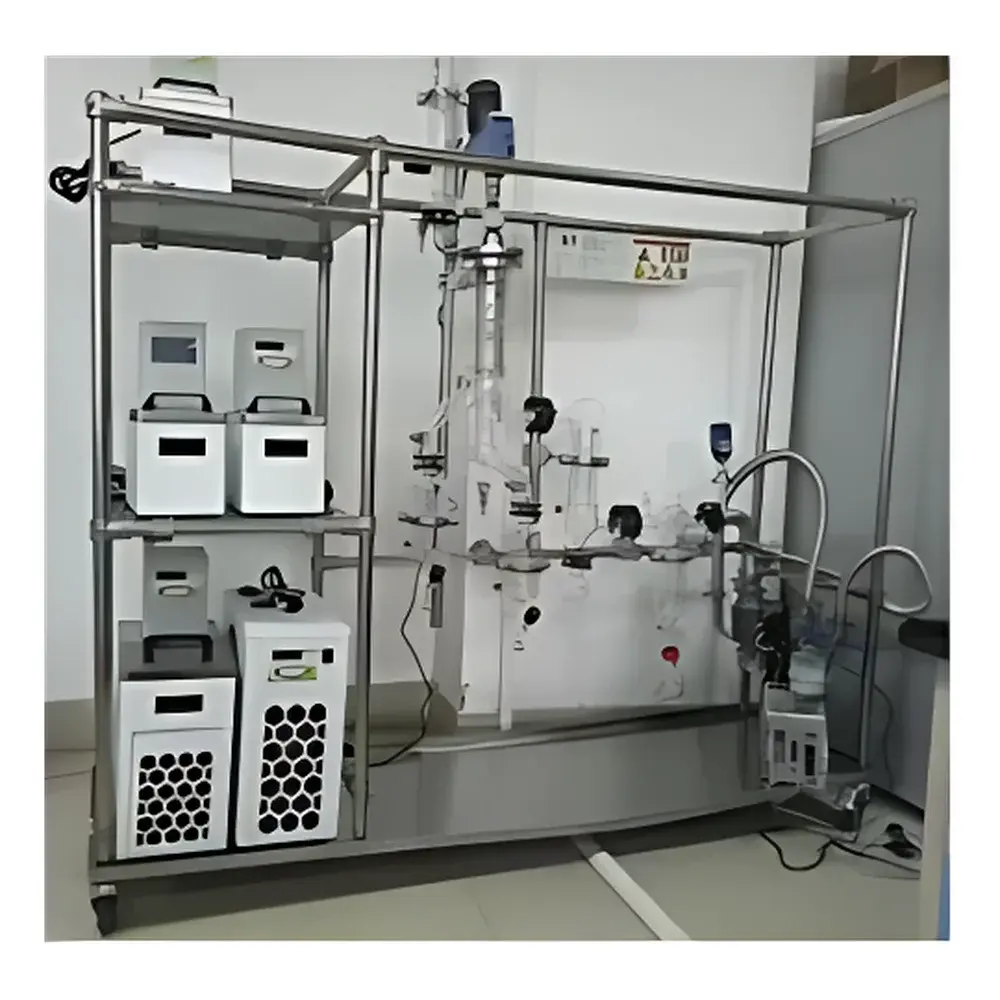
Beijing STKJ SPDL5 Laboratory Molecular Distillation System
| Brand | STKJ |
|---|---|
| Origin | Beijing, China |
| Manufacturer Type | Authorized Distributor |
| Country of Origin | China |
| Model | SPDL5 |
| Feed Rate | 0.3–1.5 kg/h (typical), up to 3.0 kg/h (max) |
| Effective Evaporation Area | 5.0 dm² |
| Evaporator Inner Diameter | 10 cm |
| Condenser Area | 8 dm² |
| Construction Material | Borosilicate Glass 3.3 |
| Maximum Evaporation Temperature | 350 °C |
| Minimum Operating Pressure | 0.001 mbar |
| Heating Method | Thermostatic Oil Bath |
| Collection Options | Dual-position glass receivers (A.3/A.5), Carousel collector (A.7, 6 × 300 mL tubes), or Gear Pump discharge (A.8/A.9) |
Overview
The Beijing STKJ SPDL5 Laboratory Molecular Distillation System is a precision-engineered short-path distillation platform designed for high-vacuum, low-temperature separation of thermally sensitive, high-boiling, or viscous compounds. Operating on the principle of molecular distillation—where separation occurs under ultra-high vacuum (down to 0.001 mbar) and relies on differences in mean free path rather than boiling point—the SPDL5 enables efficient fractionation of labile molecules without thermal degradation. Its all-borosilicate glass 3.3 construction ensures chemical inertness, optical transparency, and thermal stability across the full operational range (up to 350 °C). Unlike conventional fractional distillation, the SPDL5’s short vapor path (<10 cm) minimizes residence time and backscattering, making it ideal for isolating active pharmaceutical ingredients (APIs), cosmetic actives (e.g., tocopherols, squalene), natural antioxidants, and specialty polymers where purity, yield, and structural integrity are critical.
Key Features
- Modular, application-specific configuration: Users select from interchangeable feed, evaporation, condensation, and collection modules to align with R&D screening or small-batch GMP-compliant production.
- Dual-film formation mechanism: Combines centrifugal spreading with forced mechanical film renewal via rotating roller system—ensuring uniform, stable, and reproducible thin-film thickness across the 5.0 dm² evaporator surface.
- Full-section heated evaporator: Three independently controlled heating zones (evaporation zone, heavy fraction outlet, distillate outlet) plus jacketed feed vessel, inlet tubing, and top cover—enabling direct processing of solid or high-melting-point feedstocks without pre-melting.
- Integrated spiral-coil condenser: 8 dm² condensing area exceeds evaporation area (5.0 dm²), ensuring >98% condensation efficiency even at maximum throughput; cold trap positioning minimizes re-evaporation.
- Optically transparent operation: Real-time visual monitoring of film formation, droplet coalescence, distillate flow, and rotor dynamics—critical for method development and troubleshooting.
- Downward-oriented vacuum interface: Located at the base of the evaporator, aligned with vapor flow direction—reducing carryover, preventing cross-contamination between fractions, and improving separation selectivity.
Sample Compatibility & Compliance
The SPDL5 accommodates a broad spectrum of feed materials—including viscous oils (fish oil, lanolin), heat-sensitive nutraceuticals (astaxanthin, coenzyme Q10), polymer precursors, and crystalline APIs—without solvent addition or derivatization. Its borosilicate glass 3.3 components comply with ISO 3585 and ASTM E438 Type I, Class A specifications for laboratory glassware. While not certified as GMP equipment per se, the system supports GLP/GMP-aligned workflows: its modular design permits segregation of cleaning validation zones; temperature and pressure logging (via optional external sensors) can be integrated into 21 CFR Part 11–compliant data acquisition systems; and documentation of batch records, parameter settings, and collection timing meets USP analytical instrument qualification requirements for lab-scale purification processes.
Software & Data Management
The SPDL5 operates as a manually supervised, analog-controlled system—intentionally omitting embedded firmware to maximize operational transparency and reduce validation burden. Critical process parameters (oil bath temperature, vacuum level via Pirani/capacitance manometer, feed rate via calibrated valve, and collection timing) are recorded externally using validated data loggers or LIMS-integrated SCADA platforms. Optional PT100 probes at key locations (feed reservoir, evaporator wall, condenser jacket) enable traceable temperature mapping. All glass components bear laser-etched serial numbers for asset tracking; maintenance logs—including gasket replacement intervals and vacuum seal inspection dates—are maintained per ISO/IEC 17025 Clause 6.4.2 guidelines.
Applications
- Pharmaceutical R&D: Purification of sterols, phospholipids, and synthetic intermediates under inert atmosphere; removal of residual solvents or catalysts from API synthesis batches.
- Nutraceutical manufacturing: Deodorization and monounsaturated fatty acid enrichment of omega-3 concentrates; isolation of phytosterol esters from vegetable oil deodorizer distillates.
- Cosmetic ingredient refinement: Fractionation of squalane from olive-derived squalene; separation of fragrance volatiles from waxy botanical extracts.
- Polymer chemistry: Solvent-free depolymerization of polyethylene glycol derivatives; recovery of unreacted monomers from step-growth polymerization residues.
- Academic research: Kinetic studies of thermal decomposition pathways; measurement of vapor pressure vs. temperature for novel ionic liquids.
FAQ
What vacuum level is required for optimal molecular distillation performance?
A base pressure ≤0.001 mbar (1 × 10⁻³ mbar) is recommended to ensure mean free path exceeds the evaporator-to-condenser distance—typically verified using a calibrated capacitance manometer calibrated to NIST-traceable standards.
Can the SPDL5 handle solid or semi-solid feedstocks?
Yes—its fully jacketed feed vessel, inlet line, and evaporator top cover allow pre-melting and temperature-controlled feeding of waxes, resins, or crystalline APIs directly into the thin-film zone.
Is the system compatible with inert gas blanketing?
Yes—standard KF-40 vacuum flanges support integration of nitrogen or argon purge lines at the feed inlet and distillate receiver ports to maintain oxygen-free environments during processing of oxidation-prone compounds.
How is cleaning and validation performed between batches?
All glass components are disassemblable and autoclavable (≤121 °C); residue verification is conducted via FTIR swab testing or HPLC residual solvent analysis per ICH Q5C guidelines.
Does STKJ provide IQ/OQ documentation support?
STKJ supplies vendor-specific component drawings, material certifications (DIN 7080 for glass, EN 10204 3.1 for metal parts), and calibration certificates for supplied gauges—enabling users to develop internal IQ/OQ protocols aligned with ISO 13485 or FDA expectations.



