
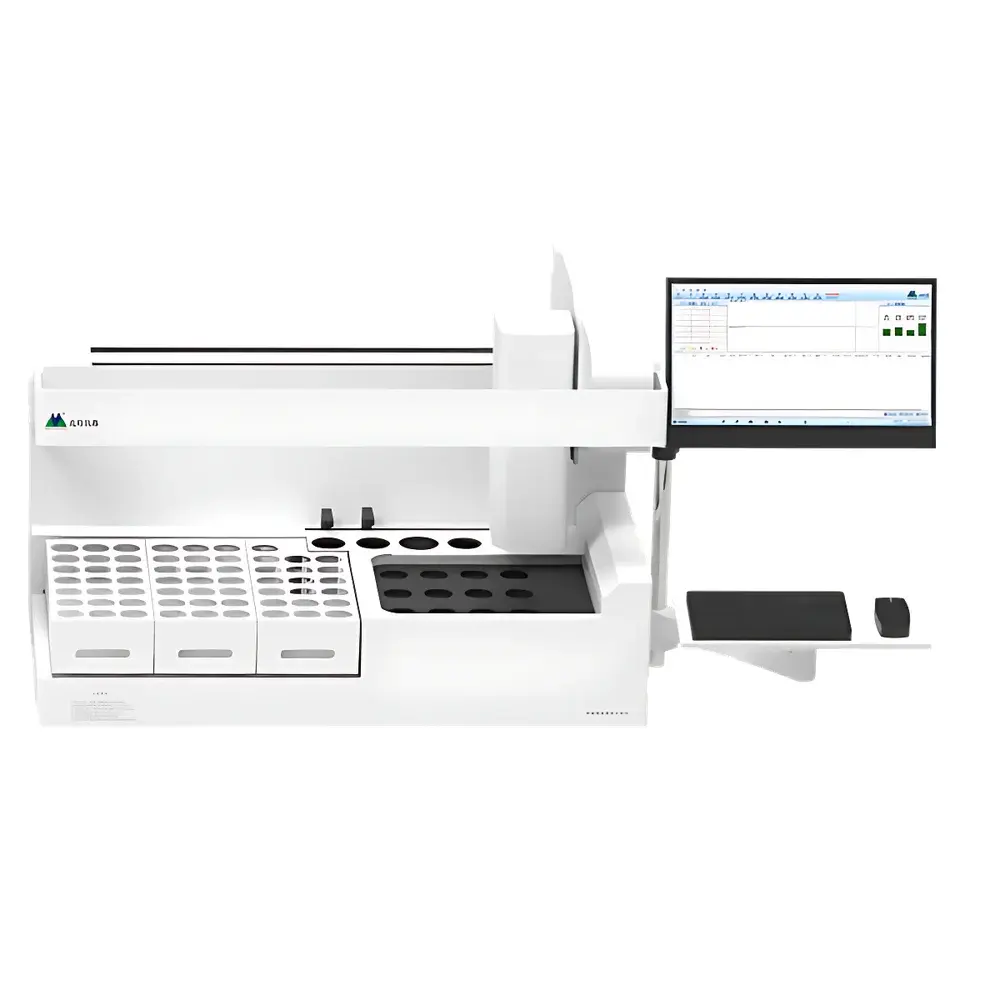
BEIYU CGM-206W Automated Permanganate Index Analyzer
| Brand | BEIYU TECHNOLOGIES |
|---|---|
| Origin | Shanghai, China |
| Manufacturer | BEIYU Analytical Instrument Co., Ltd. |
| Model | CGM-206W |
| Compliance | GB/T 11892–1989, GB/T 5750.7–2023, GB/T 13025.7–2012, GB/T 5750.4–2023 |
| Detection Parameters | Permanganate Index (COD<sub>Mn</sub>), Iodine in Salt, Total Hardness, Chloride |
| Heating Method | Constant-Temperature Water Bath |
| Automation Level | Fully Integrated Robotic Digestion–Titration System |
| Endpoint Detection | High-Resolution Machine Vision Color Recognition |
| Sample Throughput | Up to 30 samples per batch |
| Minimum Titration Volume | 0.02 mL |
| Titration Cycle Time | ≤2 min per sample |
Overview
The BEIYU CGM-206W Automated Permanganate Index Analyzer is a fully integrated, robotics-driven analytical platform engineered for precise, standardized determination of permanganate index (CODMn) in surface water, groundwater, drinking water, and saline matrices. It operates on the principle of acidified or alkaline potassium permanganate oxidation—strictly adhering to the redox titration methodology defined in GB/T 11892–1989 and GB/T 5750.7–2023. Unlike semi-automated or flow-injection systems, the CGM-206W replicates the complete manual procedure—including controlled water-bath heating (±0.5 °C stability), timed digestion, back-titration with standardized sodium oxalate, and visual endpoint recognition—while eliminating human variability. Its core innovation lies in the co-location of robotic sample handling, machine vision–guided colorimetric endpoint detection, and dual-channel precision titration within a single compact chassis. Designed for routine environmental monitoring laboratories and centralized water quality testing centers, the system supports unattended operation for up to 8 hours and delivers traceable, auditable results compliant with national standard methods.
Key Features
- Fully automated sample processing: robotic arm handles cup loading, reagent dispensing, digestion vessel transfer, and post-digestion titration—all without manual intervention.
- Patented high-fidelity machine vision system: captures real-time RGB spectral shifts during titration using calibrated CMOS imaging, enabling reliable endpoint detection even in highly turbid or colored samples (NTU ≤ 500).
- Dual independent titration channels: each equipped with glass syringe pumps delivering 0.02 mL minimum incremental dosing and sub-microliter reproducibility (RSD < 0.8% at 1 mL).
- Intelligent method selection: built-in chloride ion quantification module automatically selects acidic or alkaline digestion protocol per GB/T 5750.7–2023 requirements.
- Integrated water-bath thermal management: constant-flow preheated refill system maintains ±0.3 °C temperature stability throughout multi-hour digestion cycles.
- Modular waste handling: segregated collection paths for acidic digestate, titrant residuals, and rinse effluents—compatible with local hazardous waste disposal protocols.
- Real-time reagent inventory tracking: capacitive level sensors monitor all reagent reservoirs; low-level alerts trigger configurable notifications via Ethernet or RS485.
Sample Compatibility & Compliance
The CGM-206W accommodates liquid samples ranging from ultrapure drinking water to high-salinity brines (up to 35 g/L NaCl) and iodized salt slurries. Its adaptive dilution algorithm supports dynamic range extension from 0.5 to 10.0 mg/L KMnO4 equivalent (as O2). All operational sequences strictly follow Chinese national standards: GB/T 11892–1989 for general water bodies; GB/T 5750.7–2023 for potable water validation; GB/T 13025.7–2012 for iodine quantification in edible salt; and GB/T 5750.4–2023 for total hardness (EDTA titration mode). The system’s firmware and data log structure are designed to meet GLP documentation requirements, including electronic signatures, audit trail retention (>18 months), and immutable result archiving—fully aligned with ISO/IEC 17025:2017 clause 7.7 and supporting readiness for regulatory inspection under CNAS accreditation frameworks.
Software & Data Management
The embedded control software (v4.2+) provides role-based access control, method library management, and full LIMS interoperability via ASTM E1384-compliant HL7 and CSV export protocols. All analytical runs generate timestamped, digitally signed PDF reports containing raw image frames of titration endpoints, calibration curves, reagent lot traceability, and operator audit logs. Optional FDA 21 CFR Part 11 compliance package includes electronic signature workflows, biometric login support, and tamper-evident database encryption. Remote diagnostics and firmware updates are delivered over TLS-secured HTTPS, with optional integration into centralized lab automation ecosystems (e.g., Tecan Fluent, Hamilton STAR) via Modbus TCP and OPC UA interfaces.
Applications
- Environmental monitoring stations performing routine CODMn surveillance across river basins and reservoir networks.
- Drinking water treatment plants requiring daily compliance verification per GB 5749–2022.
- Food safety laboratories conducting iodine content analysis in fortified table salt per GB 14880–2012.
- Research institutes studying organic load dynamics in estuarine and coastal waters with variable salinity and turbidity.
- Third-party testing labs seeking ISO/IEC 17025 accreditation with automated, auditable workflows.
FAQ
Does the CGM-206W comply with international standards such as ISO 8467?
The instrument implements the core chemical methodology of ISO 8467:1993 (determination of permanganate index), though its validation documentation and certification are currently aligned with Chinese national standards. Method equivalence assessments can be performed upon request.
Can the system operate without continuous network connectivity?
Yes—the analyzer functions autonomously with local data storage (128 GB SSD) and offline method execution. Network connection is required only for LIMS synchronization, remote diagnostics, or software updates.
What maintenance intervals are recommended for the robotic arm and vision system?
Robotic gripper calibration is recommended every 6 months; lens cleaning and white-balance recalibration every 3 months. Full preventive maintenance (including pump tubing replacement and bath descaling) is scheduled annually.
Is third-party reagent compatibility supported?
The system accepts standard-grade KMnO4, Na2C2O4, H2SO4, and AgNO3 reagents from certified suppliers. Reagent lot-specific calibration curves must be entered manually prior to use.
How is data integrity ensured during power interruption?
An integrated UPS interface preserves active run state and volatile memory for ≥15 minutes. Upon recovery, the system resumes from the last completed step without data loss or sample contamination.







