
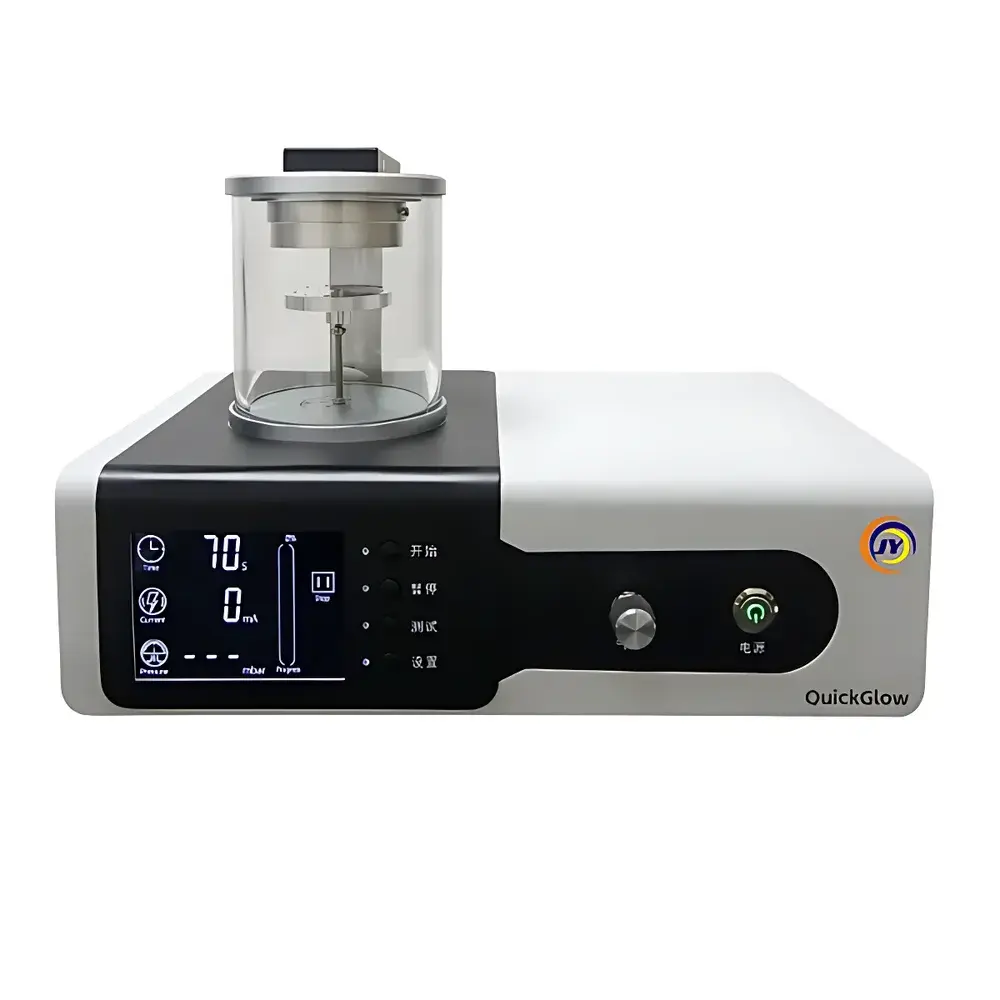
Guangzhou Jingying QuickGlow Glow Discharge Coater for TEM/SEM Grid Hydrophilization
| Brand | Guangzhou Jingying |
|---|---|
| Origin | Guangdong, China |
| Manufacturer Type | Direct Manufacturer |
| Product Category | Domestic |
| Model | QuickGlow |
| Pricing | Upon Request |
Overview
The Guangzhou Jingying QuickGlow Glow Discharge Coater is a compact, benchtop plasma treatment system engineered for precise hydrophilization of electron microscopy grids—primarily copper (Cu), nickel (Ni), and gold (Au) TEM grids—prior to specimen preparation. It operates on the principle of low-pressure direct-current (DC) glow discharge plasma generation in an inert or reactive gas environment (typically air or argon), inducing surface oxidation and functional group modification (e.g., –OH, –COOH) on grid substrates. This controlled surface activation significantly enhances wettability, enabling uniform spreading of aqueous suspensions—including protein solutions, viral particles, and nanoparticle colloids—thereby minimizing aggregation, improving monolayer formation, and facilitating consistent negative staining or cryo-EM vitrification. The system is widely deployed in structural biology labs, materials science facilities, and quality control environments where reproducible, non-destructive surface conditioning is critical for high-fidelity TEM imaging, cryo-EM grid screening, and SEM sample mounting.
Key Features
- Stable, low-noise DC glow discharge with adjustable plasma current (3–30 mA) and programmable treatment duration (0–999 s), ensuring process repeatability across batches.
- Integrated high-vacuum interlock system that prevents high-voltage activation unless chamber pressure is within the safe operational range (0.20–1.0 mbar), complying with IEC 61010-1 electrical safety standards.
- Optimized electrode geometry and negative-polarity discharge head design minimize localized heating and prevent arcing—critical for preserving delicate grid mesh integrity and avoiding carbon contamination.
- Motorized, height-adjustable sample stage (30–80 mm range) accommodates standard Ø3.05 mm TEM grids as well as custom holders; compatible with optional 25-position grid rack for parallel processing.
- Intuitive 102 × 68 mm LCD interface displays real-time vacuum level, plasma current, elapsed time, and system status—no external PC required for routine operation.
- Robust aluminum alloy chamber (Ø120 mm × 120 mm H) with O-ring sealed viewport enables visual monitoring of plasma ignition and uniformity during treatment.
Sample Compatibility & Compliance
The QuickGlow supports broad compatibility with standard EM grid types: bare Cu/Ni/Au meshes (200–400 mesh), carbon-coated, Formvar-coated, and ultrathin continuous carbon films. It is routinely validated for use with biological macromolecules (e.g., recombinant proteins, dsDNA, enveloped viruses), nanomaterials (graphene oxide, quantum dots, metal–organic frameworks), and inorganic thin films (SiO₂, TiO₂, perovskite layers). All operational parameters align with common laboratory quality requirements: processes are fully documentable for GLP-compliant workflows; vacuum and power logs can be manually recorded for audit trails. While not FDA-cleared, the device meets general lab equipment safety benchmarks per ISO 13849-1 (control system safety) and is suitable for environments adhering to ISO/IEC 17025 documentation practices.
Software & Data Management
The QuickGlow operates via embedded firmware without proprietary software dependencies. All parameters—including vacuum setpoint, current limit, exposure time, and stage height—are stored in non-volatile memory and recalled per user-defined preset. While no cloud connectivity or electronic signature capability is built-in, the system supports manual logbook integration: operators may record batch IDs, grid lot numbers, gas type, and treatment conditions alongside image metadata in LIMS or ELN platforms. For laboratories requiring 21 CFR Part 11 compliance, external timestamped digital logs (e.g., via connected USB camera or environmental data logger) may be synchronized with treatment cycles.
Applications
- Cryo-EM grid preparation: Enhances ice layer uniformity by promoting homogeneous water film formation on hydrophilic grids—reducing preferred orientation and improving particle distribution in vitrified samples.
- Negative staining TEM: Increases stain adhesion and reduces meniscus artifacts, yielding higher contrast and improved edge definition for macromolecular complexes.
- SEM sample mounting: Improves dispersion stability of nanoparticle suspensions on silicon wafers or conductive stubs, minimizing coffee-ring effects.
- Thin-film characterization: Activates oxide surfaces prior to spin-coating or drop-casting to ensure complete substrate wetting and film continuity.
- Quality assurance in diagnostics: Standardizes grid surface energy across production lots for reproducible immuno-EM assays using antibody-conjugated nanoparticles.
FAQ
What gases can be used with the QuickGlow system?
Air is the default and most commonly used gas; argon and oxygen are also compatible and may be selected depending on desired surface chemistry (e.g., O₂ for enhanced oxidation, Ar for gentler activation). Nitrogen is not recommended due to potential nitride formation.
Is the QuickGlow suitable for carbon-coated grids?
Yes—both evaporated and plasma-deposited carbon films respond effectively to glow discharge, though optimal current settings should be reduced (5–15 mA) to avoid excessive carbon etching.
How often does the chamber require cleaning?
Under normal usage (≤10 treatments/day), visual inspection every 50 cycles is sufficient; wipe-down with IPA-dampened lint-free tissue is recommended if visible residue accumulates on electrodes or viewport.
Can the system be integrated into automated EM prep workflows?
While not natively robotic-ready, its analog I/O triggers (optional add-on) allow synchronization with vacuum pumps or timer-based staging systems for semi-automated batch processing.
Does the QuickGlow meet electromagnetic compatibility (EMC) standards for shared lab environments?
Yes—the unit conforms to CISPR 11 Group 1 Class B emission limits and includes internal EMI filtering on the 50 W HV supply, minimizing interference with adjacent sensitive instrumentation such as CCD cameras or patch-clamp amplifiers.




