
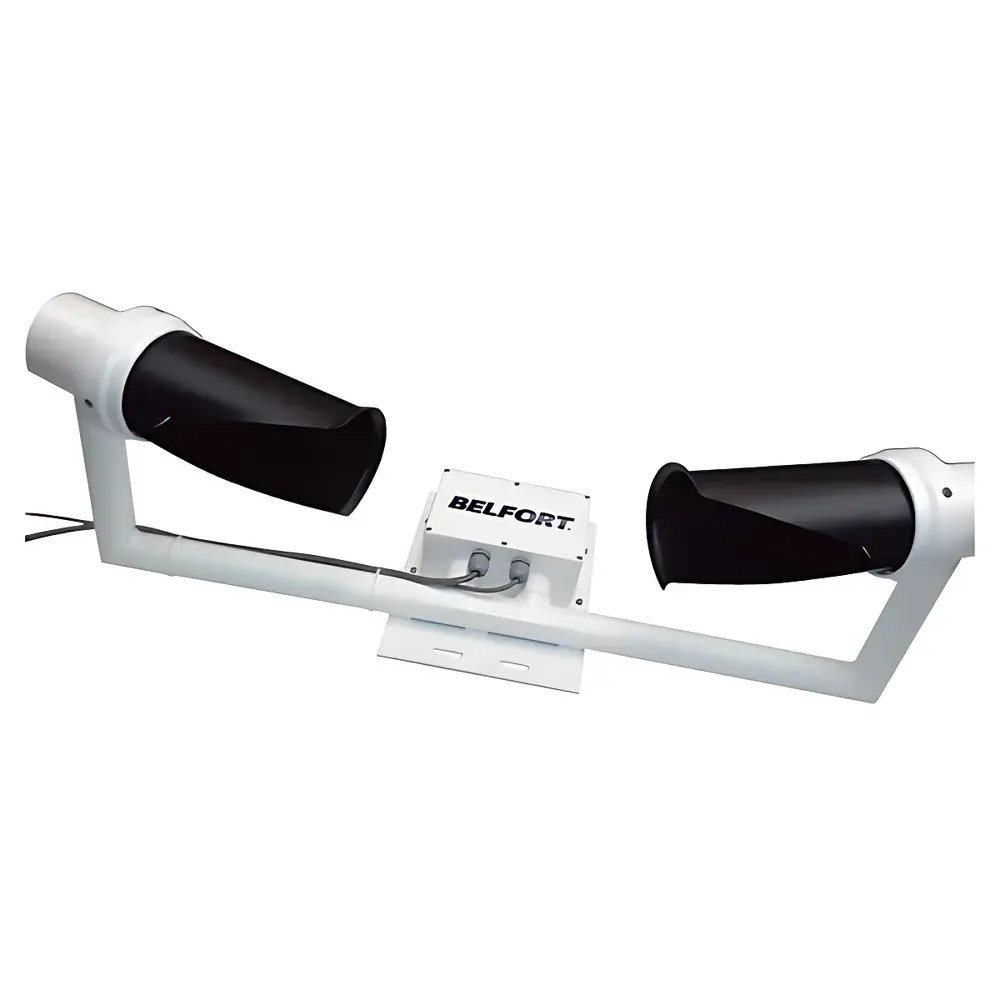
Belfort Model 6450 VisWx Visibility and Present Weather Sensor
| Brand | Belfort (USA) |
|---|---|
| Origin | USA |
| Model | 6450 |
| Measurement Range | 6 m to 80 km |
| Accuracy | ±10% |
| Scattering Angle | 42° |
| Light Source | High-output Infrared LED |
| Output | RS232 (300–38,400 baud), SPDT Relay |
| Operating Temperature | −40 °C to +60 °C |
| Relative Humidity | 0–100% RH |
| Power Consumption | 12 W (sensor), 25 W (shroud heater) |
| Dimensions | 97 × 33 × 41 cm |
| Weight | 7.9 kg |
| Weather Phenomena Recognition | 15 WMO codes including rain (R, −R, R+), snow (S, −S, S+), freezing rain (FZRA), ice pellets (PL), fog (FG), mist (BR), haze (HZ), smoke (FU), sand (SA), and clear sky (NSW) |
| Precipitation Rate Measurement | 0.25–20.3 mm/h (±<5% error) |
| Lens Heater | Standard |
| Shroud Heater | Optional |
| Calibration Kit P/N | 92001 |
Overview
The Belfort Model 6450 VisWx Visibility and Present Weather Sensor is an integrated optical instrument engineered for continuous, unattended monitoring of atmospheric visibility and real-time classification of present weather phenomena in accordance with World Meteorological Organization (WMO) Code Table 4678. It operates on the forward scatter principle—a physically robust and internationally standardized method—where a high-intensity infrared LED emits collimated light into the sampled air volume; scattered photons within a defined 42° angular acceptance cone are detected by a precision photodiode receiver. This configuration minimizes sensitivity to ambient solar radiation and natural background fluctuations while maintaining stable signal-to-noise performance across extreme diurnal and seasonal conditions. Designed for operational resilience in harsh environments—including marine platforms, airport runways, highway corridors, lighthouses, and offshore installations—the Model 6450 delivers traceable visibility measurements from 6 meters to 80 kilometers and classifies up to 15 distinct WMO weather codes, supporting both regulatory reporting and automated decision logic in critical infrastructure systems.
Key Features
- Forward scatter optical design validated per WMO Guide to Instruments and Methods of Observation (CIMO Guide, Chapter 12)
- Dual-mode digital output: RS232 serial interface (configurable baud rates from 300 to 38,400 bps) for real-time visibility values, diagnostic status, and WMO-coded weather reports
- Programmable SPDT relay outputs with user-defined visibility thresholds for alarm triggering or integration with SCADA/PLC systems
- Integrated lens heater as standard equipment to prevent condensation and frost accumulation on the optical window
- Optional shroud heater (25 W) for reliable operation in sub-zero, high-humidity, or icing-prone conditions
- Corrosion-resistant aluminum housing rated for long-term exposure to salt-laden coastal and marine atmospheres
- Modular mechanical design enabling rapid field installation on standard mounting poles without specialized tools
- On-site calibration capability using certified calibration kit (P/N 92001), traceable to NIST standards
Sample Compatibility & Compliance
The Model 6450 is designed for open-air atmospheric sampling under unrestricted environmental exposure. Its optical path remains functionally stable across the full operational range of −40 °C to +60 °C and 0–100% relative humidity. The sensor meets IEC 60529 IP65 enclosure rating for dust-tightness and protection against low-pressure water jets. While not certified as intrinsically safe, its 12 W nominal power draw and non-sparking relay architecture support deployment in non-hazardous classified zones. The device supports data integrity requirements aligned with ISO/IEC 17025 quality management systems for meteorological instrumentation laboratories. Its WMO-compliant reporting protocol ensures interoperability with national meteorological services and international aviation weather networks (e.g., METAR/SPECI, AMDAR). No sample preparation, consumables, or reagents are required—operation is fully passive and maintenance-optimized.
Software & Data Management
The VisWx sensor communicates via ASCII-based command-response protocol over RS232, enabling seamless integration with third-party data loggers (e.g., Campbell Scientific CR series), SCADA platforms (e.g., Ignition, Siemens Desigo), and custom weather display software. Configuration parameters—including measurement interval, relay setpoints, WMO code output frequency, and diagnostic verbosity—are programmable via terminal commands or embedded web interface (when paired with compatible gateway hardware). All visibility and weather event timestamps are synchronized to internal RTC with optional GPS time sync input. Data records include embedded checksums and CRC validation to ensure transmission fidelity. While the sensor itself does not store historical data, its output structure complies with BUFR and IWXXM metadata schemas for downstream ingestion into WMO Information System (WIS) nodes. Audit trails for configuration changes and calibration events may be maintained externally per GLP/GMP-aligned operational procedures.
Applications
- Airport surface detection systems (ASDS) for Runway Visual Range (RVR) estimation and Low Visibility Procedures (LVP) activation
- Intelligent Transportation Systems (ITS) for dynamic variable message sign (VMS) control and traffic incident management on high-speed highways
- Maritime safety networks—deployed on buoys, lighthouses, and vessel bridges for navigational hazard awareness
- National weather service automatic observing systems (ASOS/AWOS) fulfilling WMO observational standards
- Environmental monitoring networks assessing regional haze, dust transport, and volcanic ash dispersion
- Renewable energy operations—wind farm siting and solar irradiance forecasting where aerosol loading impacts PV efficiency
FAQ
What WMO weather codes does the Model 6450 report?
It outputs 15 standardized WMO present weather codes, including precipitation types (R, S, FZRA, PL), obscuration phenomena (FG, BR, HZ, FU, SA), and clear-sky indicators (NSW), compliant with Code Table 4678.
Can visibility and weather phenomenon data be reported at different intervals?
Yes—the RS232 interface supports asynchronous reporting: visibility values can be streamed at one frequency (e.g., every 10 seconds), while WMO weather classifications update independently (e.g., every 60 seconds) based on statistical persistence algorithms.
Is field calibration possible without returning the unit to the factory?
Yes—using the optional calibration kit (P/N 92001), users can perform traceable zero- and span-level verification and adjustment in situ under representative ambient conditions.
How does the sensor handle heavy rain or snow accumulation on the optics?
The aerodynamic shroud design, combined with standard lens heating and optional shroud heating, actively prevents liquid film formation and snow bridging across the optical aperture.
Does the Model 6450 meet FAA or EASA regulatory requirements for aviation weather sensors?
While not FAA TSO-certified as a standalone unit, it is widely deployed in FAA- and EASA-approved ASOS/AWOS configurations when integrated with certified data acquisition and processing systems meeting AC 150/5220-16 and ED-117B requirements.
Related Products







