
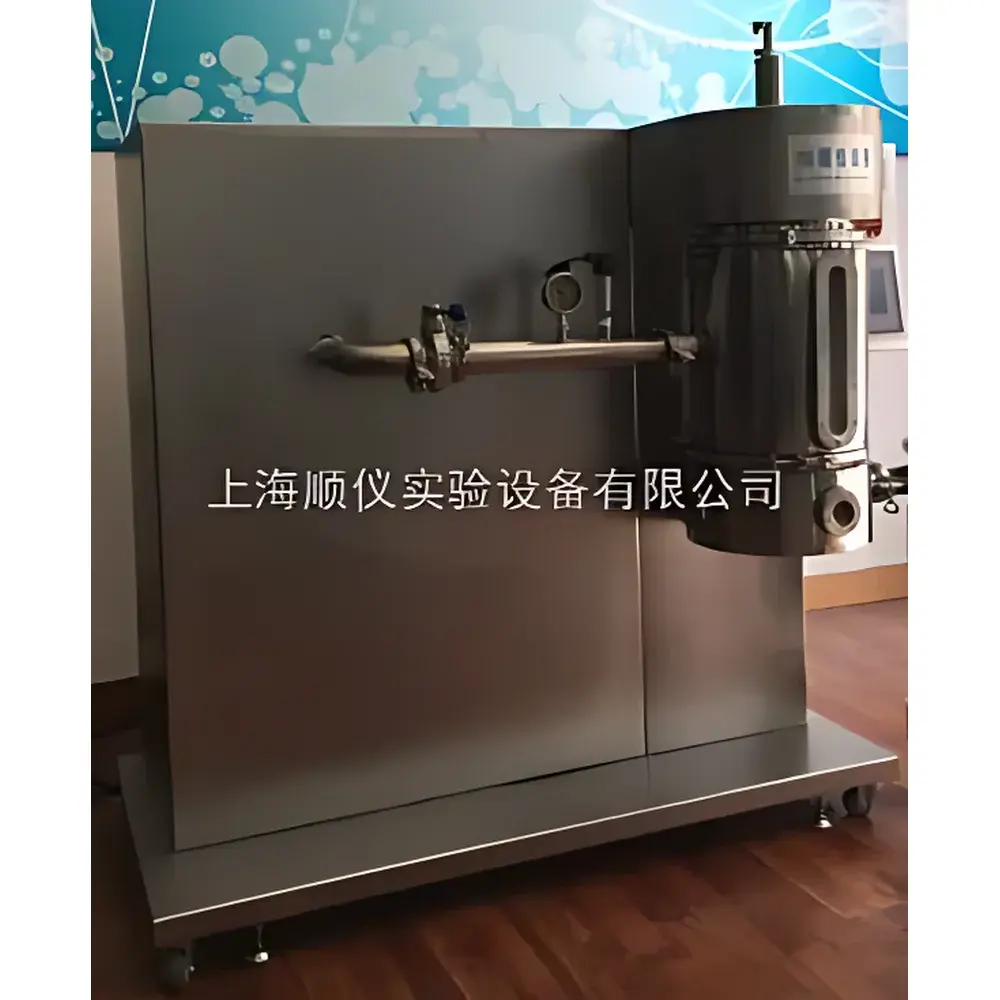
SP-3000 Compact Spray Freeze Dryer
| Origin | Shanghai, China |
|---|---|
| Manufacturer Type | Authorized Distributor |
| Origin Category | Domestic (China) |
| Model | SP-3000 |
| Price Range | USD 28,000 – 42,500 |
| Processing Capacity | 30–1000 mL/batch |
| Spray Freezing Temperature | ≤ −15 °C |
| Cold Trap Temperature | ≤ −60 °C |
| Ultimate Vacuum (Empty Chamber) | < 20 Pa |
| Spray Pressure Range | 2–5 bar (adjustable) |
| Compressed Air Supply | Integrated oil-free air compressor (0.2 kW, 4.2 m³/h) |
| Drying Air Flow Rate | 0–330 m³/h (max), 686 Pa max static pressure |
| Condenser Cooling | Built-in air-cooled hermetic compressor system |
| Control System | Full-color LCD touchscreen (bilingual: English/Chinese), real-time display of drying chamber temperature, peristaltic pump speed, fan frequency, needle purge frequency, and chamber pressure |
| Needle Purge (Jet Cleaner) | Pneumatically actuated, adjustable frequency (2.3 bar internal supply) |
| Power Supply | 9 kW, 380 V, 50 Hz |
| Dimensions (L×W×H) | 1150 × 770 × 1350 mm |
| Noise Level | < 50 dB(A) |
| Dual-Mode Capability | Optional retrofit to conventional hot-air spray dryer configuration |
Overview
The SP-3000 Compact Spray Freeze Dryer is an integrated laboratory-scale instrument engineered to combine the rapid atomization of spray drying with the low-temperature preservation integrity of vacuum freeze drying. Unlike conventional lyophilizers or thermal spray dryers, this system performs flash freezing of atomized droplets *in situ* under controlled cryogenic and sub-atmospheric conditions—enabling solidification of thermolabile solutes prior to primary drying via sublimation. The process preserves macromolecular conformation, enzymatic activity, and biological potency far more effectively than heat-driven dehydration methods. Designed for R&D environments where sample scarcity, structural fidelity, and process scalability are critical—such as pharmaceutical formulation development, natural product stabilization, and biopolymer microencapsulation—the SP-3000 delivers reproducible powder morphology with minimal denaturation or Maillard degradation.
Key Features
- Integrated dual-mode architecture: Combines high-velocity pneumatic nozzle atomization with in-flight cryogenic freezing and subsequent vacuum-assisted sublimation—eliminating thermal stress during phase transition.
- Self-contained refrigeration system: Air-cooled, hermetically sealed compressor achieves cold trap temperatures ≤ −60 °C and spray zone cooling ≤ −15 °C, ensuring rapid vitrification of droplets before ice crystal growth compromises structural homogeneity.
- Bilingual full-color touchscreen interface: Real-time digital monitoring and control of chamber temperature, peristaltic feed rate (0.1–200 mL/min), fan speed (0–330 m³/h), needle purge frequency (0–10 Hz), and absolute chamber pressure (0.1–1000 Pa resolution).
- Onboard oil-free air compressor (0.2 kW, 4.2 m³/h): Eliminates hydrocarbon contamination risk; meets ISO 8573-1 Class 0 purity requirements for sensitive biologics processing.
- Safety-interlocked operation: Heater activation is disabled until condenser reaches operational temperature and fan airflow is verified—preventing thermal runaway or chamber overpressure.
- Modular vacuum coupling: Standard ISO-KF 25/40 flanges enable rapid disassembly, cleaning, and compatibility with external vacuum gauges or secondary trapping systems.
- Dual-process flexibility: Optional hardware/software upgrade path allows conversion to hot-air spray drying mode (up to 220 °C inlet air), supporting comparative process mapping per ICH Q5C and USP <1211> guidelines.
Sample Compatibility & Compliance
The SP-3000 accommodates aqueous and organic solvent-based solutions, suspensions, and emulsions—including high-viscosity extracts (e.g., herbal glycoside concentrates), protein-rich bioreactor harvests, polymer dispersions, and fruit juice concentrates with >30% total solids. Its low-temperature trajectory (<−15 °C droplet freezing + <20 Pa vacuum) prevents caramelization, aggregation, or oxidation in labile compounds such as monoclonal antibodies, probiotic cultures, and polyphenol glycosides. The system supports GLP-compliant documentation through optional audit-trail-enabled firmware (21 CFR Part 11 ready). All wetted surfaces are electropolished 316L stainless steel; gaskets comply with USP Class VI and FDA 21 CFR 177.2600 standards.
Software & Data Management
The embedded control firmware logs timestamped parameter sets at 1-second intervals across all operational phases—atomization, freezing, primary drying, and secondary drying. Export formats include CSV and XML for integration with LIMS platforms (e.g., LabVantage, Thermo Fisher SampleManager). Optional Ethernet/Wi-Fi connectivity enables remote monitoring via secure HTTPS interface. Process data files include metadata tags for batch ID, operator, ambient humidity, and calibration certificate traceability (NIST-traceable Pt100 sensors and capacitance manometers). Automated report generation includes drying curve plots (pressure vs. time, temperature gradient maps), mass loss kinetics, and final cake moisture content estimation (via residual gas analysis correlation).
Applications
- Pharmaceutical R&D: Stabilization of mRNA-LNPs, peptide APIs, and live attenuated vaccines without cryoprotectant overload.
- Natural product laboratories: Preservation of anthocyanins, curcuminoids, and triterpenoid saponins from botanical extracts while retaining antioxidant capacity.
- Food science: Production of instant fruit powders with >90% reconstitution clarity and native volatile profile retention.
- Materials science: Synthesis of uniform polymer microparticles (10–150 µm) for controlled-release matrices or catalyst supports.
- Academic research: High-throughput screening of excipient compatibility in freeze-spray formulations under DOE-designed parameter spaces.
FAQ
What is the minimum sample volume required for a valid run?
The system supports batches as small as 30 mL, with optimized atomization stability and collection efficiency maintained down to this volume using calibrated peristaltic pump tubing and low-flow nozzle configurations.
Can the SP-3000 handle ethanol-based extracts?
Yes—provided the total solvent concentration remains below 40% v/v and the cold trap is pre-chilled to ≤−60 °C to ensure complete vapor condensation; optional explosion-proof electrical certification available upon request.
How is particle size distribution controlled?
Via coordinated adjustment of nozzle orifice diameter (standard: 0.7 mm, optional: 0.5/1.0 mm), feed rate, atomizing air pressure (2–5 bar), and drying air velocity—empirically validated against laser diffraction (Malvern Mastersizer) reference data.
Is validation support provided for GMP environments?
Factory-installed IQ/OQ protocols compliant with ASTM E2500 and EU Annex 15 are available; PQ execution requires site-specific media fill and sterility testing per ISO 13408-1.
What maintenance intervals are recommended?
Compressor oil and desiccant filters: every 2000 operating hours; vacuum pump oil: every 500 hours; O-rings and nozzle tips: inspected per batch; full system calibration: annually using NIST-traceable references.



