
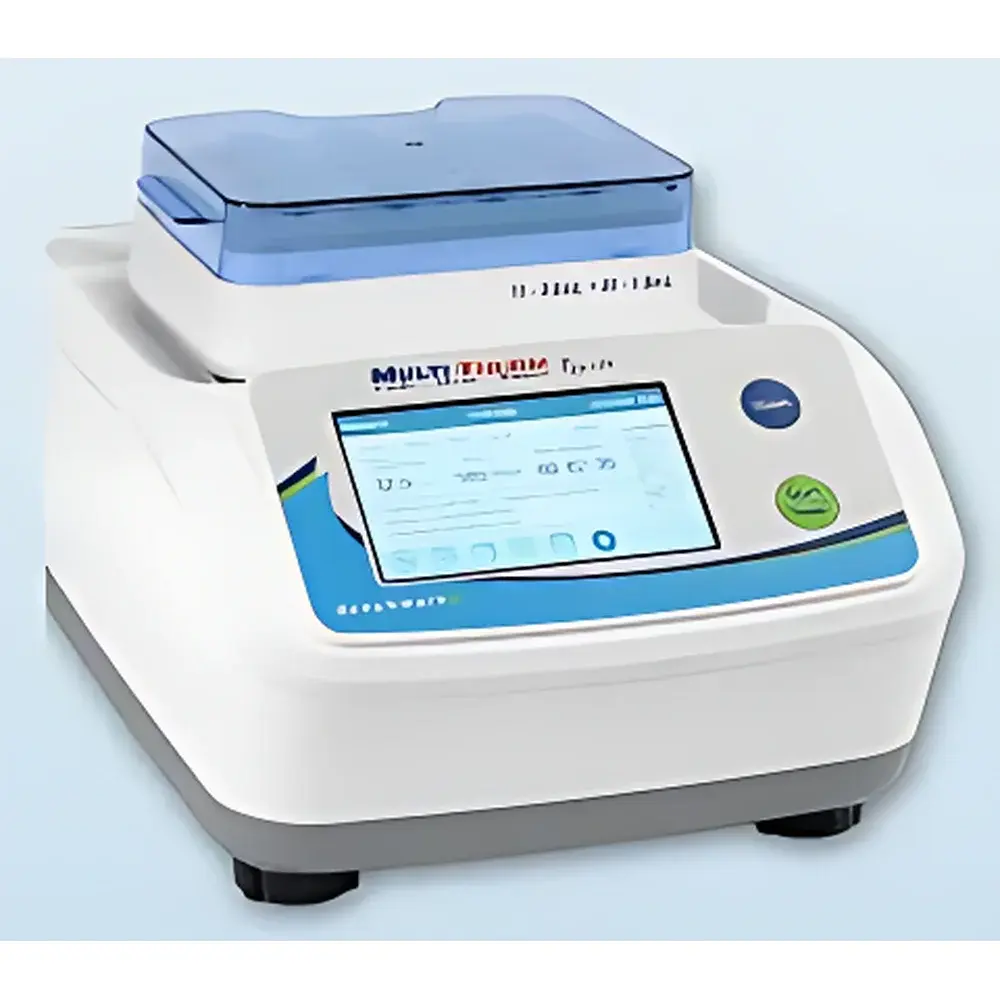
Benchmark MultiTherm Touch Thermal Shaker H5000
| Brand | Benchmark |
|---|---|
| Origin | USA |
| Manufacturer Type | Authorized Distributor |
| Product Origin | Imported |
| Model | MultiTherm Touch |
| Pricing | Upon Request |
| Display | 4.3-inch color touchscreen with graphical UI |
| Speed Range | 200–3000 rpm (load-dependent) |
| Orbit Diameter | 3 mm |
| Temperature Range | −20 °C to +105 °C |
| Temperature Uniformity | ±0.5 °C |
| Timer Range | 1 s to 99 h 59 m 59 s or continuous operation |
| Program Memory | 50 programs, up to 5 steps per program |
| Ramp Rate Control | Adjustable |
| Mixing Modes | Clockwise, counterclockwise, and bidirectional oscillation |
| Heating Lid | Programmable temperature control |
| Auto-Block Recognition | Yes |
| Dimensions (W×D×H) | 16 × 32 × 22 cm (6.3 × 12.6 × 8.7 in) |
| Weight | 10 kg (22 lb) |
| Power Input | 100–240 V AC, 50–60 Hz |
Overview
The Benchmark MultiTherm Touch Thermal Shaker H5000 is an integrated benchtop instrument engineered for precise, reproducible thermal control and orbital shaking of microplates, PCR tubes, and small-volume vials (≤50 mL). It operates on the principle of Peltier-based active heating and cooling combined with controlled orbital agitation—enabling simultaneous temperature regulation and mechanical mixing across a wide operational envelope. Unlike passive heating blocks or standalone shakers, the H5000 delivers dynamic thermal management with high spatial uniformity (±0.5 °C) and programmable ramp kinetics, making it suitable for applications requiring strict thermal profiles coupled with consistent mixing—including enzyme kinetics, cell lysis, hybridization, solubility studies, and accelerated stability testing.
Key Features
- 4.3-inch full-color graphical touchscreen interface with intuitive drag-and-drop programming and real-time parameter visualization
- Wide temperature range from −20 °C to +105 °C, supported by dual-mode Peltier thermoelectric elements for rapid heating and efficient cooling
- Orbital shaking at 200–3000 rpm with fixed 3 mm orbit diameter; speed output dynamically optimized per load configuration to maintain torque stability
- Programmable heating lid with independent temperature setpoint control to minimize evaporation during extended incubations
- Auto-block recognition system that detects plate/tube format and adjusts thermal calibration and agitation parameters accordingly
- Configurable ramp rate control for gradual temperature transitions—critical for temperature-sensitive biomolecules and crystallization workflows
- Bidirectional mixing capability (clockwise, counterclockwise, alternating) to prevent sedimentation and enhance homogenization in viscous or particulate-laden samples
- Robust metal chassis with vibration-dampened base and EMI-shielded electronics for stable operation in shared lab environments
Sample Compatibility & Compliance
The H5000 accommodates standard 96-well PCR plates, skirted and unskirted microplates, 0.2–50 mL conical tubes, and custom aluminum or silicone heat-transfer blocks. Its thermal architecture complies with IEC 61010-1 safety standards for laboratory equipment. While not certified as a medical device, its design supports GLP-compliant workflows through audit-trail-capable software logging (when paired with Benchmark’s optional DataLink software), traceable parameter changes, and timestamped program execution records. Temperature calibration is traceable to NIST-certified reference probes, and routine verification aligns with ASTM E2252 (Standard Practice for Calibration of Thermal Cyclers) and ISO/IEC 17025 requirements for accredited testing laboratories.
Software & Data Management
The onboard firmware supports local storage of up to 50 user-defined protocols, each containing up to five sequential steps with independent temperature, speed, time, and ramp settings. All programs include metadata fields for operator ID, sample description, and revision notes. Data export is performed via USB flash drive in CSV format, preserving timestamps, setpoints, and real-time sensor readings (temperature, RPM, elapsed time). Optional DataLink PC software enables remote monitoring, centralized protocol library management, electronic signature support, and 21 CFR Part 11–compliant audit trails—including user access logs, parameter change history, and export confirmation receipts. Firmware updates are delivered via secure HTTPS download and validated using SHA-256 checksums.
Applications
- PCR setup and pre-amplification incubation with simultaneous mixing to ensure master mix homogeneity
- Temperature-controlled enzymatic digestions (e.g., restriction enzyme reactions, ligations) where kinetic consistency depends on both thermal accuracy and agitation uniformity
- Cell suspension culture maintenance during short-term assays without CO₂ control
- Solubility profiling across thermal gradients for pharmaceutical excipient screening
- Accelerated degradation studies under defined thermal stress conditions per ICH Q1A(R2)
- Antibody-antigen binding assays requiring precise incubation timing and gentle agitation to reduce non-specific adsorption
- Extraction optimization for plant metabolites or nucleic acids using temperature-modulated solvent agitation
FAQ
Does the MultiTherm Touch H5000 support external temperature probes for sample-core monitoring?
Yes—optional K-type thermocouple inputs are available via the rear I/O port, enabling direct measurement of sample temperature inside tubes or wells when used with compatible probe adapters.
Can programs be password-protected to restrict unauthorized modifications?
Yes—administrator-level password protection is configurable per user profile, limiting access to program editing, calibration, and system settings.
Is the heating lid compatible with low-profile plates and opaque tube caps?
The lid features adjustable height clearance and IR-transparent quartz windowing, allowing compatibility with most standard low-profile plates and polypropylene caps without compromising thermal transfer efficiency.
What is the expected service life of the Peltier modules under continuous operation?
Rated for ≥20,000 hours of cumulative operation at ≤80 % duty cycle; performance is maintained within specification through automatic thermal derating and active fan-cooled heat sink management.
How does the auto-block recognition system function without RFID or barcode scanning?
It employs a multi-point capacitive sensing array beneath the platform surface, detecting block geometry, material dielectric properties, and thermal mass signatures to select optimal thermal PID tuning parameters and shake amplitude compensation.



