
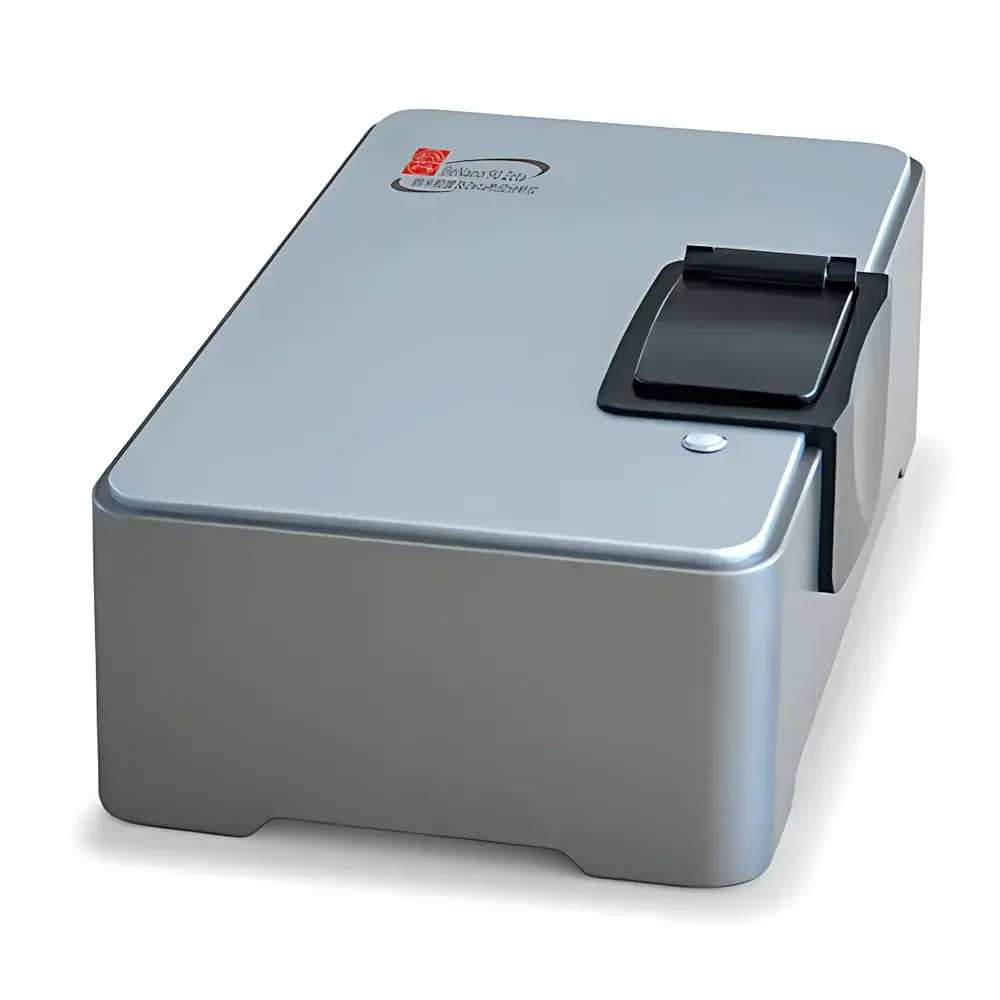
Bettersize BeNano 90 Zeta Potential Analyzer and Dynamic Light Scattering (DLS) Instrument
| Brand | Bettersize |
|---|---|
| Origin | Liaoning, China |
| Model | BeNano 90 Zeta |
| Particle Size Range (DLS) | 0.3 nm – 15 μm |
| Zeta Potential Range | No Practical Limitation |
| Electrophoretic Mobility Range | > ±20 μm·cm/V·s |
| Conductivity Range | Up to 260 mS/cm |
| pH Range | 2–12 (compatible with aqueous & low-ionic-strength media) |
| Temperature Control Range | −10 °C to +110 °C |
| Temperature Accuracy | ±0.1 °C |
| Sample Volume (DLS mode) | 3 µL (capillary cell) / 0.75 mL (standard cuvette) |
| Detection Angles | 90° (size), 12° (zeta) |
| Laser Source | 50 mW solid-state laser, 671 nm |
| Detector | APD (Avalanche Photodiode) |
| Correlator | 4000-channel digital correlator, 10¹¹ dynamic linear range |
| Optical Path Stability | Passive thermal stabilization, no daily alignment required |
| Data Output | Hydrodynamic diameter (Dₕ), polydispersity index (PDI), zeta potential distribution, electrophoretic mobility, diffusion coefficient (D), intensity/volume/number-weighted size distributions |
Overview
The Bettersize BeNano 90 Zeta is a dual-mode analytical instrument engineered for high-precision characterization of colloidal and nanoparticulate systems. It integrates dynamic light scattering (DLS) for hydrodynamic size determination and phase analysis light scattering (PALS) for zeta potential measurement — both based on first-principles physical models. DLS relies on the analysis of temporal fluctuations in scattered laser intensity caused by Brownian motion, enabling calculation of particle diffusion coefficients via the Stokes–Einstein equation. PALS employs high-frequency phase modulation to resolve electrophoretic mobility under applied electric fields, translating directly into zeta potential using the Henry equation and appropriate surface conductivity corrections. Designed for rigorous R&D and QC environments, the BeNano 90 Zeta supports nanomaterial development in battery electrode slurries, photovoltaic inks, semiconductor dispersions, and biopharmaceutical formulations where colloidal stability, surface charge, and aggregation kinetics are critical process parameters.
Key Features
- Dual-angle optical configuration: 90° detection for optimal DLS sensitivity in sub-10 nm regimes; 12° detection optimized for high-resolution zeta potential measurements across broad conductivity ranges (up to 260 mS/cm)
- High-stability 50 mW 671 nm solid-state laser with automatic power regulation — dynamically adjusts output between 0.0001% and 100% to maintain signal-to-noise ratio across sample turbidity and concentration gradients
- Capillary-based microfluidic cell design: enables reliable measurements from as little as 3 µL of sample while minimizing wall effects and electro-osmotic artifacts during electrophoresis
- Integrated Peltier temperature control system with ±0.1 °C accuracy and programmable ramping (−10 °C to +110 °C), supporting kinetic studies and thermal stability profiling
- Intelligent signal quality assessment algorithm that identifies and excludes spurious correlation decay events caused by dust, aggregates, or detector saturation — ensuring robust statistical validity of reported distributions
- Disposable capillary electrodes eliminate cross-contamination between samples and preserve measurement repeatability (RSD < 0.1% for certified latex standards)
- Passively stabilized optical architecture requiring no routine alignment — suitable for shared lab environments and GLP-compliant workflows
Sample Compatibility & Compliance
The BeNano 90 Zeta accommodates aqueous, organic, and mixed-solvent dispersions, including high-viscosity electrolyte solutions common in battery slurry analysis (e.g., NMP/LiPF₆ systems) and low-pH or high-pH formulations (pH 2–12). Its wide conductivity tolerance allows direct measurement of conductive nanocarbon suspensions without dilution — critical for maintaining representative colloidal state. The instrument complies with ISO 22412:2017 (DLS) and ISO 13099-2:2012 (electrophoretic light scattering), and supports audit-trail-enabled operation per FDA 21 CFR Part 11 when deployed with validated software configurations. All calibration protocols follow NIST-traceable reference materials (e.g., NIST SRM 1960 polystyrene nanoparticles).
Software & Data Management
The proprietary BeNano Analysis Suite provides full control over acquisition parameters, real-time correlation curve visualization, and multi-model fitting (Cumulants, NNLS, CONTIN). It supports automated batch processing, customizable report templates (PDF/Excel), and raw data export in ASCII format for third-party statistical analysis. Built-in validation tools include residual error mapping, fit convergence diagnostics, and automatic outlier rejection. Data integrity safeguards include electronic signatures, time-stamped audit logs, and role-based user access control — facilitating compliance with GMP/GLP documentation requirements.
Applications
- Electrode slurry development for Li-ion and solid-state batteries: monitoring zeta potential shifts during binder addition or solvent exchange to predict dispersion stability and coating uniformity
- Nanoparticle synthesis optimization: correlating surface charge evolution with reaction time, pH, or surfactant concentration in situ
- Photocatalyst and quantum dot formulation: assessing colloidal robustness under illumination-induced redox conditions
- Protein and liposome characterization: measuring zeta potential as a proxy for surface modification efficiency and aggregation onset thresholds
- Quality control of commercial nanomaterials: verifying batch-to-batch consistency in Dh and zeta distributions per internal SOPs or customer specifications
FAQ
What is the minimum detectable particle size in DLS mode?
The theoretical lower limit is ~0.3 nm under ideal conditions (high signal-to-noise, monodisperse gold clusters in ultra-pure water); practical resolution depends on sample transparency, viscosity, and instrument alignment.
Can the BeNano 90 Zeta measure zeta potential in highly conductive battery electrolytes?
Yes — its 12° PALS geometry and adaptive field modulation enable stable electrophoretic mobility measurements up to 260 mS/cm, covering standard carbonate-based and emerging sulfide electrolyte systems.
Is the system compatible with non-aqueous solvents such as NMP or DMF?
Yes, provided refractive index matching and electrical conductivity fall within operational limits; optional solvent-specific calibration routines are available.
Does the software support IQ/OQ/PQ documentation packages for regulated labs?
Yes — validated installation packages, test protocols, and traceable calibration records are supplied upon request for pharmaceutical and medical device applications.
How often does the optical path require maintenance or recalibration?
None — the passive thermal and mechanical design eliminates need for periodic realignment; only routine cleaning of optical windows and capillary cells is recommended.



