
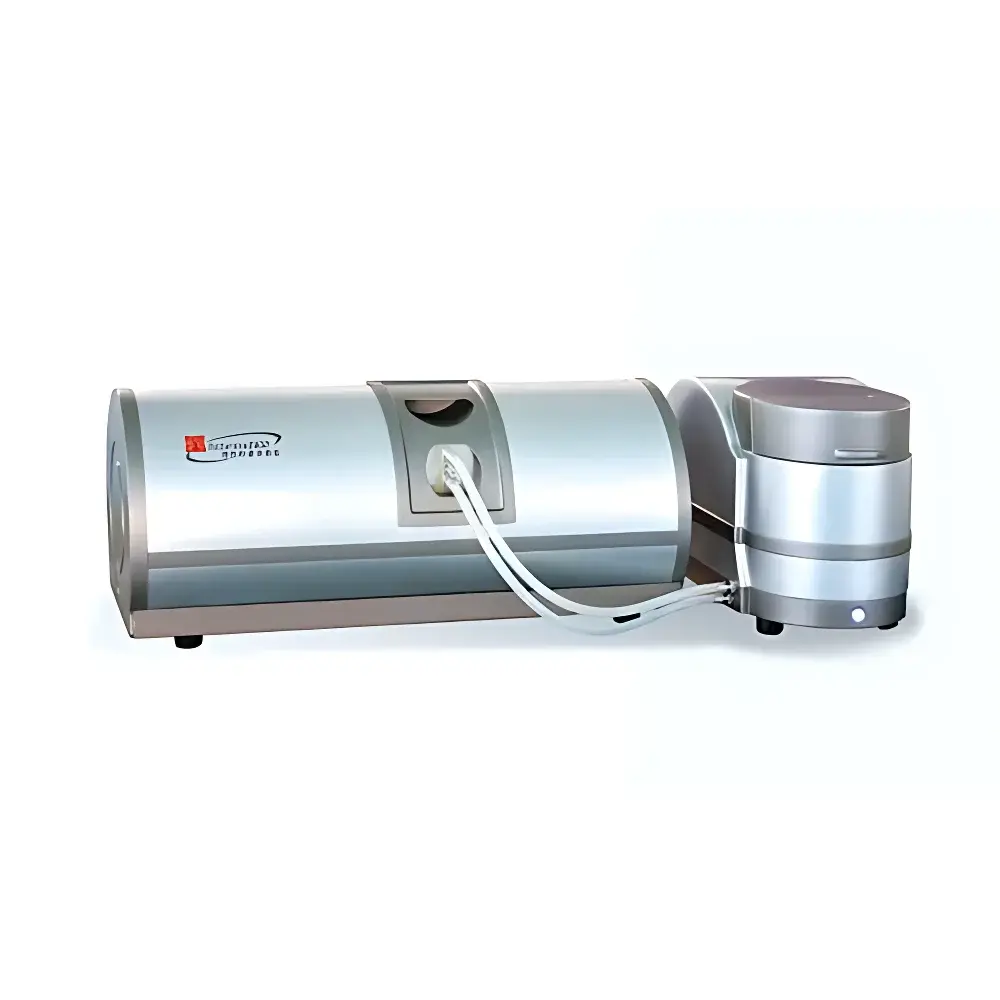
Bettersize2600 Laser Diffraction Particle Size Analyzer
| Brand | KJ GROUP (Shenyang Kejing) |
|---|---|
| Origin | Liaoning, China |
| Manufacturer Type | Authorized Distributor |
| Product Origin | Domestic (China) |
| Model | Bettersize2600 |
| Pricing | Available Upon Request |
| Measurement Principle | Mie Scattering Theory |
| Test Range | 0.02–2600 µm |
| Repeatability Error | ≤0.5% (D50 deviation vs. national standard reference material) |
| Dual-Peak Resolution | ≥1.65 (ratio of nominal sizes of two certified standards) |
| Measurement Mode | Fully Automated SOP-Based Operation |
| Laser Source | Imported Fiber-Coupled Laser (5 mW, 635 nm) |
| Optical System | Patented Bidirectional Fourier Configuration with Tilted Sample Cell |
| Detector Array | 92-channel Photodiode Array |
| Detection Angle Range | 0.016°–165° |
| Sampling Rate | 3500 Hz |
| Alignment Mechanism | Motorized Auto-Alignment System |
| Dispersion Method | Wet & Dry Dual-Mode (External Circulation + Ultrasonic + Air Jet) |
| Ultrasonic Power | 50 W |
| Circulation Flow Rate | 3000–8000 mL/min |
| Gas Flow Rate (Dry Mode) | 400–6000 L/min |
| Operating Pressure (Dry Mode) | 0.1–0.8 MPa (adjustable) |
| Sample Volume (Wet) | 0.2–10 g |
| Dispersion Medium | Deionized Water, Organic Solvents, or Compressed Inert Gas |
| Circulation Tank Capacity | 600 mL |
| Interface | USB 2.0 / 3.0 |
| Power Supply | AC 220 V, 50/60 Hz |
| Dimensions (W×D×H) | 705 × 318 × 295 mm |
| Weight | 23 kg |
| Software Platform | Windows XP / 7 / 8 / 10 Compatible |
| Data Compliance | Supports Audit Trail, User Access Levels, and Export in ASTM E2919-22 & ISO 13320:2020 Compliant Formats |
Overview
The Bettersize2600 Laser Diffraction Particle Size Analyzer is an industrial-grade instrument engineered for high-precision, traceable particle size distribution (PSD) analysis across R&D, QC, and production environments. It operates on the fundamental principles of Mie scattering theory—rigorously applied to both spherical and non-spherical particles—enabling quantitative characterization of particulate systems from sub-20 nm colloids to coarse powders up to 2600 µm. Its patented bidirectional Fourier optical architecture integrates forward, side, and backward scattering detection with a tilted sample cell design, expanding angular coverage to 0.016°–165° and eliminating blind zones inherent in conventional unidirectional systems. This configuration ensures robust signal capture across the full dynamic range, particularly enhancing sensitivity at the fine end (<0.1 µm) and resolving subtle multimodal distributions with metrological confidence.
Key Features
- Bidirectional Fourier Optical System: Combines coaxial and off-axis laser paths with a precisely angled sample cell to maximize scattered light collection efficiency and minimize Mie resonance artifacts.
- Auto-Alignment & Real-Time Stability Monitoring: A motor-driven alignment module continuously maintains optimal beam positioning relative to the detector array, compensating for thermal drift or mechanical perturbation during extended operation.
- Dual-Mode Dispersion Architecture: Fully independent wet and dry dispersion modules—each with programmable SOP control—support method transfer validation and regulatory compliance. The wet system includes a 600 mL circulation tank, 50 W ultrasonic disperser with anti-dry-burn protection, centrifugal pump, auto-fill/drain/overflow logic, and integrated cleaning cycle. The dry module delivers controlled air-jet dispersion at adjustable pressure (0.1–0.8 MPa) and flow rate (400–6000 L/min).
- High-Fidelity Signal Acquisition: 92-element photodiode array with 3500 Hz sampling frequency captures transient scattering events, enabling statistical suppression of outliers and improving measurement reproducibility (≤0.5% D50 RSD per ISO 13320).
- Optimized Optical Design: Dual-lens optical path—comprising a collimating lens and a focusing lens—minimizes spherical aberration and improves spatial resolution of the diffraction pattern at extreme angles.
Sample Compatibility & Compliance
The Bettersize2600 accommodates a broad spectrum of particulate materials without modification: inorganic pigments (titanium dioxide, zinc oxide), battery cathode/anode powders (LiCoO₂, graphite), pharmaceutical excipients (lactose, microcrystalline cellulose), catalysts (zeolites, Pt/C), construction materials (cement, fly ash), and nanomaterials (SiO₂, ZrO₂ colloids). All wet dispersion protocols are compatible with aqueous and non-aqueous media—including ethanol, isopropanol, and xylene—under GLP-aligned SOP execution. Dry dispersion supports inert gas purging for oxygen-sensitive samples. Instrument software logs all critical parameters (laser power, alignment status, pump speed, sonication duration, background subtraction) with time-stamped audit trails, meeting FDA 21 CFR Part 11 requirements for electronic records when configured with role-based user authentication and digital signature support.
Software & Data Management
Operating on native Windows platforms (XP through Win10), the Bettersize Analysis Suite provides ISO 13320-compliant data reduction using iterative constrained non-negative least squares (NNLS) algorithms. It supports automatic peak identification for unimodal, bimodal, and polymodal distributions, with customizable reporting templates (PDF, Excel, CSV) that include D10/D50/D90, span, relative width, and cumulative frequency plots. Raw scattering patterns are stored in HDF5 format for third-party reprocessing. Batch processing, method cloning, and inter-instrument comparison tools facilitate multi-site harmonization. Data export conforms to ASTM E2919-22 for particle characterization metadata exchange.
Applications
Validated use cases span regulated and non-regulated sectors: QC release testing of ceramic raw materials (kaolin, talc) per ASTM C720; particle fineness verification of pesticide suspensions under EPA guidelines; PSD monitoring of lithium iron phosphate slurry in battery electrode manufacturing; agglomeration assessment of silica nanoparticles in cosmetic emulsions; and sediment grain-size classification in environmental geology (ASTM D422). The system’s accuracy and repeatability have been verified against NIST-traceable standard reference materials (SRMs), including SRM 1980 (silicon carbide) and SRM 1963 (glass beads).
FAQ
What particle size standards are supported for calibration and verification?
The Bettersize2600 is validated using NIST SRMs and national standard reference materials such as GBW(E)130009 (silicon dioxide) and GBW(E)130010 (glass beads), with documented D50 bias ≤0.5%.
Can the instrument comply with 21 CFR Part 11 in pharmaceutical environments?
Yes—when deployed with enabled user access controls, electronic signatures, and audit trail logging, it satisfies electronic record and signature requirements for GMP-compliant laboratories.
Is dry dispersion suitable for heat-sensitive or electrostatic-prone powders?
The inert gas option (N₂ or Ar) and low-pressure dispersion mode minimize thermal degradation and static buildup, making it appropriate for APIs and polymer microparticles.
How does the tilted sample cell improve measurement fidelity?
It eliminates Fresnel reflection interference at the cuvette interface and enables detection of low-angle forward scatter without truncation—critical for accurate sub-100 nm sizing.
What maintenance routines are recommended for long-term optical stability?
Daily background measurement, quarterly alignment verification, biannual cleaning of the flow cell and detector window with spectroscopic-grade solvents, and annual laser power calibration using an NIST-traceable photodiode sensor.



