
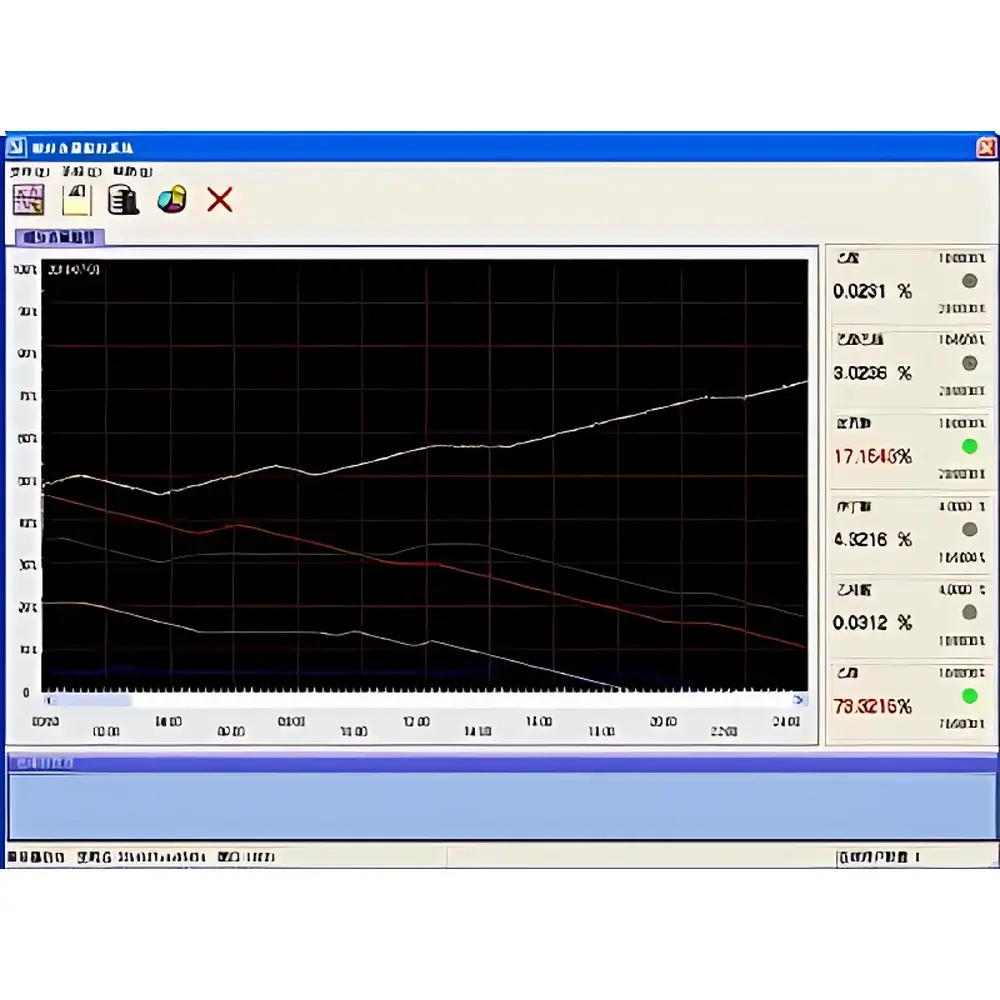
BF-3000 Component Content Monitoring System
| Brand | Beifen Sanpu |
|---|---|
| Origin | Beijing, China |
| Manufacturer Type | Manufacturer |
| Product Origin | Domestic (China) |
| Model | BF-3000 |
| Pricing | Upon Request |
Overview
The BF-3000 Component Content Monitoring System is a dedicated industrial process analytics platform engineered for real-time, automated interpretation and surveillance of chromatographic output—specifically gas chromatography (GC) data streams. It operates as a networked software-hardware integration layer that interfaces directly with standard GC workstations (e.g., Agilent, Shimadzu, Thermo Fisher, or compatible domestic GC systems), parsing raw peak area/height integrations and retention time-aligned component identifications to compute quantitative composition profiles. Unlike standalone GC data systems, the BF-3000 implements continuous statistical evaluation of component mass fractions—expressed as weight percent (wt%), volume percent (vol%), or trace-level concentrations (ppm)—across sequential injections or time-synchronized batch cycles. Its core function is to transform discrete chromatograms into dynamic, time-series compositional metrics suitable for closed-loop process monitoring in continuous or semi-batch chemical manufacturing environments, including reaction monitoring, distillation column optimization, solvent recovery tracking, and purification endpoint detection.
Key Features
- Unlimited concurrent GC workstation connectivity via TCP/IP or OPC UA protocols, supporting heterogeneous instrument fleets across distributed plant locations.
- Per-instrument component capacity: up to 32 quantified analytes per chromatogram, with configurable identification logic (retention time window ± tolerance, spectral match threshold for GC-MS variants).
- Configurable alarm engine: up to six independent high/low threshold alerts per component, with user-defined limits spanning 0.1 ppm to 99.9% concentration range.
- Real-time visualization: multi-channel trend plots rendered using stock-market-style candlestick and line overlays, enabling rapid assessment of short-term volatility and long-term drift.
- Customizable display attributes: selectable curve colors, line styles (solid/dashed/dotted), and distinct visual indicators for upper/lower alarm states (e.g., red fill, flashing border, audible tone).
- Automated archival: raw chromatogram metadata, calculated composition tables, and alarm event logs are timestamped and stored in ISO 8601-compliant daily or shift-based directories, preserving audit-ready provenance.
Sample Compatibility & Compliance
The BF-3000 accepts standardized chromatographic data exchange formats—including AIA/CDF (Analytical Instrument Association), ANDI (Analytical Data Interchange), and vendor-specific XML exports—ensuring interoperability with major GC platforms. It supports calibration curve types (linear, quadratic, polynomial) and internal standard normalization workflows required for regulatory-grade reporting. While not an analytical instrument itself, the system is designed to operate within GLP and GMP frameworks: all data modifications are logged with operator ID, timestamp, and reason code; audit trails comply with FDA 21 CFR Part 11 electronic record requirements when deployed on validated Windows Server environments with domain authentication. It meets ISO/IEC 17025 clause 5.9.1 for data integrity in testing laboratories and aligns with ASTM D3606 (benzene/toluene in gasoline), ASTM D1319 (hydrocarbon types), and IEC 60599 (dissolved gas analysis in transformer oil) reporting conventions.
Software & Data Management
The BF-3000 runs on Windows 10/11 x64 platforms with SQL Server Express or full SQL Server backends for scalable data persistence. Its embedded database schema enforces referential integrity between sample IDs, injection sequences, method versions, and analyst credentials. Historical datasets are accessible via intuitive date-range filters, with export options to CSV, PDF (including annotated trend charts), and Excel-compatible XLSX. Role-based access control (RBAC) restricts configuration changes to authorized engineering personnel while permitting QC technicians to view live dashboards and acknowledge alarms. All data transfers use TLS 1.2 encryption; local storage adheres to NIST SP 800-53 Rev. 4 controls for media protection. Backup policies support scheduled differential backups and manual snapshot capture for forensic reconstruction.
Applications
- Continuous quality assurance in petrochemical refining: monitoring C4–C12 hydrocarbon distribution across fractionation columns.
- Pharmaceutical intermediate synthesis: tracking reaction completion via residual starting material and byproduct accumulation.
- Transformer oil diagnostics: trending H2, CH4, C2H4, C2H6, C2H2 per IEC 60599 to assess insulation degradation.
- Mine atmosphere safety: real-time methane (CH4) and carbon monoxide (CO) concentration surveillance in ventilation exhaust streams.
- Natural gas custody transfer: verifying BTU content via compositional analysis (N2, CO2, C1–C5, H2S) against contractual specifications.
- Pesticide residue screening in agrochemical production: detecting trace organophosphates and carbamates at sub-ppm levels during formulation QC.
FAQ
Does the BF-3000 perform chromatographic separation or detection?
No. It is a post-acquisition data processing and monitoring system—it requires external GC instrumentation to generate chromatograms.
Can it integrate with LIMS or MES platforms?
Yes, via RESTful API endpoints and configurable ODBC/JDBC drivers for bidirectional data synchronization with laboratory information management systems (LIMS) and manufacturing execution systems (MES).
Is validation documentation provided for regulated industries?
Beifen Sanpu supplies IQ/OQ protocol templates, traceability matrices, and test scripts aligned with GAMP 5 guidelines; site-specific PQ must be executed by the end user.
What is the maximum historical data retention period?
Retention is governed by local storage capacity and administrative policy—not by software limitation. Default configurations retain 90 days of raw chromatogram metadata and 36 months of summarized composition statistics.
How are alarm acknowledgments recorded and audited?
Each acknowledgment requires digital signature (Windows login credentials), includes contextual notes, and generates an immutable entry in the system’s electronic audit trail with SHA-256 hash integrity verification.




