
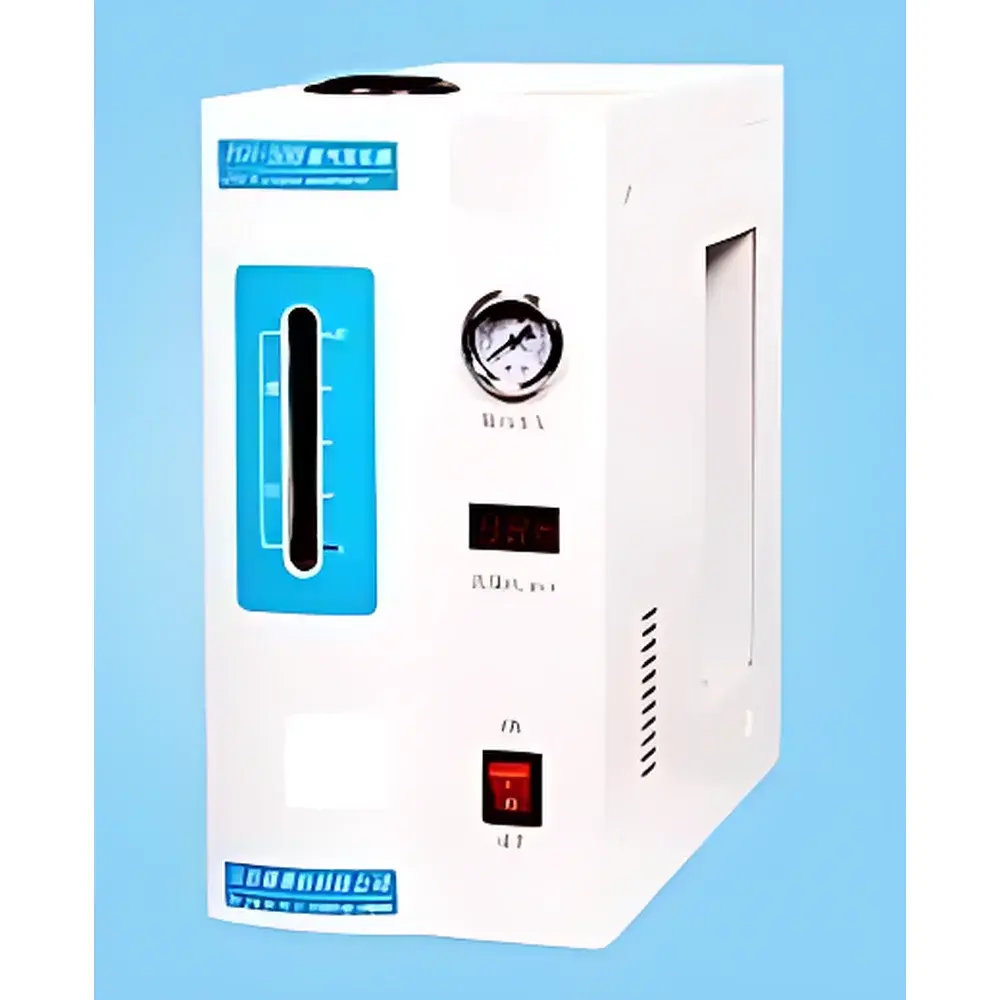
BF-300E Hydrogen Generator by Beifen Sanpu
| Brand | Beifen Sanpu |
|---|---|
| Origin | Beijing, China |
| Manufacturer Type | Direct Manufacturer |
| Model | BF-300E |
| Output Purity | 99.999% (v/v, O₂-equivalent basis) |
| Flow Rate Range | 0–300 mL/min |
| Input Voltage | AC 220 V, 50 Hz |
| Operating Temperature | 0–40 °C |
| Relative Humidity | <85% RH (non-condensing) |
| Power Consumption | 180 W |
| Dimensions (L×W×H) | 360 × 190 × 380 mm |
| Net Weight | 12 kg |
| Environmental Requirement | Low-dust, non-corrosive atmosphere |
| Electrolyte | Deionized/Distilled Water Only |
| Safety Features | Anti-backflow liquid protection |
| Cooling Method | Passive convection (low-cell-temperature design) |
Overview
The BF-300E Hydrogen Generator is a compact, membrane-based alkaline electrolysis system engineered for continuous, on-demand hydrogen supply in analytical laboratory environments. It operates via water electrolysis—splitting deionized water into high-purity hydrogen and oxygen within a sealed PEM-free alkaline cell stack—followed by integrated catalytic recombination of residual oxygen and selective gas separation through a palladium-silver diffusion membrane. The resulting hydrogen meets stringent purity requirements for carrier and fuel gas applications in gas chromatography (GC), GC–MS, and hydrogenation reactors. Unlike cylinder-based supply, the BF-300E eliminates high-pressure storage risks, reduces logistical overhead, and ensures consistent flow and pressure stability across variable demand cycles—critical for retention time reproducibility in chromatographic methods.
Key Features
- Stable output pressure regulation with digital closed-loop feedback control, maintaining ±0.02 MPa pressure tolerance under dynamic load conditions.
- LED-displayed real-time flow rate (0–300 mL/min) with 1 mL/min resolution, enabling precise method setup and trace-level calibration verification.
- Integrated electrolyte reservoir, electrolysis chamber, and oxygen venting subsystem in a single monolithic module—minimizing thermal gradients and extending cell lifetime beyond 5,000 operational hours.
- Patented anti-backflow liquid trap prevents condensate migration into downstream instrumentation, eliminating risk of column contamination or detector damage in GC systems.
- Low-thermal-load cell architecture maintains electrolyte temperature below 45 °C during continuous operation, reducing evaporation rate and electrolyte replenishment frequency.
- Front-panel power switch initiation with automatic system self-check (pressure integrity, electrolyte level, thermal cutoff) prior to gas generation.
Sample Compatibility & Compliance
The BF-300E is designed exclusively for use with Type I ultrapure water (resistivity ≥18.2 MΩ·cm, TOC <5 ppb) as the sole consumable. It is incompatible with tap water, buffer solutions, or any solution containing ions, organics, or particulates. No sample introduction occurs—the device functions solely as a gas source. Its construction complies with IEC 61010-1:2010 for electrical safety in laboratory equipment and incorporates overtemperature shutdown (≥60 °C) and low-level electrolyte interlock per EN 62366-1 usability engineering requirements. While not certified to ISO 8573-1 Class 1 for compressed air, its hydrogen output meets ASTM D7613–22 specifications for GC-grade hydrogen (O₂ ≤0.1 ppmv, H₂O ≤1 ppmv, total hydrocarbons ≤0.1 ppmv) when operated with validated water quality and maintained per manufacturer schedule.
Software & Data Management
The BF-300E is a standalone analog-controlled instrument without embedded firmware, network interface, or data logging capability. All operational parameters—including flow, pressure, and status—are conveyed via front-panel LED indicators and mechanical gauges. This architecture intentionally omits digital connectivity to enhance electromagnetic compatibility (EMC) in sensitive analytical suites and aligns with GLP-compliant “black-box” gas source validation protocols where audit trails are maintained externally (e.g., in lab notebooks or LIMS). Routine maintenance logs—including date/time of water refill, visual inspection of seals, and pressure decay tests—must be recorded manually per internal SOPs. No FDA 21 CFR Part 11 electronic signature functionality is provided or required.
Applications
- Carrier gas for capillary GC and GC–FID/TCD/ECD detectors requiring stable, low-oxygen hydrogen streams.
- Fuel gas for flame ionization detectors (FID) and pulsed discharge helium ionization detectors (PDHID).
- Reducing atmosphere generation in thermal desorption units and purge-and-trap concentrators.
- Hydrogen supply for benchtop catalytic hydrogenation reactors operating below 1 bar gauge pressure.
- Calibration gas blending systems where metered hydrogen addition is required at sub-100 mL/min precision.
- Replacement for high-pressure hydrogen cylinders in ISO/IEC 17025-accredited testing laboratories seeking improved safety and audit readiness.
FAQ
What type of water must be used with the BF-300E?
Deionized or distilled water meeting ASTM D1193 Type I specifications is mandatory. Tap water, RO water, or water containing additives will cause rapid electrode fouling and irreversible cell degradation.
Can the BF-300E be used with GC–MS systems?
Yes—provided the hydrogen purity requirement of the mass spectrometer’s ion source (typically ≤0.1 ppm O₂) is verified via in-line gas analyzers; users should consult their MS vendor’s gas specification sheet prior to integration.
How often does the electrolyte require refilling?
Under continuous operation at 300 mL/min, the 1.2 L reservoir requires replenishment every 7–10 days. Refill intervals scale inversely with average flow rate and ambient humidity.
Is the BF-300E compatible with hydrogen sensors or gas purity monitors?
It features a standard 1/8″ Swagelok® outlet fitting compatible with most third-party hydrogen analyzers, residual oxygen detectors, and moisture sensors equipped with stainless steel sampling lines.
Does the unit require annual recalibration?
No—flow and pressure sensors are factory-calibrated and non-adjustable. Users perform periodic verification using NIST-traceable flow meters and pressure gauges as part of their laboratory’s equipment qualification program.



