
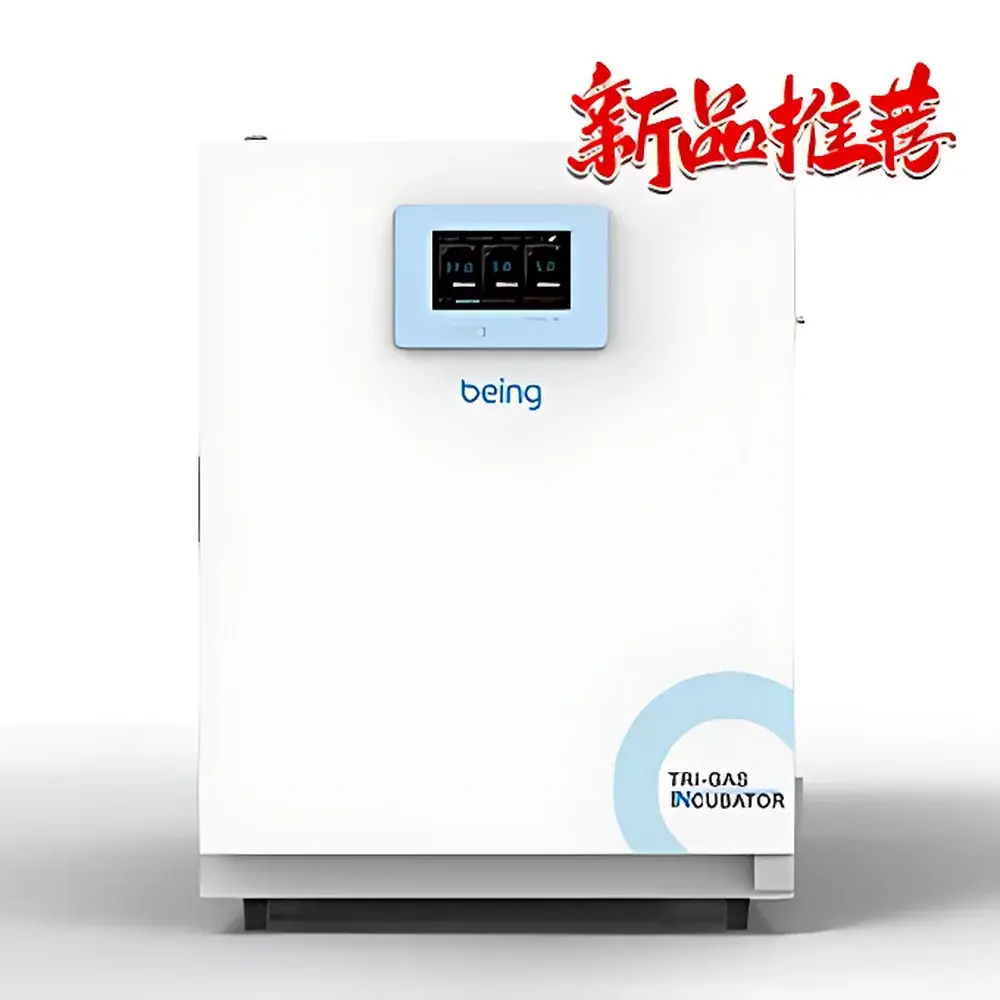
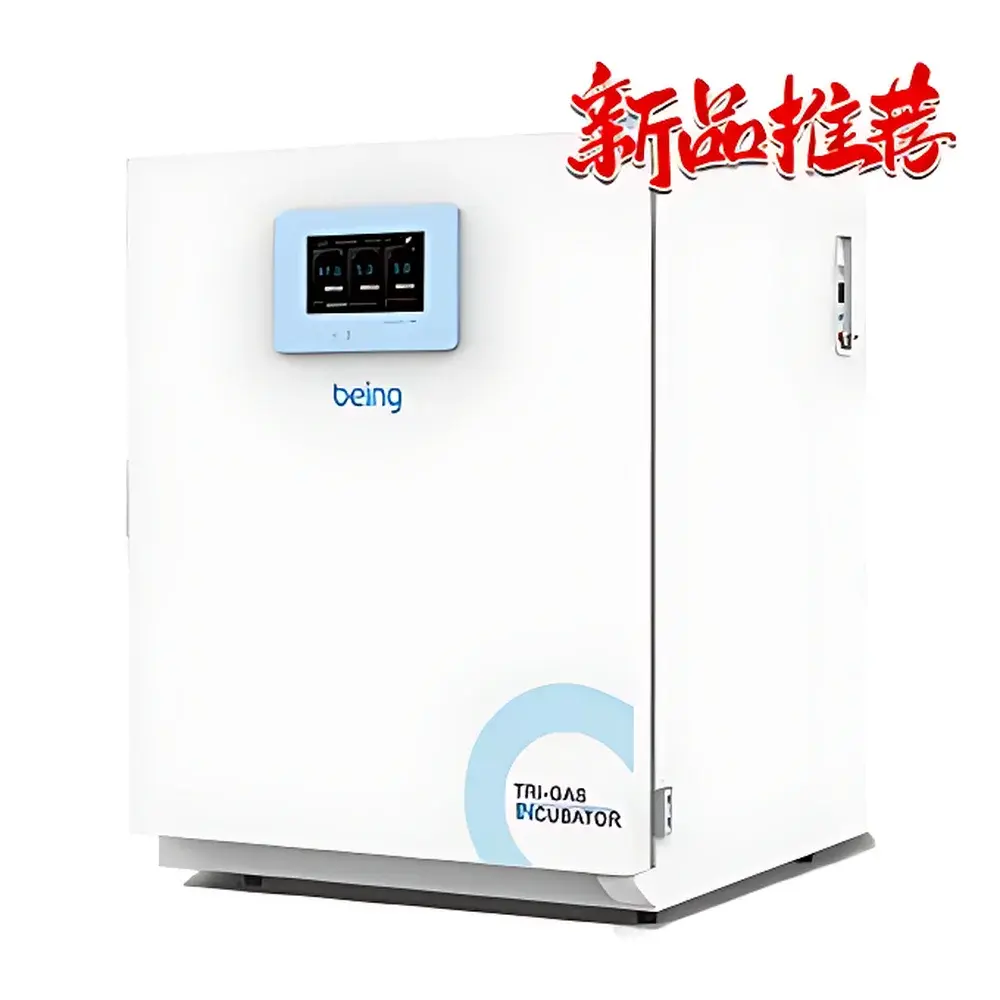
Being BIO-RHP III Series Tri-Gas Incubator
| Brand | Being |
|---|---|
| Origin | Jiangsu, China |
| Manufacturer Type | Authorized Distributor |
| Instrument Type | Air-Jacketed Tri-Gas Incubator |
| O₂ Concentration Range | 1–90% (±0.1% accuracy, zirconia sensor) |
| CO₂ Concentration Range | 0–20% (±0.1% accuracy, infrared IR sensor) |
| Temperature Control Range | RT + 3°C to 50°C |
| Temperature Uniformity | ±0.3°C at 37°C |
| Chamber Capacity | 155–233 L |
| External Dimensions (W×D×H) | 670 × 767 × 880 mm |
| Sterilization Mode | 90°C dry-heat sterilization (in situ, full-chamber) |
Overview
The Being BIO-RHP III Series Tri-Gas Incubator is an air-jacketed, microprocessor-controlled environmental chamber engineered for precise, independent regulation of oxygen (O₂), carbon dioxide (CO₂), and temperature—critical parameters in advanced cell culture workflows including hypoxia modeling, stem cell expansion, tumor spheroid formation, and microbiological anaerobe cultivation. Unlike conventional CO₂-only incubators, the BIO-RHP III employs dual gas-sensing architecture: a high-stability infrared (IR) CO₂ sensor and a linear-response zirconia-based O₂ sensor—both calibrated for long-term drift resistance and immunity to cross-interference from humidity or thermal transients. The system maintains gas setpoints via proportional solenoid valves with feedback-driven pulse-width modulation, enabling rapid recovery kinetics: CO₂ concentration re-stabilizes to ±0.1% of setpoint within 3 minutes after a 30-second door opening event. Its six-sided air-jacket heating system eliminates cold spots and condensation on inner surfaces, directly supporting GMP-aligned aseptic integrity.
Key Features
- Air-jacketed thermal design with Pt100 temperature sensing and ambient temperature compensation—ensures ±0.3°C uniformity at 37°C across full chamber volume
- Integrated 90°C dry-heat sterilization cycle—fully automated, one-touch activation; sterilizes interior surfaces, sensors, fan assembly, shelves, and support rails without disassembly
- Standard HEPA filtration (≥99.99% efficiency for ≥0.3 µm particles) on internal recirculation path, with real-time filter life monitoring on touchscreen interface
- Microbial-grade inlet filters (≥99.99% retention for ≥0.3 µm particles) on both CO₂ and O₂/N₂ supply lines—prevents introduction of airborne contaminants during gas replenishment
- Automatic dual-cylinder switching for CO₂ and O₂/N₂ supply—minimizes process interruption during cylinder changeover and ensures continuous gas delivery
- Multi-level security architecture: three-tier user access (Administrator, Operator, Guest), electronic signature capability (optional), and USB data export compliant with ALCOA+ principles
- Comprehensive alarm suite—including independent overtemperature cutoff, gas deviation alerts, door-open duration warning, and sensor fault diagnostics—with visual and audible notification
Sample Compatibility & Compliance
The BIO-RHP III supports diverse biological sample formats—including T-flasks, Petri dishes, multiwell plates, roller bottles, and bioreactor vessels—within its 155–233 L working volume. Its gas control fidelity meets ISO 13485 requirements for medical device manufacturing environments and aligns with USP recommendations for cell therapy process controls. The 90°C dry-heat sterilization protocol satisfies ISO 14644-1 Class 5 cleanroom equivalency for internal chamber decontamination. Optional UV irradiation (254 nm) provides supplementary surface disinfection of humidification pans and sloped floor reservoirs. All firmware operations—including parameter logging, alarm history, and sterilization cycle records—are timestamped and attributable per FDA 21 CFR Part 11 Annex 11 expectations when electronic signature and audit trail modules are enabled.
Software & Data Management
The 7-inch capacitive touchscreen controller runs embedded Linux-based firmware with intuitive icon-driven navigation. Real-time graphs display O₂%, CO₂%, temperature, and relative humidity (when optional RH probe installed). Historical data—covering up to 30 days of 1-minute-interval logging—is stored internally and exportable via USB flash drive in CSV format. Optional remote monitoring via iOS/Android app enables push notifications for critical alarms, live status dashboards, and configurable email/SMS alerts. All data exports include instrument ID, operator ID (if logged), timestamps, and measurement units—supporting traceability under GLP and GMP frameworks. Firmware updates are performed offline via encrypted USB media to maintain system validation integrity.
Applications
- Hypoxic and hyperoxic cell culture: modeling ischemic disease states (e.g., 1–5% O₂), wound healing (10–15% O₂), or oxidative stress studies (up to 90% O₂)
- Stem cell maintenance and differentiation: where O₂ tension directly regulates HIF-1α signaling and pluripotency markers
- Microaerophilic and capnophilic bacterial cultivation: e.g., Helicobacter pylori, Campylobacter jejuni, and Neisseria gonorrhoeae
- 3D organoid and spheroid development: requiring stable O₂ gradients and minimized pH fluctuation via precise CO₂ control
- Bioprocess development for regenerative medicine: supporting qualification of closed-system expansion protocols under ISO/IEC 17025-compliant validation
FAQ
What gas sensing technologies are used—and why do they matter for reproducibility?
The BIO-RHP III uses non-dispersive infrared (NDIR) detection for CO₂ and electrochemical zirconia cells for O₂. Both are inherently immune to interference from water vapor, temperature shifts, or background hydrocarbons—unlike thermal conductivity or paramagnetic sensors—ensuring measurement stability across long-term experiments.
How does the 90°C dry-heat cycle differ from moist-heat sterilization?
Dry-heat sterilization avoids condensation-related corrosion of sensors and electronics while achieving microbial lethality equivalent to 121°C saturated steam for spores—validated per ISO 14937 Annex C for incubator decontamination.
Is the system compatible with regulatory audit requirements?
Yes—when equipped with electronic signature and audit trail options, it supports 21 CFR Part 11 compliance through role-based access, immutable logs, and digital signature imprinting on exported reports.
Can the incubator operate continuously during gas cylinder replacement?
Yes—the integrated A/B cylinder manifold automatically switches between primary and backup gas sources without interrupting flow or altering setpoints.
What maintenance is required for the HEPA and inlet filters?
HEPA filter lifetime is dynamically calculated based on runtime and airflow; replacement prompts appear on-screen. Inlet filters are rated for ≥6 months under typical lab gas quality and require visual inspection quarterly.
Related Products



