
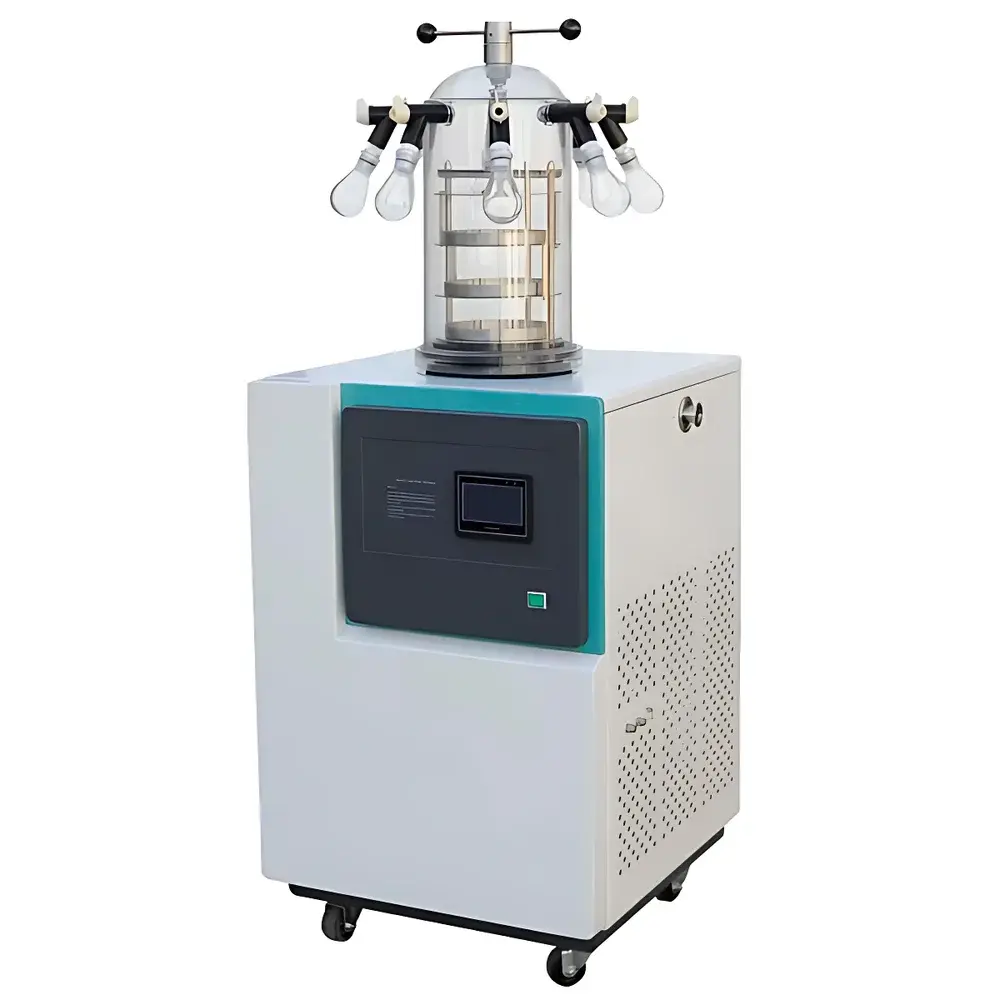
BIOCOOL FD-1A-110+ Laboratory Benchtop Freeze Dryer
| Brand | BIOCOOL |
|---|---|
| Origin | Beijing, China |
| Model | FD-1A-110+ |
| Instrument Type | Standard Shelf-Type Freeze Dryer |
| Application | Laboratory-Scale Lyophilization |
| Freeze-Drying Area | 0.12 m² |
| Ultimate Vacuum | <3 Pa |
| Condenser Temperature (No-Load) | −110 °C |
| Water Capture Capacity (24 h) | 3 L |
| Refrigeration Compressor | Imported Industrial-Grade Unit |
| Control System | PLC + Touchscreen Interface |
| Sample Temperature Monitoring | Dual PT100 Sensors |
| Optional Features | Pulse Backfill Valve (N₂/Inert Gas), Auto-Defrost, Lyophilization Curve Logging & USB Data Export, Cold Trap Pre-Freezing Function |
| Structural Design | Monolithic Drying Chamber (Welded, Leak-Proof) |
| Condenser Technology | Deep-Cold Trap with Organic Solvent Compatibility (≤95% v/v Volatile Organics) |
Overview
The BIOCOOL FD-1A-110+ is a laboratory-scale benchtop freeze dryer engineered for precision lyophilization of heat-sensitive biologicals, pharmaceuticals, and research-grade formulations containing volatile organic solvents. It operates on the fundamental principles of sublimation under deep vacuum: frozen samples are subjected to controlled primary drying (ice sublimation) and secondary drying (desorption of bound water), facilitated by a −110 °C condenser that captures water vapor and volatile organics simultaneously. Unlike conventional −50 °C or −80 °C systems, the FD-1A-110+’s ultra-low condenser temperature ensures effective trapping of low-boiling-point solvents—such as acetone, ethanol, methanol, and ethyl acetate—preventing solvent backstreaming, pump oil contamination, and chamber corrosion. Its monolithic stainless-steel drying chamber eliminates seam-related leakage risks, while the integrated cold trap pre-freezing function enables direct sample freezing inside the chamber—reducing transfer steps and minimizing thermal shock to labile matrices.
Key Features
- Ultra-low temperature condenser (−110 °C no-load) with high-efficiency capture of both water vapor and organic solvents up to 95% (v/v)
- Monolithic, fully welded drying chamber—no adhesives or gasketed joints—ensuring structural integrity and long-term vacuum integrity
- Dual PT100 temperature sensors for real-time monitoring of shelf and sample temperatures during all drying phases
- Patented baffle flow duct design optimizing vapor path geometry to reduce drying cycle time by up to 18% versus conventional configurations
- PLC-based control system with intuitive touchscreen HMI, supporting programmable multi-step drying profiles and real-time parameter logging
- Pulse-controlled inert gas backfill system (N₂ or argon) with imported solenoid valve for precise atmosphere restoration post-drying
- Auto-defrost functionality with timed condenser regeneration cycles to maintain consistent trapping efficiency over extended operation
Sample Compatibility & Compliance
The FD-1A-110+ is validated for lyophilizing aqueous solutions, suspensions, emulsions, and viscous pastes with eutectic temperatures above −20 °C. Its solvent-tolerant architecture complies with ISO 22042:2017 (freeze-drying equipment safety and performance requirements) and supports Good Manufacturing Practice (GMP) and Good Laboratory Practice (GLP) workflows when paired with optional audit-trail-capable software modules. While not FDA 21 CFR Part 11–certified out-of-the-box, the system’s data export capability (via USB) and timestamped curve logging enable full traceability for regulatory submissions. All electrical components meet IEC 61000-6-3 EMC standards; mechanical safety includes overcurrent protection, compressor overload cutoff, and pressure-relief venting.
Software & Data Management
The embedded control firmware records time-stamped process variables—including shelf temperature, condenser temperature, chamber pressure, and sample thermocouple readings—at user-configurable intervals (1–60 s). Lyophilization curves are rendered in real time and stored internally (≥100 cycles); data can be exported in CSV format via USB flash drive for offline analysis in MATLAB, Python, or commercial QC platforms. Optional upgrades include password-protected user roles, electronic signature support, and PDF report generation with metadata (operator ID, batch ID, start/stop timestamps). No cloud connectivity is included—data remains on-device unless manually exported, aligning with institutional IT security policies.
Applications
This system serves academic research labs studying protein stability, vaccine formulation, and nanocarrier development; contract development and manufacturing organizations (CDMOs) performing early-phase lyo cycle development; and quality control units validating freeze-drying protocols for analytical reference standards. It is routinely employed for drying enzyme preparations, monoclonal antibody intermediates, microbial cultures, botanical extracts, and diagnostic reagents. The −110 °C condenser makes it uniquely suited for lyophilizing solvent-based formulations such as PLGA nanoparticle dispersions in dichloromethane/water mixtures or peptide solutions in TFA-containing mobile phases—applications where standard −50 °C traps fail catastrophically due to solvent breakthrough.
FAQ
What types of organic solvents can the FD-1A-110+ safely handle?
It is validated for continuous operation with acetone, ethanol, methanol, isopropanol, acetonitrile, and ethyl acetate at concentrations ≤95% (v/v); chlorinated solvents require prior consultation due to material compatibility constraints.
Does the system support automated shelf temperature ramping during primary drying?
Yes—the PLC controller allows stepwise or linear ramping of shelf temperature based on user-defined setpoints and duration, synchronized with vacuum level thresholds.
Can I monitor sample temperature without inserting probes into vials?
The dual-sensor configuration includes one shelf-mounted sensor and one optional surface-contact probe; direct vial insertion requires separate thermocouple accessories (not included by default).
Is the condenser designed for continuous 24-hour operation?
Yes—the −110 °C condenser uses a cascade refrigeration circuit with industrial-grade compressors rated for >10,000 hours MTBF; auto-defrost cycles prevent ice accumulation without interrupting vacuum integrity.
What vacuum pump specifications are recommended for optimal performance?
A 2 L/s two-stage oil-sealed rotary vane pump is supplied; for solvent-heavy applications, an optional oil mist filter and anti-backstreaming valve are strongly advised to extend pump service life.
Related Products



