
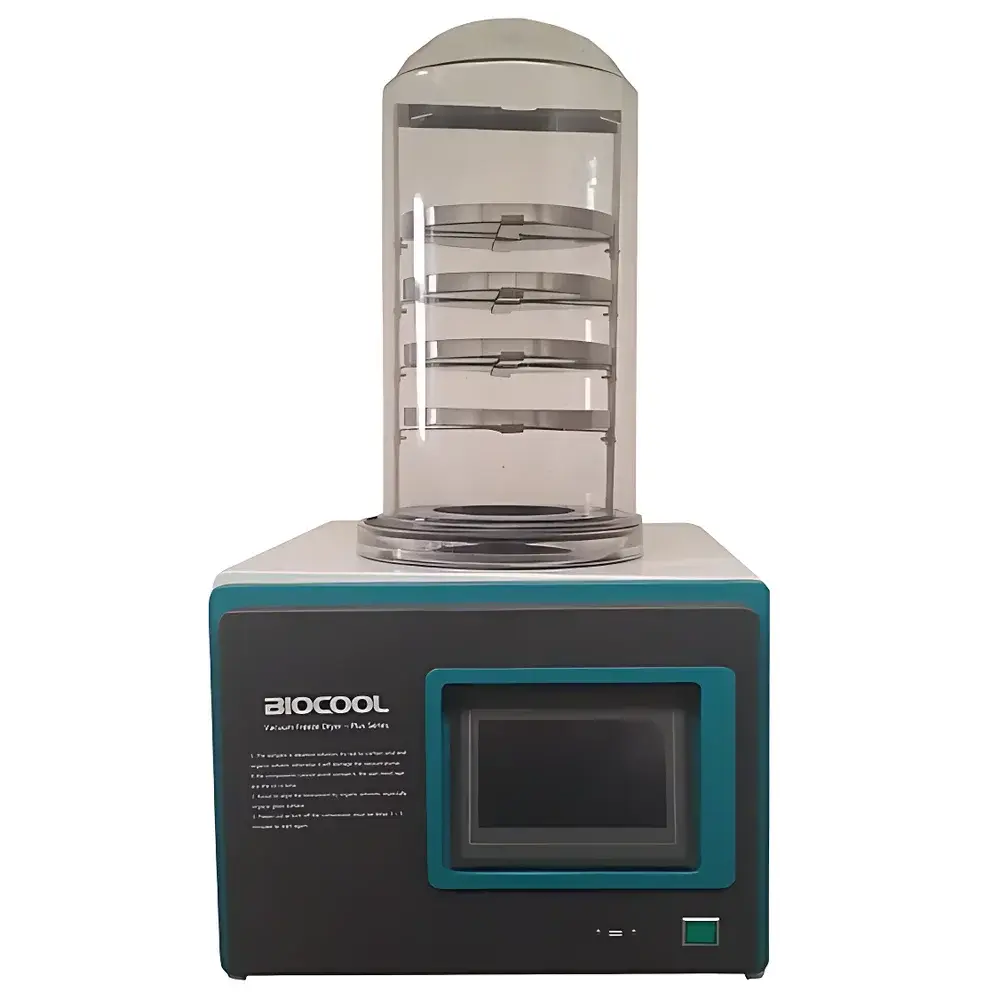
BIOCOOL FD-1C-50+ Laboratory Benchtop Freeze Dryer
| Brand | BIOCOOL |
|---|---|
| Origin | Beijing, China |
| Model | FD-1C-50+ |
| Instrument Type | Standard Shelf-Type Freeze Dryer |
| Application | Laboratory-Scale Lyophilization |
| Freeze-Drying Area | 0.12 m² |
| Ultimate Vacuum | <9 Pa |
| Condenser Temperature (No Load) | −55 °C |
| Condensate Capacity (24 h) | 3 L |
Overview
The BIOCOOL FD-1C-50+ is a compact, benchtop shelf-type laboratory freeze dryer engineered for reliable primary and secondary drying of heat-sensitive biological, pharmaceutical, and analytical samples. It operates on the fundamental principles of lyophilization—sublimation of ice under controlled low-pressure and low-temperature conditions—enabling preservation of structural integrity, bioactivity, and chemical stability in lab-scale formulations. Designed for routine use in R&D labs, QC/QA facilities, and academic research settings, the FD-1C-50+ integrates a robust refrigeration system with precise vacuum regulation and real-time thermal monitoring to deliver reproducible drying cycles across diverse sample matrices including aqueous solutions, suspensions, and pastes with eutectic temperatures above −20 °C.
Key Features
- Monolithic stainless-steel drying chamber: Seamless one-piece construction ensures structural rigidity, zero leakage risk, and compliance with ISO 13485–aligned cleanability standards.
- High-efficiency dual-stage refrigeration system: Equipped with an internationally certified hermetic compressor delivering stable condenser performance at −55 °C (no-load), optimized for rapid ice capture and minimal thermal drift.
- Cold trap pre-freezing capability: Enables simultaneous sample freezing and condenser cooldown prior to vacuum initiation—reducing total cycle time and minimizing thermal shock to sensitive biomolecules.
- Dual Pt100 temperature sensors: Monitor both shelf surface and sample core temperature in real time; data logged at user-defined intervals (1–60 s) for process traceability.
- Graphical lyophilization curve recording: Built-in PLC controller plots and stores time–temperature–pressure profiles; curves exportable via USB interface for post-process analysis or regulatory documentation.
- Intelligent hot-gas defrost system: Uses controlled refrigerant reversal for uniform, residue-free defrosting—eliminating manual intervention and reducing downtime between batches.
- Inert gas backfill option: Integrated high-purity solenoid valve supports nitrogen or argon purging post-drying to prevent oxidation and support aseptic handling under Class A/B cleanroom conditions.
Sample Compatibility & Compliance
The FD-1C-50+ accommodates standard Ø200 mm sample trays (four-layer configuration) and is compatible with vial-based formats when used with optional multi-port manifolds. It supports lyophilization of water-based formulations—including protein solutions, enzyme preparations, microbial cultures, and diagnostic reagents—provided their collapse or eutectic temperature exceeds −20 °C. The system meets essential mechanical safety requirements per IEC 61010-1 and incorporates overcurrent, overload, and temperature-limit protection circuits. While not certified to FDA 21 CFR Part 11 out-of-the-box, its data logging architecture (with timestamped, non-editable .csv exports) supports GLP/GMP-aligned documentation workflows when paired with validated SOPs and external audit trails.
Software & Data Management
Control is executed via an industrial-grade 7-inch resistive touchscreen HMI running embedded PLC firmware. All operational parameters—including shelf setpoints, vacuum ramp rates, hold durations, and defrost triggers—are programmable and stored in non-volatile memory. Each batch generates a unique log file containing full sensor history, event timestamps (e.g., pump start/stop, defrost initiation), and alarm records. Data export occurs exclusively via USB 2.0 port in comma-separated format (.csv), compatible with Excel, MATLAB, and LIMS platforms. Optional integration with third-party SCADA systems is supported through Modbus RTU (RS485) protocol.
Applications
- Pharmaceutical development: Stabilization of monoclonal antibodies, vaccines, and peptide APIs prior to stability testing per ICH Q5C guidelines.
- Biotechnology: Preservation of cell lysates, plasmid DNA, and CRISPR-Cas reagents without activity loss.
- Food science: Dehydration of probiotic cultures, natural extracts, and flavor compounds while retaining volatile organoleptic profiles.
- Environmental testing: Preparation of soil/water extracts for GC-MS or ICP-MS analysis where solvent removal must avoid analyte degradation.
- Academic research: Routine lyophilization of calibration standards, reference materials, and teaching-lab specimens requiring long-term archival integrity.
FAQ
What is the maximum sample volume this unit can process per cycle?
With a 0.12 m² drying area and typical loading density of 5–8 mm liquid depth, the FD-1C-50+ handles up to ~1.2 L of aqueous solution per batch—assuming optimal sublimation front progression and no vapor choking.
Does the system support automated cycle development?
No built-in PAT (Process Analytical Technology) tools such as tunable diode laser absorption spectroscopy (TDLAS) or capacitance manometry are included; however, the open .csv export format enables integration with external modeling software for empirical cycle optimization.
Is validation documentation available for IQ/OQ protocols?
BIOCOOL provides factory test reports (FAT), electrical safety certificates, and component traceability sheets. Full GMP-compliant IQ/OQ documentation requires engagement with authorized service partners and is delivered separately upon request.
Can the condenser temperature be lowered further than −55 °C?
The FD-1C-50+ is configured for −55 °C nominal condenser operation. Lower temperatures (e.g., −85 °C) require hardware upgrades (FD-1C-80+ variant) involving enhanced compressor staging and larger heat exchangers—not retrofittable to the −50+ model.
What maintenance intervals are recommended for the vacuum pump?
For the included 2 L/s domestic oil-sealed rotary vane pump, oil replacement is advised every 500 operating hours or quarterly—whichever occurs first—using ISO VG 100 synthetic vacuum oil; optional oil mist filter extends pump life and reduces lab ambient contamination.



