
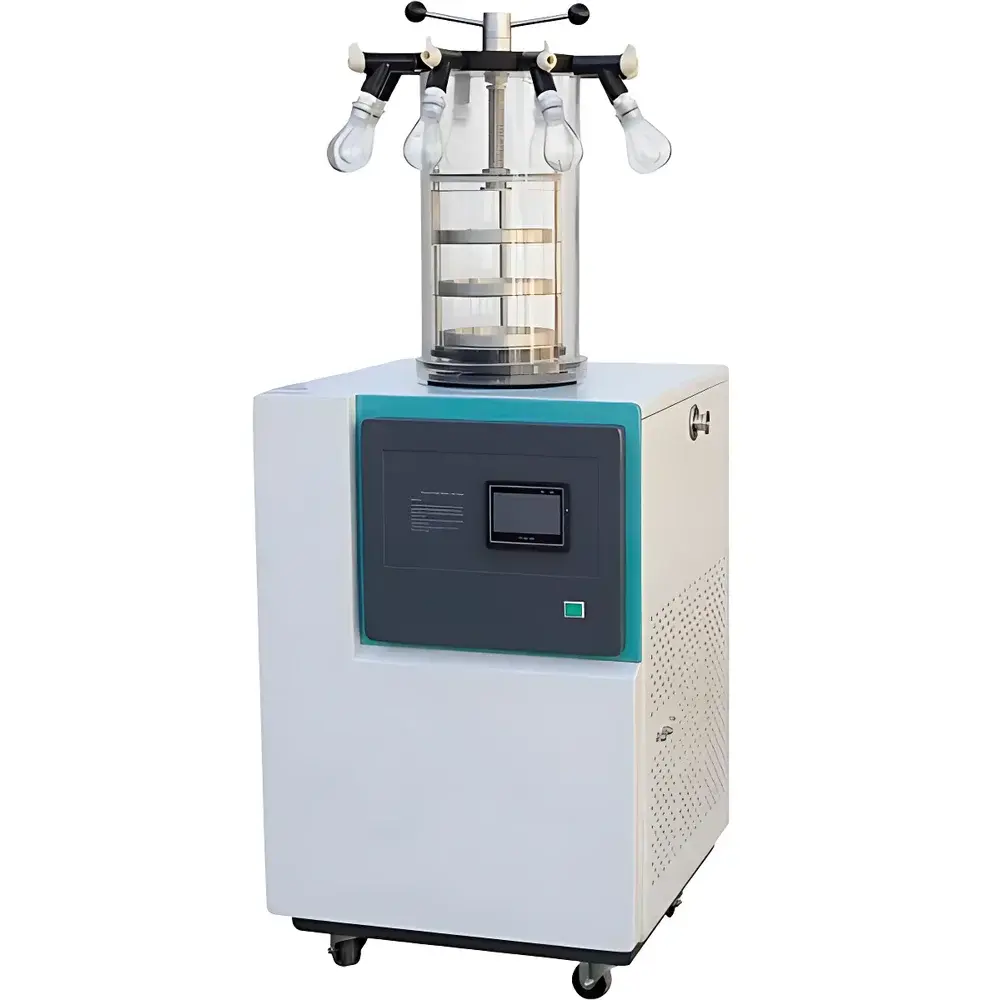
BIOCOOL Lab-1D-110E Laboratory Benchtop Freeze Dryer
| Brand | BIOCOOL |
|---|---|
| Origin | Beijing, China |
| Model | Lab-1D-110E |
| Instrument Type | Standard Shelf-Type Freeze Dryer |
| Application | Laboratory-Scale Lyophilization |
| Lyophilization Area | 0.08 m² |
| Ultimate Vacuum | <3 Pa |
| Condenser Temperature | −110 °C |
| Condensate Capacity (24 h) | 3 L |
| Refrigeration System | Industrial Scroll Compressor |
| Vacuum Pump | Korean-Made Rotary Vane Pump (2 L/s) |
| Control System | PLC + 7″ Industrial Touchscreen HMI |
| Data Logging | Internal Memory (90 days), USB Storage (optional), PC Database Integration (optional) |
| Safety Features | Overcurrent/Overload Protection, 36 V Low-Voltage Heating Circuit, Dual-Temperature Overheat Cut-off, Vacuum Interlock for Drain Valve |
Overview
The BIOCOOL Lab-1D-110E is a laboratory-grade benchtop freeze dryer engineered for reproducible, process-controlled lyophilization of heat-sensitive biologicals, pharmaceuticals, and organic-solvent-based formulations. It operates on the fundamental principles of sublimation under deep vacuum and low-temperature condensation—where frozen water or volatile solvents are removed directly from the solid phase without passing through the liquid state. The system integrates a −110 °C cryogenic condenser capable of capturing not only water vapor but also low-boiling organic solvents (e.g., ethanol, acetone, acetonitrile), making it uniquely suited for lyophilizing samples containing up to 95% (v/v) organic solvent. Its all-acrylic drying chamber—constructed from aerospace-grade, seamless polymethyl methacrylate (PMMA)—ensures structural integrity, optical clarity, and zero risk of vacuum leakage or solvent-induced stress cracking. Designed for GLP-compliant workflows, the Lab-1D-110E supports full traceability via time-stamped, 50-ms-resolution monitoring of shelf temperature, condenser temperature, and chamber pressure.
Key Features
- Deep-cold condenser at −110 °C enables efficient capture of water and volatile organic solvents (VOCs), preventing pump oil contamination and extending vacuum system service life.
- Seamless PMMA drying chamber with no adhesive joints—certified leak-tight per ISO 20487:2020 Annex B for vacuum integrity testing.
- Programmable PLC-based control architecture with 7″ industrial touchscreen interface; supports user-defined freeze-drying cycles with up to 500 stored protocols.
- Shelf heating system utilizes PID-fuzzy logic control with dual thermal sensors and real-time thermal loop monitoring; heating voltage limited to 36 V for intrinsic electrical safety.
- Non-electric, gas-assisted auto-defrost system eliminates resistive heating elements—reducing fire hazard and condenser thermal shock while achieving <15-minute defrost-to-ready recovery.
- Optional pulse backfill system offers three controlled inert-gas (N₂ or Ar) reintroduction rates—preventing collapse, powder dispersion, or particle loss in fragile amorphous matrices.
- Integrated vacuum regulation module (optional) enables dynamic pressure control during primary and secondary drying stages, mitigating boil-over, foaming, or vial breakage in high-viscosity or surfactant-rich formulations.
Sample Compatibility & Compliance
The Lab-1D-110E accommodates vial-based, bulk, and external manifold-loaded samples. It is validated for aqueous solutions, suspensions, emulsions, and organic-aqueous mixtures with eutectic temperatures ≥ −20 °C. All wetted surfaces comply with USP polymer classification requirements. The system meets CE Machinery Directive 2006/42/EC and conforms to IEC 61000-6-2/6-4 for electromagnetic compatibility. Optional calibration kits support NIST-traceable temperature (±0.3 °C) and vacuum (±0.1 Pa) validation per ASTM E2500-13 and FDA 21 CFR Part 11 data integrity guidelines when paired with PC database logging.
Software & Data Management
Data acquisition occurs at 50 ms intervals across all critical parameters—shelf temperature (PT100), condenser temperature (PT100), and chamber pressure (capacitance manometer). Raw data is timestamped and stored internally for up to 90 days. Optional USB export enables CSV-formatted datasets compatible with MATLAB, Python pandas, or commercial statistical process control (SPC) platforms. PC remote monitoring (up to 1.5 km via RS485/Ethernet gateway) provides real-time access to operational status, alarm history, and live curve visualization. Audit trails—including user login, parameter edits, cycle starts/stops, and calibration events—are retained with immutable timestamps, satisfying ALCOA+ principles for regulated environments.
Applications
- Stabilization of monoclonal antibodies, vaccines, and enzyme preparations prior to long-term storage.
- Lyophilization of small-molecule APIs dissolved in ethanol/water or DMSO/water systems.
- Preparation of reference standards and certified reference materials (CRMs) requiring minimal thermal degradation.
- R&D-scale formulation development for nasal sprays, injectables, and diagnostic reagents.
- Drying of botanical extracts, probiotics, and microbial cultures where residual solvent removal is critical.
- Processing of forensic or environmental samples containing volatile organics prior to GC-MS analysis.
FAQ
What types of organic solvents can be safely lyophilized using the Lab-1D-110E?
The −110 °C condenser effectively traps methanol, ethanol, acetone, isopropanol, acetonitrile, and ethyl acetate. Solvents with boiling points >100 °C (e.g., DMSO, DMF) require extended primary drying times and are supported subject to concentration limits and condenser loading calculations.
Is the system compliant with FDA 21 CFR Part 11 for electronic records?
Yes—when configured with optional PC database logging, user authentication, electronic signatures, and audit trail export, the system satisfies Part 11 requirements for closed systems under GxP-regulated laboratories.
Can the Lab-1D-110E perform in-situ freezing?
Yes—the shelf and condenser operate independently; the system supports pre-freezing of samples directly on shelves prior to vacuum application, eliminating the need for external ultra-low temperature freezers.
What maintenance intervals are recommended for the vacuum pump?
The Korean rotary vane pump requires oil replacement every 500 operating hours or annually—whichever occurs first—and installation of an optional oil mist filter to prevent hydrocarbon backstreaming into the chamber.
Does the unit support IQ/OQ documentation packages?
BIOCOOL provides customizable Installation Qualification (IQ) and Operational Qualification (OQ) templates aligned with ISO 9001:2015 and ASTM E2500-13; site-specific protocol execution and witness support are available as part of extended service contracts.



