
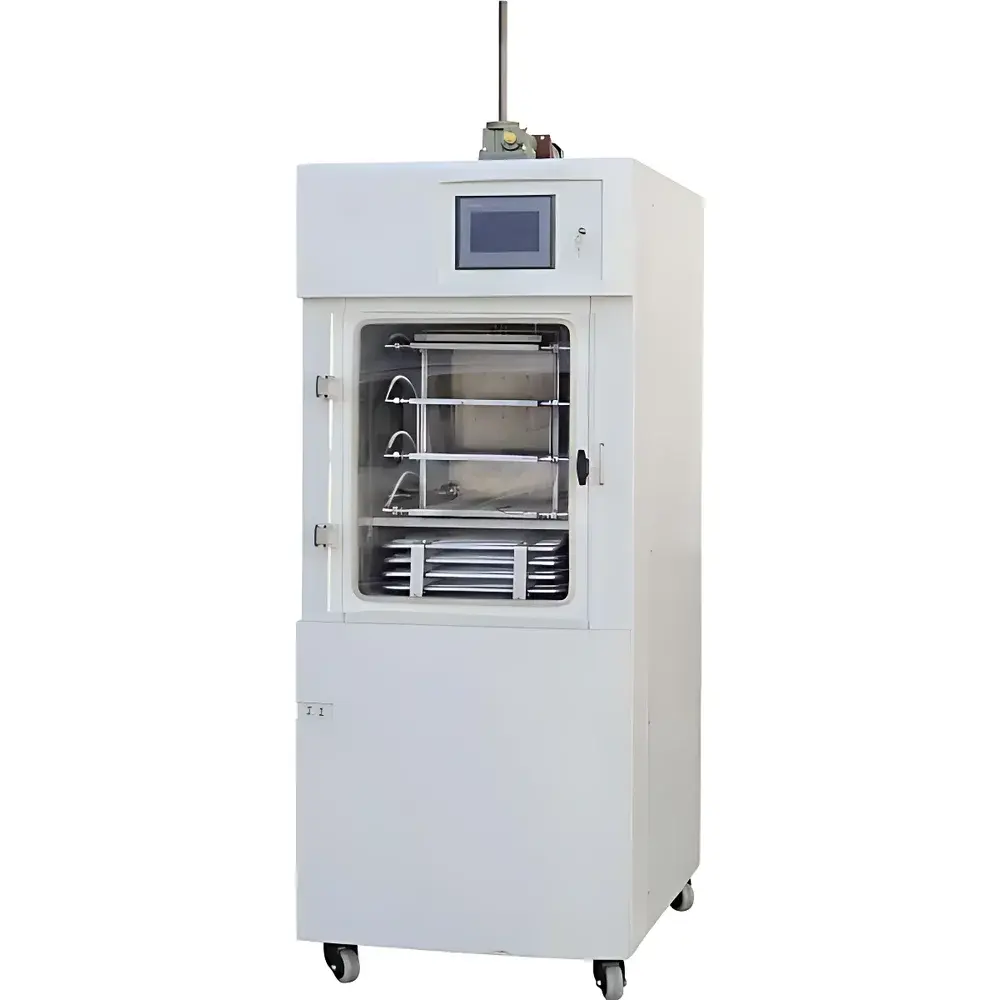
BIOCOOL Pilot10-15L Pilot-Scale Freeze Dryer
| Brand | BIOCOOL |
|---|---|
| Origin | Beijing, China |
| Model | Pilot10-15L |
| Type | Standard Shelf-Type Freeze Dryer |
| Application | Pilot-Scale Production |
| Lyophilization Area | 1.0 m² |
| Ultimate Vacuum | ≤3 Pa |
| Condensation Capacity | 15 L/24h |
| Cold Trap Temperature | <−55 °C |
Overview
The BIOCOOL Pilot10-15L is a robust, industrial-grade pilot-scale freeze dryer engineered for reproducible lyophilization of pharmaceuticals, biologics, diagnostics, and high-value research materials under controlled, scalable conditions. Based on the fundamental principles of sublimation—where ice is removed directly from the frozen matrix under deep vacuum without passing through the liquid phase—the system delivers precise thermal and vacuum management across primary and secondary drying stages. Its 1.0 m² shelf area supports batch processing of up to 10–15 L of aqueous or semi-viscous formulations per cycle, bridging the critical gap between laboratory feasibility studies and commercial manufacturing validation. Designed for GLP-compliant environments, the unit integrates process-critical subsystems—including programmable shelf temperature control, real-time vacuum regulation (optional), and endpoint determination (optional)—to support ICH Q5C stability requirements and USP lyophilization guidance.
Key Features
- Aerospace-grade acrylic chamber door: Seamless, leak-tight construction with zero adhesive bonding ensures long-term vacuum integrity and optical clarity for in-process observation.
- Shelf pre-freezing capability: Enables uniform sample freezing directly on temperature-controlled shelves—eliminating reliance on external ultra-low freezers and reducing thermal history variability.
- Dual-stage refrigeration system: Utilizes internationally certified compressors and a silicone oil circulation loop for stable, low-noise shelf temperature control (−40 °C to +60 °C) with ±0.5 °C accuracy.
- High-efficiency cold trap: Achieves ≤−55 °C operating temperature with ≥15 L/24h condensation capacity; optimized for water vapor load during extended primary drying cycles.
- Non-electric defrost mechanism: Patented mechanical defrost system avoids thermal shock to cold trap components and eliminates electrical hazards associated with resistive heating—reducing downtime and maintenance frequency.
- Automated stoppering actuator: Motor-driven vertical motion control ensures consistent, repeatable compression force for rubber stopper seating in vials—critical for sterility assurance and container closure integrity (CCI) testing alignment.
- Fuzzy PID shelf temperature algorithm: Delivers dynamic response to load-dependent thermal inertia, minimizing overshoot and improving drying homogeneity across large-area shelves.
- Industrial HMI touchscreen interface: Intuitive 10.1″ capacitive display with multi-language support; operation requires no manual reference—process initiation, parameter adjustment, and alarm acknowledgment are fully icon-driven.
Sample Compatibility & Compliance
The Pilot10-15L accommodates standard 2R–50R serum vials, trays, and open containers for bulk drying of solutions, suspensions, emulsions, and pastes. It is validated for formulations with eutectic temperatures above −20 °C (−50 °C cold trap configuration) and supports optional organic solvent trapping for excipient systems containing acetone, ethanol, or tert-butanol. All vacuum and temperature sensors comply with ISO/IEC 17025 traceability standards; built-in calibration routines enable on-site verification of shelf temperature (±0.3 °C) and vacuum transducer (±5% full scale). The system architecture supports 21 CFR Part 11 compliance when configured with PC database storage, electronic signatures, and audit-trail-enabled software (optional). Safety certifications include CE marking, UL 61010-1, and IP22 enclosure rating.
Software & Data Management
Embedded control firmware enables full-cycle automation—from freezing ramping and hold steps to primary drying slope monitoring and secondary drying endpoint detection (optional). Up to 500 user-defined lyophilization protocols can be stored locally, each supporting multi-segment ramp/hold profiles with independent vacuum setpoints per phase. Real-time data acquisition occurs at 50 ms intervals for shelf temperature, product thermocouple (optional), chamber pressure, and condenser temperature. Data logging options include internal flash memory (retains ≥90 days of continuous operation), USB export (FAT32 formatted drives), and secure TCP/IP transmission to SQL-based enterprise databases. Optional PC remote monitoring allows supervisory access within 1.5 km via Ethernet or fiber-optic link—with encrypted session handshaking and role-based permission levels.
Applications
- Process development and scale-up of monoclonal antibodies, vaccines, and mRNA-LNPs.
- Stability batch production for ICH Q1–Q5 regulatory submissions.
- Lyophilized diagnostic reagent manufacturing (ELISA kits, lateral flow assays).
- Preservation of microbial cultures, enzymes, and probiotic strains requiring low-residual moisture (<1.5%).
- Academic and contract research organization (CRO) services requiring GMP-aligned documentation packages.
- Formulation screening of cryoprotectants and bulking agents under variable shelf-ramp rates and vacuum modulation.
FAQ
What is the maximum allowable sample volume per batch on the Pilot10-15L?
The system supports up to 15 L of total liquid volume across its 1.0 m² shelf area—subject to vial fill depth, formulation viscosity, and desired residual moisture specifications.
Does the unit support vacuum-controlled drying for heat-sensitive APIs?
Yes—optional vacuum regulation enables dynamic pressure control during both primary and secondary drying, mitigating collapse, melt-back, or foaming in low-Tg formulations.
Can the freeze dryer be integrated into a cleanroom environment?
The unit meets ISO Class 8 (Class 100,000) compatibility requirements; optional HEPA-filtered nitrogen purge and oil-free vacuum pump configurations are available for Grade A/B environments.
Is calibration documentation provided upon installation?
Yes—factory calibration certificates for all critical sensors (shelf thermistors, Pirani and capacitance manometers) are included, with NIST-traceable references and as-found/as-left data.
What maintenance intervals are recommended for long-term reliability?
Compressor oil and filter replacement every 3,000 operating hours; cold trap cleaning after every 100 cycles or when frost accumulation exceeds 80% capacity; annual full-system performance verification recommended.



