
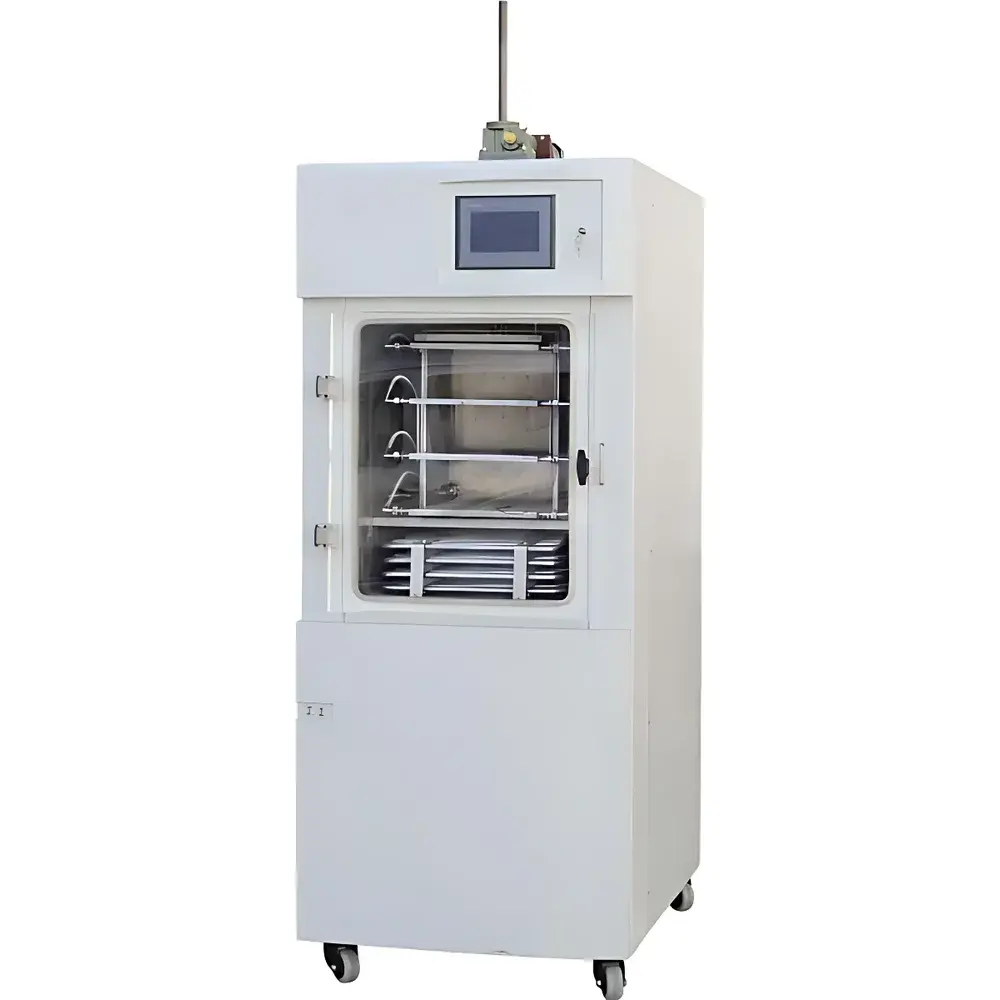
BIOCOOL Pilot3-6M Pilot-Scale Freeze Dryer
| Brand | BIOCOOL |
|---|---|
| Origin | Beijing, China |
| Model | Pilot3-6M |
| Type | Shelf-Type Freeze Dryer |
| Application | Pilot-Scale Processing |
| Freeze-Drying Area | 0.35 m² |
| Ultimate Vacuum | ≤3 Pa |
| Condensation Capacity | 6 L/24 h |
| Cold Trap Temperature | <−85 °C |
Overview
The BIOCOOL Pilot3-6M is a robust, industrial-grade pilot-scale freeze dryer engineered for reproducible lyophilization of pharmaceuticals, biologics, diagnostics, and high-value research materials under controlled, scalable conditions. Based on the fundamental principles of sublimation—where ice is removed directly from the frozen matrix under deep vacuum without passing through the liquid phase—the system integrates precision thermal management, high-efficiency condensation, and programmable process control to bridge laboratory development and small-batch GMP manufacturing. Designed for applications requiring validation-ready operation, the Pilot3-6M features a stainless steel drying chamber with an aviation-grade acrylic viewing door (leak-tight, non-adhesive construction), silicone oil–circulated shelf heating/cooling, and a −85 °C cold trap capable of capturing up to 6 liters of water vapor over 24 hours. Its ultimate vacuum performance (≤3 Pa) ensures efficient primary drying across a broad range of formulations, including aqueous solutions, suspensions, and pastes with eutectic points above −40 °C.
Key Features
- Shelf temperature control via PID-regulated silicone oil circulation, with operating range from −55 °C to +70 °C and ±0.5 °C uniformity across shelves.
- Integrated automatic stoppering system with programmable vertical actuation—enabling precise, repeatable closure of vials without manual intervention or pressure inconsistency.
- Non-electric cold trap defrosting mechanism—eliminates thermal shock to components, reduces downtime, and avoids safety hazards associated with resistive heating.
- Dual-mode operation: Manual mode supports empirical process development with real-time parameter override; Automatic mode executes preloaded, validated protocols with full sequence logic (pre-freeze → primary drying → secondary drying → purge → stopper seal).
- Industrial 10.1″ touchscreen HMI with intuitive workflow navigation, multilingual UI support, and embedded help overlays—designed for operator efficiency without reference documentation.
- Real-time data acquisition at 50 ms sampling intervals for shelf temperature, product thermocouple signals (if configured), chamber pressure, and cold trap temperature.
- Comprehensive safety architecture including overcurrent protection, compressor overload cutoff, shelf overtemperature lockout, vacuum interlock during drain cycles, and vacuum pump anti-backflow safeguards.
Sample Compatibility & Compliance
The Pilot3-6M accommodates standard pharmaceutical containers—including 10–30 mL serum vials, trays, and custom molds—within its 0.35 m² shelf area and 100 mm shelf spacing. It supports lyophilization of heat-labile proteins, monoclonal antibodies, vaccines, enzyme preparations, and sterile APIs where residual moisture must be reduced to ≤1–2 wt% per USP and Ph. Eur. 2.9.39. Optional accessories extend compliance capability: a calibrated eutectic point tester enables formulation-specific cycle design; an organic solvent trap permits safe drying of acetone-, ethanol-, or DMSO-based systems; and a vacuum regulation module allows dynamic pressure modulation (1–50 Pa) during both primary and secondary drying—critical for preventing collapse, bubbling, or melt-back in sensitive matrices. The system meets mechanical and electrical safety requirements per IEC 61010-1 and is compatible with GLP/GMP environments when paired with optional 21 CFR Part 11–compliant PC database logging and audit trail functionality.
Software & Data Management
The embedded control software supports storage of up to 500 user-defined lyophilization protocols—including ramp rates, hold times, pressure setpoints, and shelf temperature profiles—with version timestamping and operator ID tagging. Data logging options include internal flash memory (retention capacity equivalent to three months of continuous operation), USB export (FAT32-formatted drives), and networked PC database integration via Ethernet (SQL-compatible schema). All recorded parameters—including time-stamped shelf temperature curves, vacuum transients, and condenser load trends—are exportable in CSV format for statistical process analysis (e.g., PCA, multivariate trend monitoring). Optional remote monitoring enables secure web-based access to real-time status, alarms, and historical logs within a 1.5 km line-of-sight radius—facilitating centralized facility oversight without compromising cybersecurity boundaries.
Applications
- Pharmaceutical process development: Scale-up from benchtop (e.g., Labconco FreeZone) to pilot batches (50–500 g API per run) prior to clinical trial material production.
- Vaccine stabilization: Lyophilization of viral vectors, mRNA-LNPs, and adjuvanted antigens requiring strict thermal history control and low residual moisture.
- Biomaterial preservation: Long-term storage of stem cells, exosomes, and tissue-engineered constructs without cryoprotectant-induced osmotic stress.
- Diagnostic reagent manufacturing: Stabilization of ELISA kits, lateral flow assay components, and PCR master mixes for ambient-temperature distribution.
- Academic and contract research: Reproducible freeze-drying of novel nanocarriers, hydrogels, and peptide conjugates under publication-grade documentation standards.
FAQ
What is the maximum batch size supported by the Pilot3-6M?
The system is rated for up to 3 kg of frozen material (assuming ~10% solids content), corresponding to approximately 300–500 standard 10-mL vials per cycle.
Does the system support IQ/OQ documentation support?
Yes—BIOCOOL provides factory-verified calibration certificates for temperature sensors and vacuum transducers, along with URS-aligned test protocols for Installation Qualification (IQ) and Operational Qualification (OQ) execution on-site.
Can the Pilot3-6M be integrated into a cleanroom environment?
The unit complies with ISO 14644-1 Class 8 (100,000) particulate limits when installed with HEPA-filtered exhaust routing and static-dissipative flooring; optional stainless steel cladding and passivation are available upon request.
Is nitrogen backfilling supported during the final drying stage?
Yes—the system includes a dedicated inert gas inlet port with mass flow controller integration, enabling programmable N₂ or argon backfill at adjustable rates (slow/medium/fast) to prevent powder dispersion during vial sealing.
What maintenance intervals are recommended for long-term reliability?
Compressor oil and refrigerant checks every 12 months; vacuum pump oil replacement every 500 operational hours; cold trap cleaning and O-ring inspection every 200 cycles; full calibration verification annually or after any major component service.



