
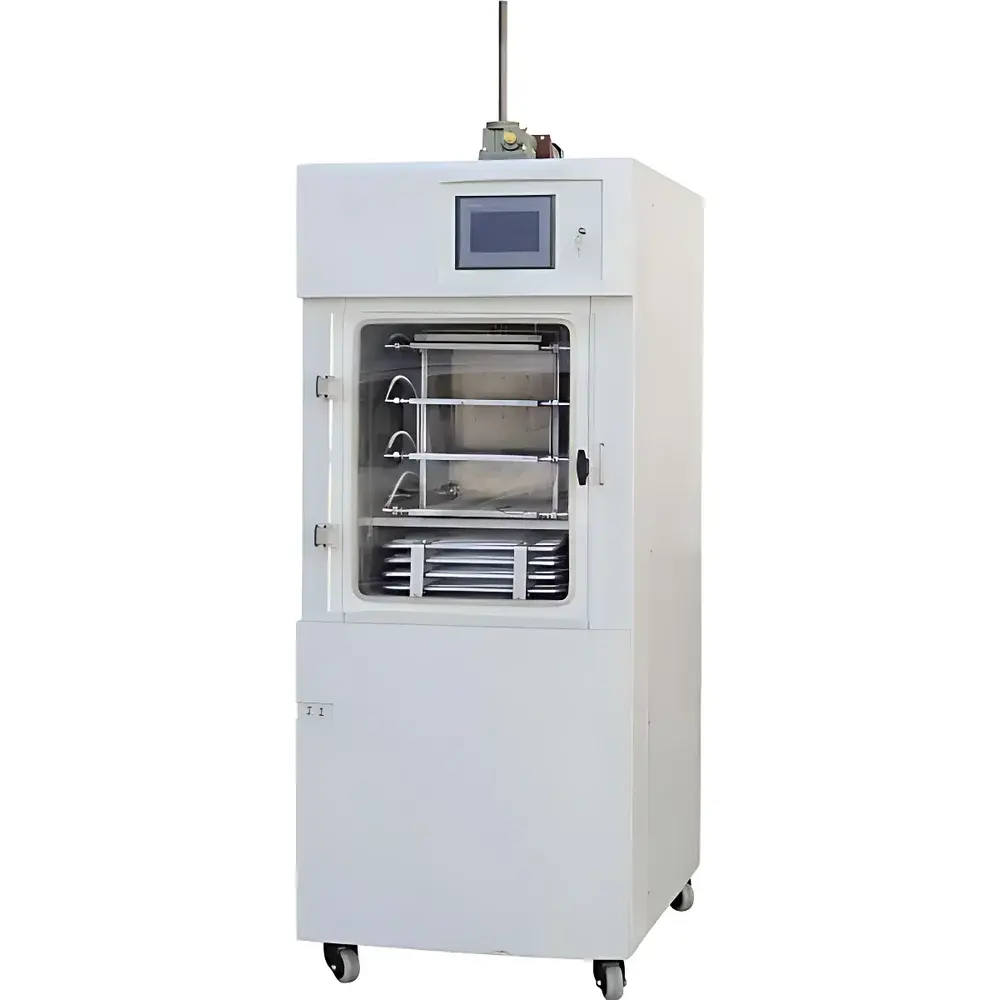
BIOCOOL Pilot7-12L Pilot-Scale Freeze Dryer
| Brand | BIOCOOL |
|---|---|
| Origin | Beijing, China |
| Model | Pilot7-12L |
| Type | Standard Shelf-Type Freeze Dryer |
| Application | Pilot-Scale Production |
| Freeze-Drying Area | 0.8 m² |
| Ultimate Vacuum | ≤3 Pa |
| Condensation Capacity | 12 L/24 h |
| Cold Trap Temperature | <−55 °C |
| Shelf Temperature Range (Empty) | −40 °C to +60 °C |
| Shelf Cooling Method | Silicone Oil Circulation |
| Compressor Power | 3 HP |
| Vacuum Pump Speed | 4 L/s |
| Shelf Spacing | 80 mm |
| Control Interface | Industrial Touchscreen HMI |
| Data Storage | Internal (3-month buffer), USB (optional), PC Database (optional) |
| Compliance | Designed for GLP/GMP-aligned process development and scale-up |
Overview
The BIOCOOL Pilot7-12L is a pilot-scale, shelf-type freeze dryer engineered for reproducible, scalable lyophilization of pharmaceuticals, biologics, diagnostics, and functional food formulations. It operates on the fundamental principles of sublimation under controlled low-pressure and low-temperature conditions: frozen water in the sample transitions directly from solid to vapor phase without passing through liquid, preserving structural integrity, biological activity, and chemical stability. With a validated freeze-drying area of 0.8 m² and a condensation capacity of 12 L per 24 hours, the system bridges the gap between laboratory feasibility studies and commercial manufacturing—supporting batch sizes typical of Phase II/III clinical trial material production or small-batch cGMP intermediate processing. Its silicone oil–circulated shelf system ensures uniform temperature distribution (±1.5 °C across shelves), critical for consistent drying kinetics and residual moisture control. The cold trap maintains ≤−55 °C under load, enabling efficient capture of both bulk water and low-volatility solvents commonly encountered in formulation development.
Key Features
- Optically clear aerospace-grade acrylic chamber door—leak-tight, non-adhesive construction with high impact resistance and UV stability.
- Shelf pre-freezing capability: shelves cool to −40 °C prior to loading, eliminating secondary freezing steps and reducing thermal shock to heat-sensitive samples.
- Dual-stage refrigeration architecture with internationally certified compressors—high efficiency, low acoustic emission (<62 dB[A]), and extended service life under continuous operation.
- High-speed, oil-lubricated vacuum pump (4 L/s nominal pumping speed) with integrated anti-backstreaming valve to prevent oil contamination of the drying chamber and cold trap.
- Fully programmable freeze-drying control system supporting up to 500 user-defined or factory-stored lyo cycles; includes stepwise ramping, hold, and pressure-controlled drying phases.
- Fuzzy PID-controlled shelf heating with real-time thermal loop monitoring and overtemperature cutoff—ensures precise energy delivery during primary and secondary drying.
- Non-electric cold trap defrosting: uses internal pressure equalization and controlled ambient air purge—eliminates electrical hazards, reduces downtime, and avoids thermal stress on condenser coils.
- Motorized automatic stoppering mechanism compatible with standard 10–30 mL serum vials; programmable force and stroke depth ensure consistent seal integrity without manual intervention.
- Optional endpoint determination module: performs dynamic pressure rise tests (DPR) during desorption drying to objectively confirm completion based on vapor pressure equilibrium criteria (ASTM F2370-18 compliant methodology).
- Modular vacuum regulation system (optional): enables dynamic backfilling with N₂ or inert gas at user-defined setpoints—mitigates boil-over, collapse, and particle dispersion in sensitive amorphous matrices.
Sample Compatibility & Compliance
The Pilot7-12L accommodates aqueous solutions, suspensions, emulsions, and viscous pastes with eutectic temperatures above −20 °C (standard −55 °C configuration). For formulations containing organic co-solvents (e.g., ethanol, acetone), optional solvent traps are available to protect the vacuum pump and maintain long-term system integrity. All wetted surfaces contact-grade 316L stainless steel or electropolished AISI 304 components—fully traceable and passivation-certified. The system supports audit-ready documentation per FDA 21 CFR Part 11 requirements when configured with PC-based database logging (including electronic signatures, audit trails, and role-based access control). It is routinely deployed in laboratories operating under ISO 9001, ISO 13485, and ICH Q5C/Q8 frameworks for stability-indicating process validation.
Software & Data Management
An embedded industrial touchscreen HMI provides intuitive cycle navigation, real-time parameter visualization (shelf temp, chamber pressure, condenser temp, time), and alarm management—all updated at 50 ms intervals. Process data—including temperature profiles, vacuum trends, and power consumption—are logged internally for ≥90 days. Optional USB export enables CSV-formatted datasets for offline analysis in MATLAB, JMP, or Python-based modeling tools. When connected to a local network, the optional PC remote monitoring interface permits live status viewing and limited parameter adjustment up to 1.5 km via secure TCP/IP protocol. Calibration logs for shelf sensors and Pirani capacitance manometers are stored separately and support traceability to NIST-traceable references. Firmware updates preserve all user recipes and historical logs.
Applications
- Process development and optimization for parenteral biologics (mAbs, vaccines, gene therapies)
- Stability batch production for accelerated and real-time ICH storage studies
- Lyophilized diagnostic reagent kits requiring strict moisture control (<1.0% w/w)
- Preservation of probiotic cultures, enzymes, and labile natural extracts
- Scale-down modeling for commercial freeze-dryer qualification (IQ/OQ/PQ)
- Academic research on cryoprotectant screening, collapse temperature mapping, and mass transfer kinetics
FAQ
What is the maximum batch volume this unit can handle in a single run?
With 0.8 m² of shelf area and typical loading density of 10–15 mL per 100 cm², the Pilot7-12L supports 8–12 L of aqueous solution per cycle—consistent with its 12 L/24 h condensation rating.
Does the system comply with GMP documentation requirements?
Yes—when equipped with optional PC database logging and electronic signature modules, it meets ALCOA+ data integrity principles and supports 21 CFR Part 11 compliance for regulated environments.
Can the cold trap accommodate solvents other than water?
Standard configuration is optimized for water removal; optional cold trap liners and solvent-specific condenser upgrades (e.g., −85 °C option) enable safe capture of methanol, ethanol, and acetonitrile.
Is shelf temperature uniformity validated across the full surface?
Yes—each unit undergoes thermal mapping per ASTM E2297-21 using calibrated PT100 probes; as-delivered uniformity is documented in the Factory Acceptance Test report.
What maintenance intervals are recommended for sustained performance?
Vacuum pump oil change every 500 operational hours; refrigerant leak check annually; sensor calibration verification every 6 months or per internal SOP—full service history log is maintained in the HMI.



