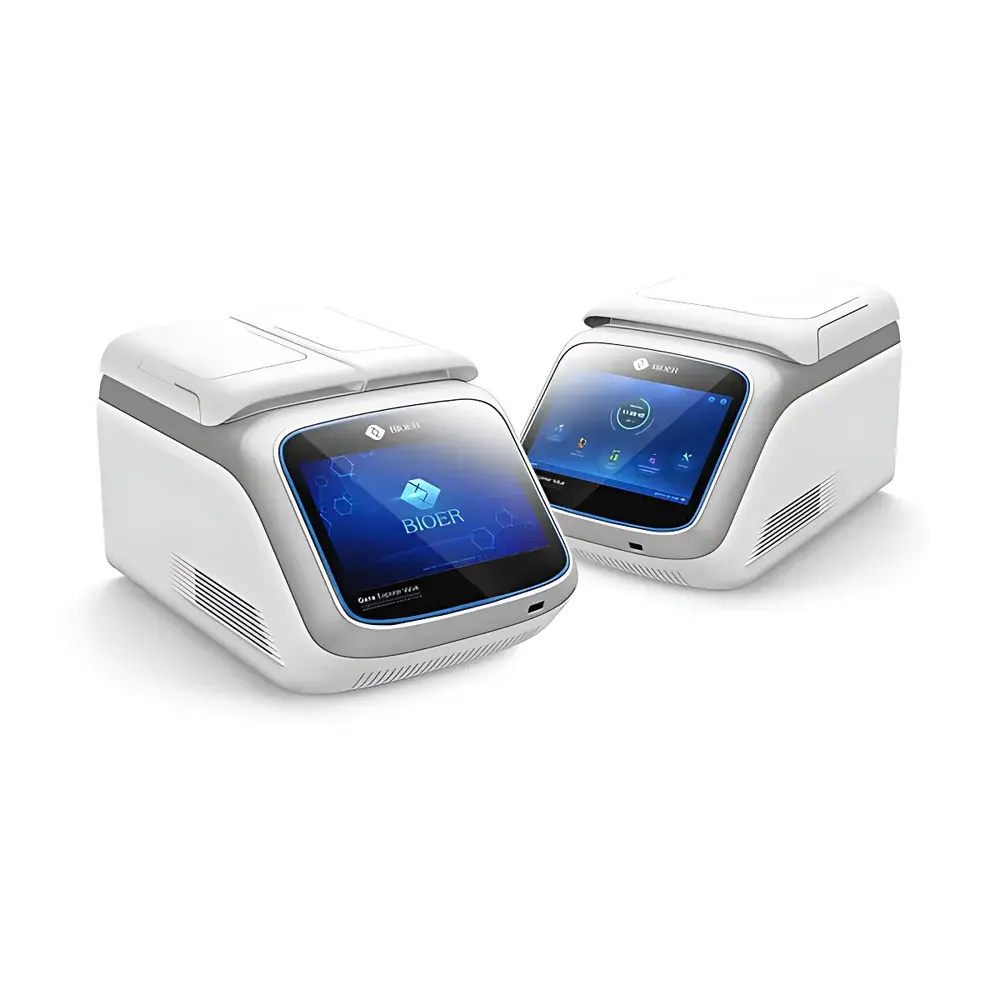
Bioer GeneExplorer Gradient PCR Thermal Cycler
| Brand | Bioer |
|---|---|
| Origin | Zhejiang, China |
| Manufacturer Type | Authorized Distributor |
| Product Category | Domestic |
| Model | GeneExplorer |
| Instrument Type | Gradient PCR Thermal Cycler |
| Sample Capacity | 96-well plate |
| Maximum Heating Rate | 6°C/sec |
| Temperature Accuracy | ≤ ±0.1°C |
| Well-to-Well Temperature Uniformity | ≤ ±0.2°C |
| Gradient Function | 12-column linear gradient (1–30°C) |
| Dimensions (L×W×H) | 420 × 269 × 254 mm |
Overview
The Bioer GeneExplorer Gradient PCR Thermal Cycler is a precision-engineered nucleic acid amplification platform designed for robust, reproducible polymerase chain reaction (PCR) cycling under tightly controlled thermal conditions. Leveraging Peltier-based semiconductor ceramic heating and cooling elements co-developed with Yamato Scientific (Japan), the system implements rapid thermal ramping (up to 6°C/sec) and exceptional temperature fidelity—achieving ≤ ±0.1°C accuracy across the full operating range (4–100°C) and ≤ ±0.2°C well-to-well uniformity in a standard 96-well format. Its core architecture follows the fundamental thermodynamic principles of PCR: precise denaturation, annealing, and extension phase control via real-time feedback-regulated thermal blocks. The GeneExplorer is engineered for routine molecular biology workflows—including genotyping, cloning, mutation detection, and endpoint PCR—where consistency, traceability, and compliance-ready operation are critical in academic, clinical, and quality-controlled laboratory environments.
Key Features
- High-speed thermal cycling with maximum heating rate of 6°C/sec and symmetric cooling kinetics, reducing total run time without compromising amplification fidelity.
- 12-column linear gradient functionality (1–30°C span) enabling simultaneous optimization of annealing temperatures across a single 96-well plate—ideal for primer validation and assay development.
- Advanced Peltier module architecture with dual-zone thermal sensing and dynamic PID compensation ensures stable block temperature control under varying ambient and load conditions.
- Intuitive 7-inch capacitive touchscreen interface with multi-language support (English, Chinese, Spanish), onboard protocol storage (≥1,000 programs), and USB port for method import/export.
- Robust aluminum alloy thermal block with gold-plated contact surfaces for enhanced thermal conductivity and long-term corrosion resistance.
- Comprehensive safety design including lid overheat protection, power-fail resume capability, and automatic shutdown after idle timeout.
Sample Compatibility & Compliance
The GeneExplorer supports standard 0.2 mL skirted and semi-skirted 96-well PCR plates, as well as individual 0.2 mL tubes and 8-strip tubes—compatible with all major commercial master mixes and enzyme formulations. It meets essential electrical safety standards per IEC 61010-1 and electromagnetic compatibility requirements per IEC 61326-1. While not certified for in vitro diagnostic (IVD) use under EU IVDR or FDA 510(k), the instrument’s operational logs, user-accessible calibration records, and password-protected administrator mode support alignment with GLP and ISO/IEC 17025 documentation practices. Audit trail functionality (via optional software export) enables retrospective verification of cycle parameters, user actions, and thermal profiles—facilitating internal QA/QC review and regulatory readiness.
Software & Data Management
The GeneExplorer operates independently via its embedded firmware but integrates seamlessly with Bioer’s PC-based GeneExplorer Control Software (v3.2+), compatible with Windows 10/11. This application enables remote monitoring, batch protocol deployment, real-time temperature graphing, and export of raw thermal data in CSV format. All runs generate timestamped log files containing cycle count, ramp rates, hold durations, and deviation metrics—structured for integration into LIMS environments or electronic lab notebooks (ELNs). The software supports 21 CFR Part 11-compliant configurations when deployed with network authentication, role-based access control, and digital signature modules—meeting audit requirements for regulated laboratories conducting method validation or stability testing.
Applications
- Routine DNA amplification for Sanger sequencing template preparation and NGS library enrichment.
- Optimization of multiplex PCR assays through parallel gradient testing of primer pairs.
- Expression analysis via RT-PCR using cDNA templates synthesized from extracted RNA.
- Pathogen detection in food safety, environmental, and veterinary screening workflows.
- Teaching applications in undergraduate molecular biology labs requiring reliability, ease of use, and consistent inter-user performance.
- Pre-analytical processing in biobanking facilities where standardized nucleic acid amplification is required prior to downstream sequencing or microarray hybridization.
FAQ
Does the GeneExplorer support dual-block or multi-module configurations?
No—the standard GeneExplorer model features a single 96-well aluminum thermal block. Multi-module variants (e.g., TC-EA-B-384GA, TC-XP-D) are separate product lines within Bioer’s portfolio and are not interchangeable with the GeneExplorer platform.
Is calibration traceable to national standards?
Yes—each unit ships with a factory calibration certificate referencing NIST-traceable reference thermometers. Users may perform field verification using calibrated PT100 probes; Bioer provides documented procedures for user-initiated calibration checks.
Can the instrument be integrated into automated liquid handling systems?
The GeneExplorer does not feature native robotic arm interfaces or RS-232/Modbus protocols. However, its USB-based software API allows custom script-driven control via Python or LabVIEW for semi-automated workflow orchestration.
What maintenance is required to sustain thermal performance?
Annual inspection of Peltier module thermal interface paste and cleaning of air intake filters are recommended. Bioer advises against disassembly of the thermal block assembly by non-certified personnel to preserve calibration integrity.