
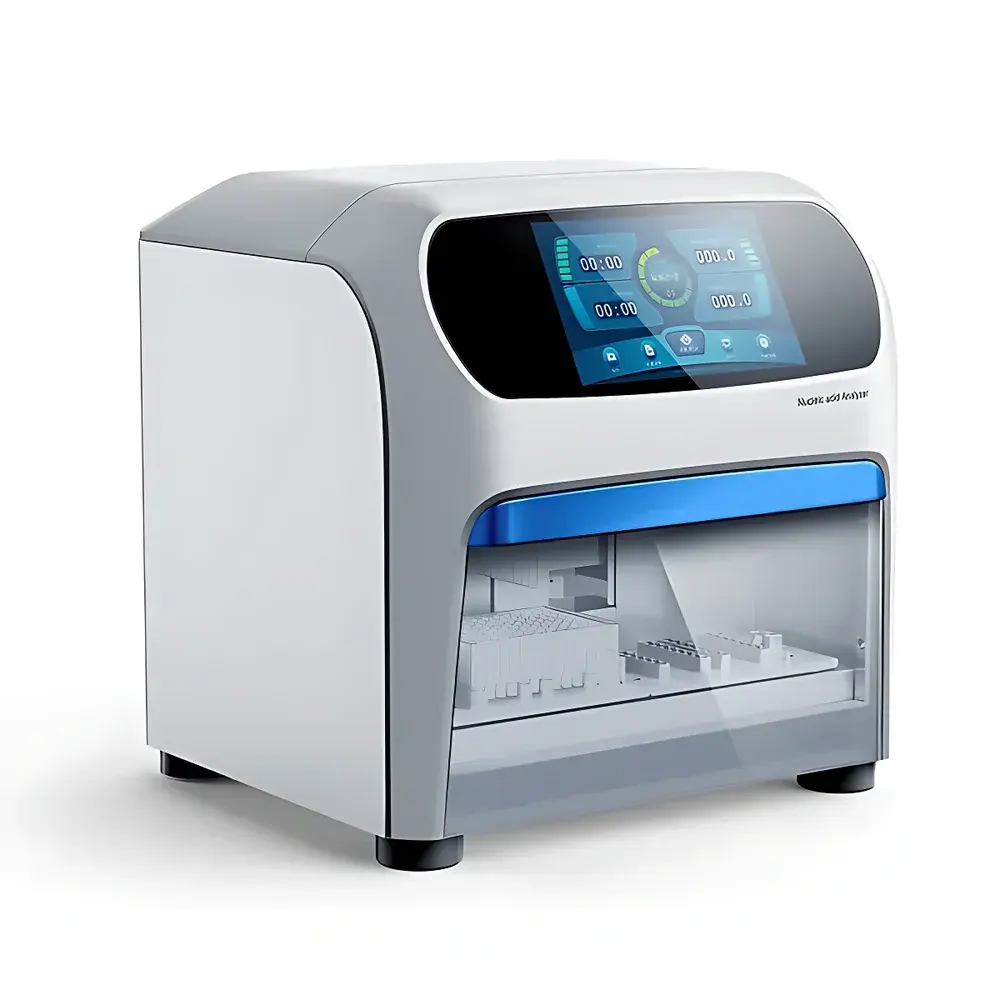
Bioer GenePure Pro NPA-32P Automated Magnetic Bead-Based Nucleic Acid Extraction System
| Brand | Bioer |
|---|---|
| Origin | Zhejiang, China |
| Manufacturer Type | Authorized Distributor |
| Country of Origin | China |
| Model | NPA-32P |
| Instrument Type | Magnetic Bead-Based Extraction |
| Automation Level | Dedicated Fully Automatic |
| Throughput | 32 samples per run |
| Sample Volume Range | 20–1000 µL |
| Magnetic Bead Recovery Efficiency | ≥98% |
| Inter-well CV | <3% |
| Lysis & Elution Heating Range | Ambient to 120 °C |
| Oscillation Modes | Multi-stage, adjustable |
| UV Decontamination | Integrated UV lamp |
| Barcode Scanning | Optional |
| Consumables | 96-well deep-well plate + magnetic rod sleeves |
| Touchscreen Interface | 8-inch embedded capacitive touchscreen |
| Dimensions (L×W×H) | 430 × 395 × 435 mm |
| Weight | 32.5 kg |
| Power Supply | AC 100–240 V, 50/60 Hz |
Overview
The Bioer GenePure Pro NPA-32P is a dedicated fully automated nucleic acid purification system engineered for high-reproducibility magnetic bead-based isolation from diverse biological matrices—including whole blood, buffy coat, cultured cells, fresh/frozen tissue, and saliva. It operates on the principle of paramagnetic particle separation under controlled magnetic fields, where nucleic acids bind selectively to silica-coated magnetic beads in high-salt chaotropic buffers, followed by sequential washing and low-salt elution. The system integrates thermally regulated lysis and elution steps, programmable oscillation kinetics, and real-time process monitoring via an embedded industrial-grade control architecture—ensuring compliance with routine molecular diagnostic and research-grade nucleic acid yield and purity requirements (A260/A280 ≥ 1.7, A260/A230 ≥ 1.8).
Key Features
- Optimized magnetic rod drive mechanism: Dual-axis synchronized motion with variable amplitude control ensures uniform bead suspension, minimal wall adhesion, and consistent binding/washing across all 32 channels—critical for minimizing inter-sample variability.
- Uniform deep-well thermal management: Independently controllable heating blocks for lysis and elution zones maintain ±0.5 °C stability across the full 20–1000 µL volume range, reducing thermal gradient-induced yield loss in viscous or high-protein samples.
- Integrated biosafety design: Built-in 254 nm UV-C irradiation module (≥1000 µW/cm² at surface) activates automatically between runs; disposable magnetic rod sleeves and sealed reagent compartments prevent cross-contamination and aerosol carryover—supporting ISO 15189 and CLIA-aligned pre-analytical workflows.
- Modular hardware scalability: Swappable magnetic head assemblies and heating modules enable future expansion to 48-sample throughput without firmware or software modification—preserving capital investment during lab capacity scaling.
- Open reagent compatibility: Validated with third-party magnetic bead kits (e.g., Qiagen MagAttract, Thermo Fisher KingFisher Flex-compatible chemistries), eliminating vendor lock-in while maintaining protocol fidelity per manufacturer specifications.
- Embedded GLP-compliant operation: All user actions, parameter edits, runtime logs, and error events are timestamped and stored locally with tamper-resistant audit trails—facilitating 21 CFR Part 11 readiness when paired with networked data export protocols.
Sample Compatibility & Compliance
The NPA-32P supports extraction from human and non-human vertebrate specimens compliant with ISO 20387:2018 (biobanking), ISO/IEC 17025:2017 (testing laboratories), and EU IVDR Annex II general safety and performance requirements. Compatible input formats include EDTA/K2EDTA anticoagulated whole blood (up to 200 µL), PBMC suspensions, homogenized tissue lysates (≤50 mg equivalent), and bacterial pellets (OD600 ≤ 1.0). All consumables meet USP Class VI biocompatibility standards; instrument housing conforms to IEC 61010-1:2010 for laboratory electrical safety.
Software & Data Management
The 8-inch capacitive touchscreen runs a real-time Linux-based OS with intuitive graphical workflow navigation. Users can create, duplicate, version-control, and password-protect extraction protocols—including conditional step branching (e.g., extended lysis for fibrous tissues). Raw log files (CSV/JSON) export via USB or optional Ethernet interface; metadata includes cycle count, temperature ramp profiles, magnetic engagement duration, and UV exposure history. Audit trail records support retrospective review for CAP/CLIA inspections and internal quality audits.
Applications
This platform serves clinical molecular pathology labs performing HPV genotyping, SARS-CoV-2 RT-qPCR screening, and hereditary cancer panel prep; academic core facilities conducting CRISPR gRNA library construction or single-cell RNA-seq sample prep; and biopharma QC units validating plasmid DNA purity for transfection-grade production. Its consistency in yield (≥3 µg genomic DNA from 200 µL whole blood) and inhibitor removal efficacy enables direct downstream use in multiplex PCR, digital PCR, and long-read sequencing library preparation without clean-up.
FAQ
Does the NPA-32P support dual-temperature-zone operation during a single run?
Yes—the lysis and elution blocks operate independently, allowing simultaneous 75 °C lysis and 65 °C elution to optimize time-to-result for high-viscosity samples.
Can custom heating profiles be programmed for specialized protocols?
Yes—users define up to 12 temperature segments per zone, including hold times, ramp rates (0.1–5.0 °C/sec), and dynamic oscillation coupling.
Is remote monitoring or alerting available?
Local network integration enables SNMP trap generation and SMTP email notifications for completion or critical faults—configuration requires IT-administered VLAN access.
What validation documentation is provided for regulatory submissions?
Bioer supplies IQ/OQ documentation templates, reagent compatibility matrices, and raw performance qualification data (precision, accuracy, robustness per ISO 20387 Annex C) upon request.
How often does the UV lamp require replacement?
The lamp is rated for 8,000 hours; system firmware tracks cumulative exposure and alerts at 90% end-of-life.
Related Products




