
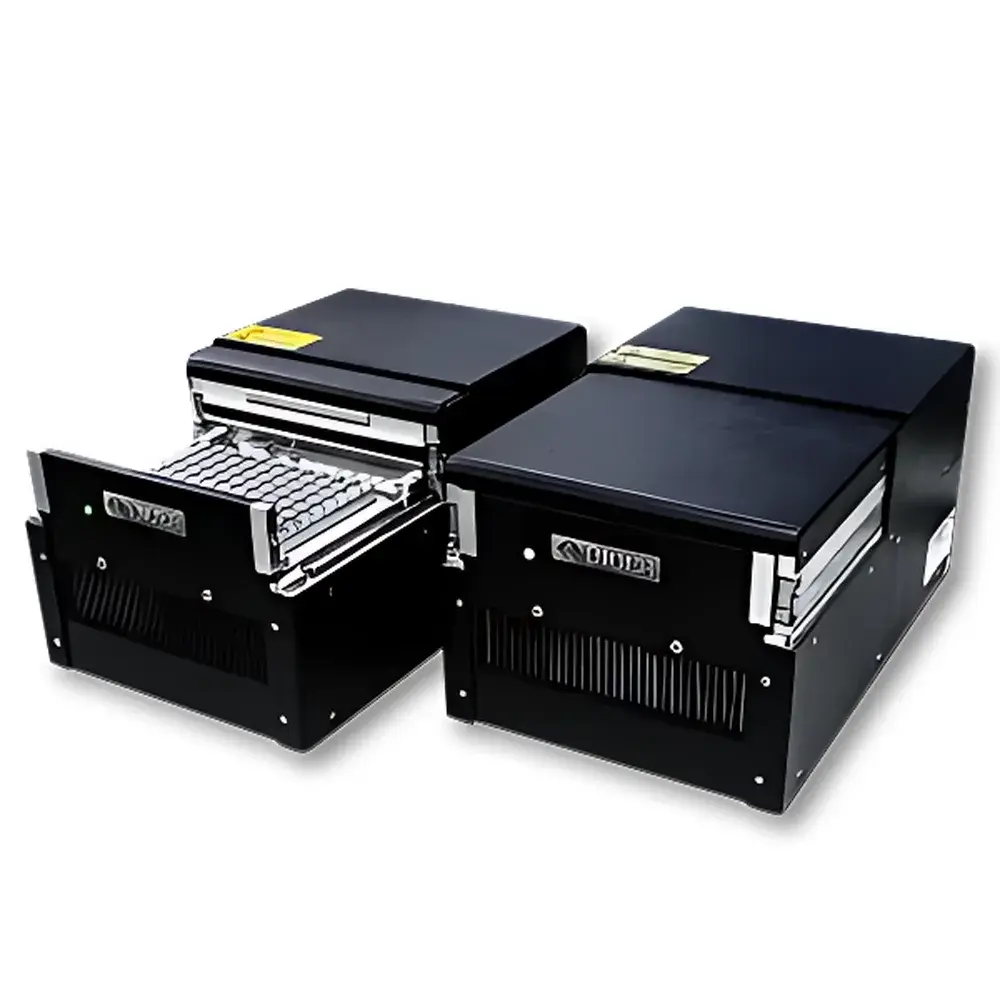
Bioer TC-EA-B-96GA Automated Thermal Cycler Module
| Brand | Bioer |
|---|---|
| Origin | Zhejiang, China |
| Model | TC-EA-B-96GA |
| Temperature Range | 4–99 °C |
| Communication Interfaces | USB, RJ45 |
| Input Power | 100–240 V AC, 50–60 Hz (1000 W) |
| Module Dimensions | 156.5 × 253 × 125.8 mm |
| Host Dimensions | 256.5 × 414.5 × 65 mm |
| Compliance | CE-marked for laboratory use in EU |
Overview
The Bioer TC-EA-B-96GA Automated Thermal Cycler Module is an OEM-integrated temperature control subsystem engineered for precise, repeatable thermal ramping and holding across molecular biology workflows. Unlike standalone PCR instruments, this module operates as a plug-and-play thermal actuator designed for seamless integration into automated liquid handling platforms, robotic workcells, and high-throughput nucleic acid processing systems. Its core function relies on Peltier-based thermoelectric heating and cooling, enabling rapid transitions between setpoints with minimal overshoot and high thermal uniformity across the 96-well compatible aluminum block surface. The module maintains ±0.25 °C temperature accuracy at steady state and achieves ramp rates up to 4.5 °C/s (heating) and 3.8 °C/s (cooling), supporting protocols requiring stringent thermal fidelity—such as library amplification prior to NGS, hybridization stringency control, and enzymatic reaction quenching. Its compact footprint and standardized mechanical/electrical interfaces reduce integration overhead for system integrators developing GLP-compliant assay automation.
Key Features
- Peltier-driven thermal control with active heat dissipation via dual-stage forced-air cooling, ensuring stable operation during extended cycling sequences
- 96-position aluminum heating/cooling block with optimized thermal mass distribution for ≤±0.3 °C well-to-well uniformity at 72 °C
- Dual communication architecture: USB 2.0 for local configuration and firmware updates; RJ45 Ethernet port supporting TCP/IP-based remote command execution and status polling
- Programmable temperature profiles with up to 99 steps per protocol, including hold durations from 1 second to 99 hours 59 minutes
- Integrated condensation management: block surface geometry and thermal gradient design minimize dew formation and reagent evaporation during low-temperature holds
- Compliance-ready architecture: supports audit trail generation (via external software logging), configurable user access levels, and timestamped event logs aligned with 21 CFR Part 11 data integrity principles
Sample Compatibility & Compliance
The TC-EA-B-96GA accommodates standard 96-well PCR plates (full-skirted, semi-skirted, and unskirted), 0.2 mL tube strips, and individual 0.2 mL tubes—compatible with common consumables from major vendors including Eppendorf, Thermo Fisher Scientific, and Axygen. Block aperture geometry ensures consistent thermal coupling without requiring proprietary accessories. From a regulatory standpoint, the module meets IEC 61010-1:2010 safety requirements for laboratory equipment and carries CE marking under the EU Machinery Directive and EMC Directive. While not certified as a medical device, its performance characteristics align with ISO/IEC 17025 reference method validation criteria for temperature-controlled instrumentation used in accredited testing laboratories. It is routinely deployed in environments adhering to ISO 13485 QMS frameworks for IVD assay development and CLIA-certified molecular labs performing pre-analytical sample conditioning.
Software & Data Management
The module operates natively via ASCII-based SCPI-like command sets transmitted over USB or Ethernet—enabling direct integration with LabVIEW, Python (pySerial/pyVisa), or custom C++/C# host applications. Bioer provides a Windows-compatible configuration utility for offline protocol creation, real-time temperature monitoring, and firmware version verification. All thermal events—including setpoint changes, actual block temperature readings (sampled at 10 Hz), error codes, and power-on/off timestamps—are accessible via serial query or HTTP GET requests. When paired with validated LIMS or ELN platforms, the module supports structured JSON or CSV export of cycle logs, facilitating traceability in FDA-submitted analytical method documentation. Audit trail records include operator ID (if authenticated), action type, timestamp (UTC), and pre/post values—satisfying ALCOA+ data integrity expectations.
Applications
- Automated NGS library preparation: precise denaturation (95 °C), annealing (55–65 °C), and extension (72 °C) steps synchronized with pipetting cycles
- Hybridization incubation for microarray and capture-based enrichment workflows, where controlled ramp-down to 45–55 °C improves probe specificity
- Enzyme inactivation post-digestion (e.g., restriction enzyme heat-quench at 65–80 °C) within integrated DNA fragmentation pipelines
- Controlled cooling of reaction mixtures prior to storage or downstream purification—maintaining integrity of temperature-sensitive enzymes like T4 DNA ligase
- Thermal preconditioning of samples before mass spectrometry injection or capillary electrophoresis separation
FAQ
Is the TC-EA-B-96GA suitable for use in GMP-regulated environments?
Yes—when integrated into a validated system architecture with appropriate procedural controls, its deterministic thermal behavior, configurable logging, and electronic signature support meet baseline requirements for Annex 11 and PIC/S GMP Annex 15 alignment.
Can the module be operated independently without a host controller?
No—it lacks an embedded display, keypad, or standalone protocol memory; it requires continuous command input from an external host system.
What is the maximum ambient temperature for continuous operation?
The module is rated for ambient temperatures up to 30 °C with ≥150 mm clearance on all sides for airflow; operation above 30 °C may reduce thermal ramp performance and long-term reliability.
Does Bioer provide SDKs or API documentation for third-party integration?
Yes—comprehensive command reference manuals, sample code repositories (Python/C#), and Ethernet packet structure specifications are available under NDA upon request from authorized distributors.
How is calibration verified and maintained?
Users perform periodic verification using NIST-traceable PT100 probes placed in designated wells; Bioer recommends annual recalibration by an ISO/IEC 17025-accredited service provider using fixed-point dry-block standards at 4 °C, 55 °C, and 95 °C.




