
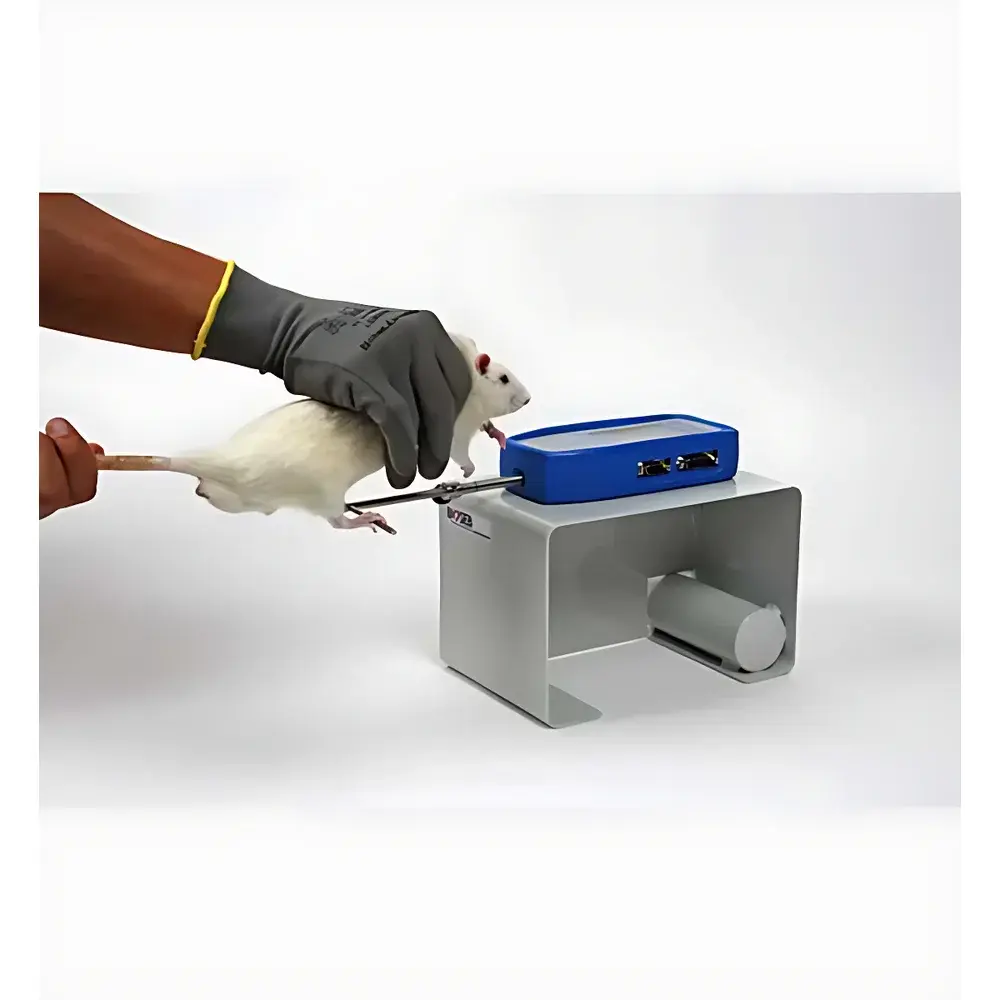
Bioseb BIO-GS3 Rodent Grip Strength Meter
| Origin | Italy |
|---|---|
| Manufacturer Type | Distributor |
| Origin Category | Imported |
| Model | BIO-GS3 |
| Price Range | USD 7,000 – 14,000 |
| Force Range | 0–2000 g |
| Resolution | 0.1 g |
| Sampling Rate | 1000 Hz |
| Max Load Capacity | 2000 g |
| Sensor Accuracy | < ±0.25% FS |
| Display Units | g, N, lb |
| Data Storage | ≥100 tests |
| Interface | RS232 / USB |
| Forelimb Bar Dimensions | 76 mm × 50 mm |
| Hindlimb Bar Dimensions | 127 mm × 127 mm |
| Software | BIO-CIS Grip Strength Analysis Suite |
Overview
The Bioseb BIO-GS3 Rodent Grip Strength Meter is an ISO-compliant, precision-engineered instrument designed for objective, quantitative assessment of neuromuscular function in laboratory rodents—primarily rats and mice. It operates on the principle of isometric force transduction: when a rodent grasps a standardized grid or T-bar apparatus and is gently drawn backward by the operator, the system captures the peak tensile force exerted by the forelimbs (or forelimbs plus hindlimbs, depending on configuration) prior to release. This endpoint reflects integrated motor unit recruitment, neuromuscular junction integrity, and skeletal muscle contractility. The device employs dual high-stability load cells with < ±0.25% full-scale accuracy and a 1000 Hz real-time sampling rate—ensuring temporal fidelity in detecting transient force maxima during voluntary grip release. Its design adheres to widely accepted preclinical testing paradigms described in OECD Test Guidelines 425 and ASTM E2975-14, supporting reproducible longitudinal studies in toxicology, pharmacology, neurodegeneration, and aging research.
Key Features
- Dual-sensor architecture enables flexible experimental configurations: dedicated forelimb-only measurement or simultaneous forelimb/hindlimb assessment using interchangeable hardware modules.
- Modular grip interfaces—including rat/mouse-specific grids (BIO-GRIPGR/BIO-GRIPGS) and T-bars (BIO-GRIPBR/BIO-GRIPBS)—are tool-free swappable and conform to standardized dimensions per NIH Office of Laboratory Animal Welfare (OLAW) recommendations.
- Real-time force visualization via high-contrast LED display with selectable units (grams, newtons, pounds), calibrated traceably to NIST-traceable standards.
- Onboard non-volatile memory stores ≥100 test records with timestamp, peak force value, and operator ID (if configured), meeting GLP data integrity requirements for audit-ready documentation.
- RS232 and USB 2.0 interfaces support direct connection to Windows-based PCs; compatible with FDA 21 CFR Part 11-compliant electronic signature workflows when used with validated BIO-CIS software.
- Robust mechanical housing rated for continuous use in AAALAC-accredited vivarium environments; sensor housing meets IP54 dust/moisture resistance specifications.
Sample Compatibility & Compliance
The BIO-GS3 is validated for use with Sprague-Dawley, Wistar, Long-Evans, and C57BL/6 mouse strains, as well as CD-1 and Fischer 344 rats across weight ranges from 15 g (weanling mice) to 500 g (adult rats). Its force range (0–2000 g) and resolution (0.1 g) satisfy sensitivity requirements outlined in USP “Biological Assays for Neuromuscular Function” and ISO 10993-11 for biocompatibility-related functional safety evaluation. All accessories comply with Directive 2010/63/EU Annex VIII criteria for humane handling and minimal stress induction. Calibration certificates are supplied with each unit, referencing EURAMET cg-18 guidelines for force metrology.
Software & Data Management
The optional BIO-CIS Grip Strength Analysis Software provides FDA 21 CFR Part 11–compliant data acquisition, visualization, and statistical reporting. It supports batch import/export in CSV, Excel (.xlsx), and PDF formats; includes built-in ANOVA, t-test, and repeated-measures analysis modules; and maintains full audit trails—including user login logs, parameter change history, and electronic signatures for test validation. Raw time-force curves are exportable for third-party analysis in MATLAB or Python-based biomechanical modeling pipelines. Software validation packages (IQ/OQ/PQ documentation) are available upon request for GxP-regulated laboratories.
Applications
- Neurotoxicity screening: Quantifying dose-dependent grip strength deficits induced by organophosphates, heavy metals, or chemotherapeutic agents (e.g., vincristine).
- Neuromuscular disease modeling: Longitudinal tracking of functional decline in SOD1-G93A ALS mice, mdx dystrophic mice, or myasthenia gravis rat models.
- Pharmacodynamic evaluation: Assessing efficacy of muscle anabolic agents (e.g., selective androgen receptor modulators) or neuroprotective compounds in spinal cord injury models.
- Aging studies: Detecting age-related sarcopenia onset through progressive reduction in normalized forelimb force (N/g body weight).
- Rehabilitation monitoring: Validating functional recovery post-peripheral nerve crush or sciatic nerve transection using bilateral grip asymmetry indices.
FAQ
What is the recommended acclimatization protocol before testing?
Animals should be habituated to the testing room (23 ± 2°C, 50 ± 10% RH) for ≥30 minutes and handled gently for 2–3 days prior to baseline measurements to minimize stress-induced force suppression.
Can the BIO-GS3 be used for longitudinal studies across multiple timepoints?
Yes—the system supports consistent inter-session calibration verification and auto-zero drift compensation, enabling reliable intra-animal comparison over weeks or months when combined with standardized handling protocols.
Is the BIO-CIS software validated for regulated submissions to EMA or FDA?
BIO-CIS v3.2+ includes full 21 CFR Part 11 validation documentation and is routinely accepted in IND/CTA dossiers when deployed within a validated IT infrastructure meeting ALCOA+ data governance principles.
How often does the system require recalibration?
Annual recalibration against certified deadweight standards is recommended; field verification using NIST-traceable check weights is advised before each daily testing session.
Does the device meet requirements for Good Laboratory Practice (GLP) audits?
Yes—when operated with documented SOPs, calibrated accessories, and BIO-CIS audit-trail logging enabled, the BIO-GS3 satisfies OECD Principles of GLP (ENV/MC/CHEM(98)17) for nonclinical health and environmental safety studies.





