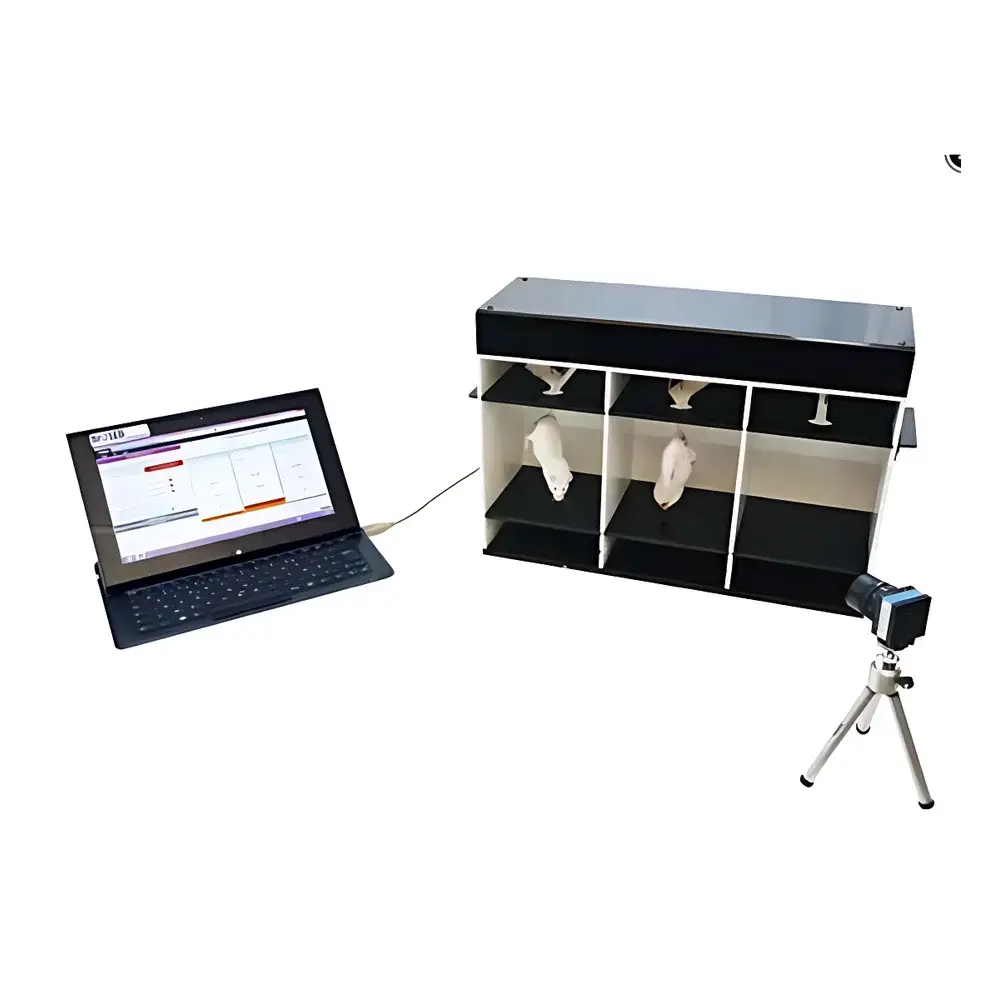
Bioseb TST-4 Automated Tail Suspension Test System
| Origin | France |
|---|---|
| Manufacturer Type | Authorized Distributor |
| Origin Category | Imported |
| Model | TST-4 |
| Price Range | USD 6,800 – 13,600 |
| Sampling Rate | 200 Hz |
| Capacity | Up to 6 Mice Simultaneously |
| Sensor Principle | Precision Load Cell-Based Force Transduction |
| Software Features | Real-Time Energy Calculation, Configurable Thresholds, Audit-Trail Enabled Data Editing, Session Replay & Parameter Reanalysis |
Overview
The Bioseb TST-4 Automated Tail Suspension Test System is a rigorously engineered behavioral phenotyping platform designed for preclinical assessment of antidepressant and sedative pharmacological activity in murine models. Unlike video-based tracking systems vulnerable to lighting artifacts, occlusion, or subjective frame interpretation, the TST-4 employs high-fidelity load cell transduction to quantify minute force fluctuations generated by mouse limb and torso movements during tail suspension. This physical measurement principle—grounded in Newtonian mechanics and calibrated against ISO/IEC 17025-traceable standards—ensures direct, objective quantification of immobility duration, kinetic energy expenditure, and peak exertion force. The system operates on the validated behavioral paradigm wherein mice suspended by the tail exhibit periods of struggle (active coping) followed by immobility (behavioral despair), a response modulated predictably by serotonergic and noradrenergic agents. With a native sampling rate of 200 Hz, the TST-4 captures transient motor events with temporal resolution sufficient to resolve micro-movements (<5 ms duration), enabling robust discrimination between pharmacologically induced reductions in immobility and nonspecific motor suppression.
Key Features
- Load cell–based force acquisition eliminates reliance on optical contrast, ambient light stability, or animal coat color—ensuring consistent performance across diverse C57BL/6, BALB/c, and CD-1 strains.
- Simultaneous monitoring of up to six individually suspended mice within a single assay run, with independent real-time energy profiling and threshold-triggered immobility classification per subject.
- Configurable immobility detection algorithm: users define amplitude (±0.05–0.5 g-force) and duration (0.5–5 s) thresholds to align with institutional SOPs or publication requirements (e.g., Porsolt protocol adaptations).
- Integrated session replay functionality supports retrospective reprocessing—enabling recalibration of thresholds, exclusion of artifact segments (e.g., cage contact or tail slip), and generation of secondary metrics (e.g., cumulative active time, burst frequency).
- Full audit trail compliance: all parameter edits, data deletions, and session reanalyses are timestamped, user-logged, and immutable—meeting GLP and FDA 21 CFR Part 11 requirements for regulated neuropharmacology studies.
Sample Compatibility & Compliance
The TST-4 accommodates standard laboratory mice (18–32 g) suspended via adhesive tape or custom tail cuffs; no surgical preparation or restraint training is required. Each test chamber features non-reflective matte black walls and vibration-damped mounting to minimize environmental confounds. The system conforms to ASTM E2575-22 guidelines for behavioral assay instrumentation validation and supports ISO 9001-certified calibration documentation. All hardware components comply with CE marking directives (2014/30/EU EMC Directive and 2014/35/EU Low Voltage Directive). Software architecture adheres to ALCOA+ principles (Attributable, Legible, Contemporaneous, Original, Accurate, Complete, Consistent, Enduring, Available) for raw data integrity.
Software & Data Management
Bioseb’s TST Control Suite v4.2 (Windows 10/11, 64-bit) provides a deterministic, non-proprietary data model: raw force-time series (.csv export), processed event logs (.xlsx), and session metadata (.json) are stored in open, human-readable formats. The software implements role-based access control (RBAC), electronic signatures for protocol approval, and automatic backup to network drives or NAS devices. Exported datasets include standardized columns compliant with MIAME and MINSEQE metadata schemas, facilitating integration into ELN platforms (e.g., LabArchives, Benchling) and statistical pipelines (R, Python pandas). Batch analysis modules support ANOVA-ready grouping by treatment cohort, genotype, or timepoint—without requiring third-party scripting.
Applications
- Primary screening of novel monoamine reuptake inhibitors, NMDA antagonists, and neurotrophic modulators in depression/anxiety models.
- Dose-response characterization of CNS-active compounds under OECD TG 426 (Neurotoxicity Study) and ICH S7A (Safety Pharmacology) frameworks.
- Genetic validation of knockout/knockin lines exhibiting altered stress-coping behavior (e.g., BDNFVal66Met, 5-HTT-/-).
- Longitudinal behavioral phenotyping in chronic mild stress (CMS) or social defeat paradigms, where repeated TST sessions track therapeutic progression.
- Cross-laboratory reproducibility studies—leveraging force-based metrics that eliminate inter-operator variability inherent in manual scoring.
FAQ
How does the TST-4 distinguish true immobility from passive hanging?
The system applies a dual-threshold algorithm: immobility is classified only when force variance remains below user-defined amplitude limits for a sustained duration—rejecting static suspension without physiological relevance.
Can data from older TST versions be imported into TST Control Suite v4.2?
Yes—backward compatibility is maintained for .tdf files generated by TST-2 and TST-3 systems, with automated metadata mapping and unit normalization.
Is the load cell calibrated before shipment?
Each unit undergoes factory calibration using NIST-traceable deadweight standards; a certificate of calibration (including uncertainty budget) is included with delivery.
What happens if a mouse detaches during testing?
The software flags the event automatically; users may exclude the affected segment while preserving full traceability of the edit—including reason code, operator ID, and timestamp.
Does the system support integration with third-party video recording?
Yes—the TST-4 provides TTL synchronization pulses and API hooks for triggering external cameras (e.g., Basler acA2000-50gm) aligned to force acquisition timestamps.