
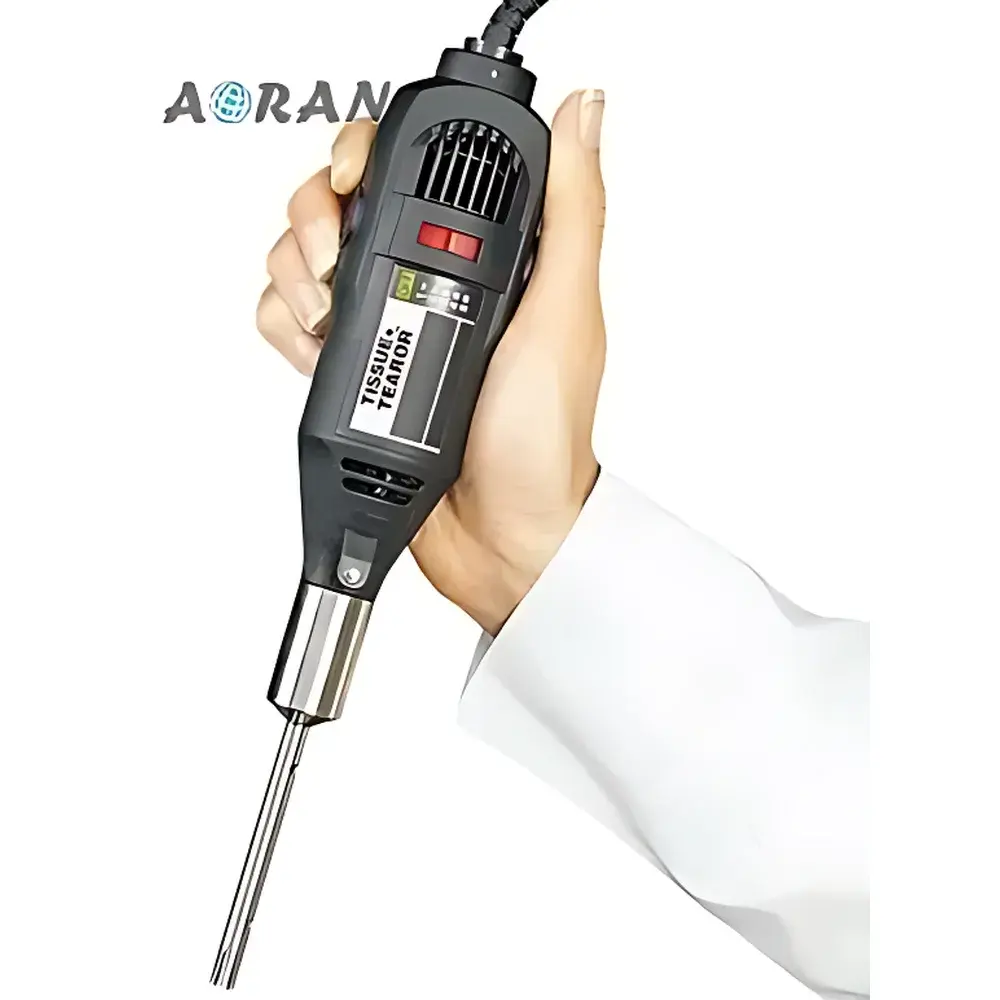
Biospec BSP TissueTearor Handheld Homogenizer
| Brand | Biospec |
|---|---|
| Origin | USA |
| Model | TissueTearor |
| Instrument Type | Probe-type Rotor-Stator Homogenizer |
| Processing Volume Range | 0.2–1000 mL |
| Rotor Diameter | 5–14 mm |
| Speed Range | 5,000–35,000 rpm |
| Compatible Tube Minimum Inner Diameter | 6 mm |
| Construction | Stainless Steel Rotor, Chemically Resistant Housing |
| Stand Included | Yes |
Overview
The Biospec BSP TissueTearor Handheld Homogenizer is a precision-engineered, probe-based rotor-stator homogenization system designed for rapid, reproducible mechanical disruption of biological tissues and suspension-based samples in research and diagnostic laboratories. Operating on the principle of high-shear fluid dynamics—where a rapidly rotating stainless-steel rotor generates intense localized turbulence within a fixed stator sleeve—the device delivers efficient cell lysis, tissue homogenization, and emulsification across a broad volume range (0.2–1000 mL). Its compact, ergonomic design enables direct insertion into standard microcentrifuge tubes, conical tubes, and small-diameter vessels—including 0.5 mL Eppendorf tubes with internal diameters as narrow as 6 mm—making it especially suitable for low-volume, high-value samples where cross-contamination risk and sample loss must be minimized. The TissueTearor is widely deployed in molecular biology, proteomics, pharmacokinetics, and clinical pathology workflows requiring consistent, scalable homogenization without thermal degradation or foaming artifacts.
Key Features
- Ergonomic handheld housing with balanced weight distribution for prolonged operator comfort and precise tip placement.
- Interchangeable stainless-steel rotor probes (diameters: 5 mm, 7 mm, 10 mm, and 14 mm) engineered for durability, chemical resistance, and autoclavability (up to 121°C, 20 min).
- Variable-speed electronic control (5,000–35,000 rpm) with soft-start functionality to prevent sample splashing and ensure repeatable shear input.
- Integrated vertical stand with adjustable clamp for hands-free operation during extended processing or multi-sample protocols.
- No external cooling required for short-duration runs; optional ice-jacketed tube holders available for temperature-sensitive applications (e.g., enzyme preservation, RNA integrity maintenance).
- Low-voltage DC motor with brushless design ensures long service life, minimal electromagnetic interference, and compliance with IEC 61000-6-3 emission standards.
Sample Compatibility & Compliance
The TissueTearor accommodates diverse biological matrices—including fibrous muscle, dense liver, avian pectoral tissue, plant root segments, and cultured cell pellets—without pre-chopping or dilution. It supports ISO 17025-aligned validation protocols when paired with documented calibration certificates (traceable to NIST standards) and routine performance verification using standardized viscosity reference fluids (e.g., Brookfield SRM oils). The instrument meets general safety requirements per UL 61010-1 and EN 61010-1 for laboratory electrical equipment. While not inherently 21 CFR Part 11 compliant, its operation can be integrated into GLP/GMP environments through procedural controls, audit-trail documentation of speed/time settings, and operator training records.
Software & Data Management
The TissueTearor operates as a standalone analog-controlled instrument with no embedded firmware or digital interface. All operational parameters—speed (rpm), duration (seconds), probe selection, and sample tube type—are manually set and recorded in laboratory notebooks or LIMS-compatible electronic logs. For traceability in regulated environments, users are advised to implement SOPs specifying minimum dwell time per sample volume, maximum cumulative run time per probe (to limit metal fatigue), and post-use cleaning verification (e.g., visual inspection, water-break test). Optional accessories include programmable timer switches and calibrated tachometers for periodic speed verification.
Applications
- Routine homogenization of mammalian tissues (liver, spleen, kidney, brain) prior to nucleic acid extraction or protein quantification.
- Preparation of single-cell suspensions from solid tumors for flow cytometry or scRNA-seq library construction.
- Disruption of yeast and bacterial cultures for plasmid isolation or enzyme activity assays.
- Homogenization of plant material for metabolite profiling or pesticide residue analysis.
- Emulsification of lipid nanoparticles and liposomal formulations during early-stage pharmaceutical development.
- Processing of forensic swabs and clinical biopsy specimens under biosafety level 2 (BSL-2) containment conditions.
FAQ
What is the recommended maintenance schedule for the TissueTearor rotor probes?
Rotor probes should be visually inspected before each use for burrs, corrosion, or deformation. After every 100 homogenization cycles (or daily in high-throughput labs), clean with 70% ethanol followed by sterile water rinse and air drying. Autoclave at 121°C for 20 minutes once per week if used with infectious agents.
Can the TissueTearor be used with corrosive or high-viscosity solvents?
Stainless-steel rotors resist mild organic solvents (e.g., chloroform, isopropanol) but are not compatible with strong oxidizers (e.g., concentrated nitric acid) or halogenated hydrocarbons at elevated temperatures. For viscous samples (>500 cP), reduce speed to ≤15,000 rpm and limit run time to ≤30 seconds per cycle.
Is speed calibration traceable to national standards?
Yes—Biospec provides optional factory calibration reports (NIST-traceable tachometer verification) upon request. Users may also perform in-house verification using a certified optical tachometer per ASTM E2586-22 guidelines.
Does the device support continuous operation mode?
No. The TissueTearor is rated for intermittent duty: maximum 60 seconds ON followed by ≥90 seconds OFF to prevent motor overheating. Continuous operation exceeds thermal design limits and voids warranty.
How does probe diameter selection affect homogenization efficiency?
Smaller-diameter probes (5–7 mm) generate higher tip velocity and shear stress per unit volume—ideal for low-volume, high-integrity applications (e.g., RNA work). Larger probes (10–14 mm) offer greater throughput for volumes >100 mL but require higher clearance between probe tip and vessel wall to avoid cavitation-induced foaming.



