
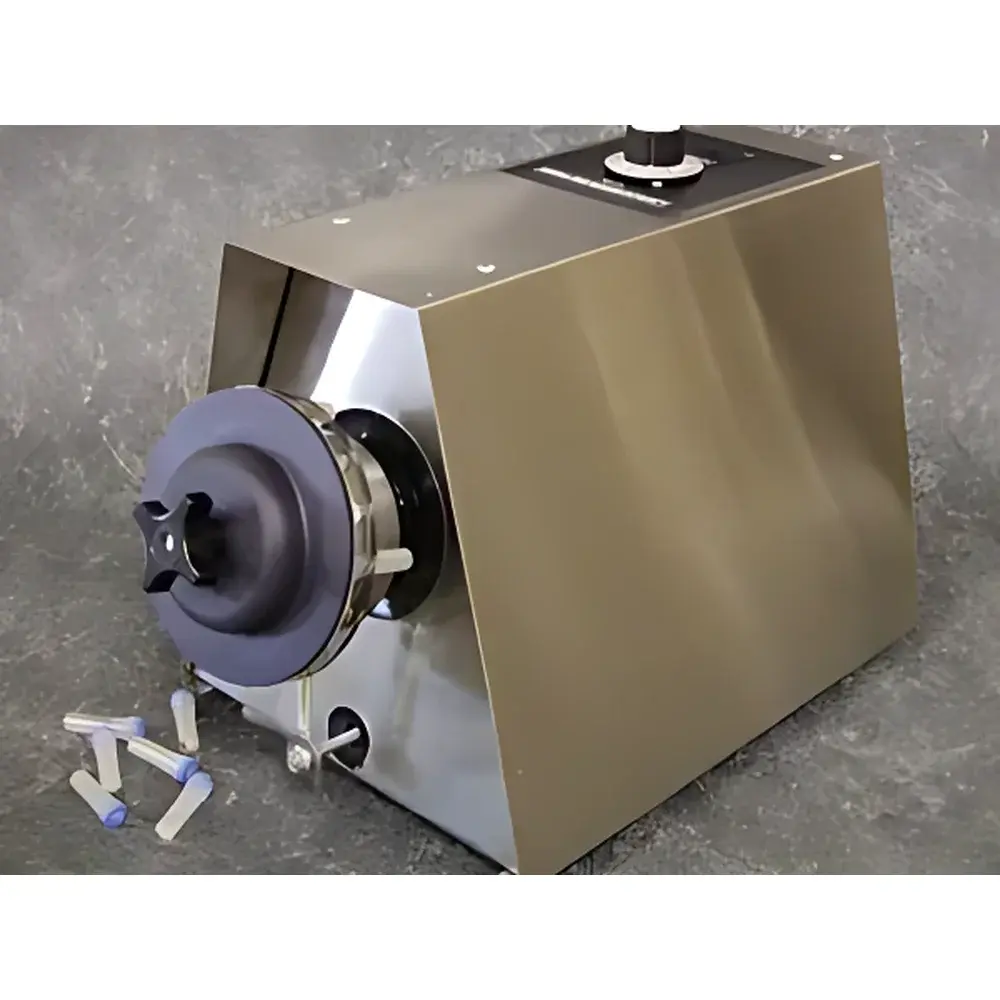
Biospec MiniBeadbeater-16 High-Efficiency Bead Mill Homogenizer
| Brand | Biospec |
|---|---|
| Origin | USA (Manufactured under Biospec specifications |
| Model | MiniBeadbeater-16 |
| Sample Capacity | 16 × 1–1.5 mL tubes or 8 × 7 mL tubes (with optional adapter) |
| Operating Speed | 3450 rpm |
| Time Range | 0–300 s, programmable in 1-s increments |
| Noise Level | <72 dBA (measured at 1 m distance) |
| Construction | Reinforced steel housing with vibration-dampening feet |
| Compliance | CE, RoHS, UL-listed electrical safety |
Overview
The Biospec MiniBeadbeater-16 is a high-throughput, benchtop bead mill homogenizer engineered for rapid, reproducible mechanical lysis of biological samples across diverse matrices—including microbial cells, yeast, plant tissues, mammalian cells, and environmental isolates. It operates on the principle of high-frequency horizontal oscillation, transferring kinetic energy from stainless-steel or ceramic beads to sample suspensions contained in sealed microtubes. This shear- and impact-driven lysis mechanism enables efficient disruption without significant thermal buildup—critical for preserving labile biomolecules such as RNA, proteins, and metabolites. Unlike rotor-stator or ultrasonic systems, the MiniBeadbeater-16 delivers consistent mechanical energy input independent of sample viscosity or particulate load, making it especially suitable for heterogeneous or fibrous samples where enzymatic or chemical lysis may underperform.
Key Features
- Simultaneous processing of up to 16 × 1–1.5 mL microcentrifuge tubes—or 8 × 7 mL tubes using the optional high-capacity adapter—enabling scalable throughput without compromising lysis efficiency.
- Precisely controlled oscillation at 3450 rpm, delivering uniform energy transfer across all tube positions via a balanced dual-clamp drive system with hardened steel camshaft and polymer-damped linkage.
- Programmable timer (0–300 seconds, 1-second resolution) with automatic shut-off and audible end-of-cycle signal for unattended operation and protocol standardization.
- Acoustically optimized housing with integrated vibration isolation feet reduces operational noise to <72 dBA at 1 meter—significantly quieter than earlier-generation MiniBeadBeater models—while maintaining structural rigidity during extended runs.
- Robust construction featuring a powder-coated steel chassis, corrosion-resistant internal components, and tool-free tube clamp access ensures long-term reliability in high-use laboratory environments.
Sample Compatibility & Compliance
The MiniBeadbeater-16 accommodates a broad range of sample types and volumes when used with compatible consumables. Standard protocols support lysis of Gram-positive bacteria (e.g., Staphylococcus aureus), fungal spores (Aspergillus, Candida), plant leaf tissue, frozen soil extracts, and cultured mammalian cells. For optimal results, users select bead size (0.1 mm, 0.5 mm, or 1.0 mm diameter) and material (glass, stainless steel, or zirconia ceramic) based on cell wall toughness and downstream application requirements—e.g., 0.1 mm glass beads for RNA isolation from yeast, or 1.0 mm zirconia for fibrous plant material. All recommended consumables—including certified RNase/DNase-free 2 mL microtubes—are supplied with traceable lot documentation. The instrument meets CE marking requirements for electromagnetic compatibility (EMC Directive 2014/30/EU) and low-voltage safety (LVD Directive 2014/35/EU), and complies with RoHS 2011/65/EU restrictions on hazardous substances. Its design supports GLP-compliant workflows when paired with validated SOPs and electronic logbooks.
Software & Data Management
The MiniBeadbeater-16 is a stand-alone, hardware-controlled instrument with no embedded software or network interface. All operational parameters are set directly via the front-panel digital display and tactile membrane keypad. While it does not generate digital logs or export data natively, its deterministic timing and repeatable mechanical output make it fully compatible with laboratory information management systems (LIMS) and electronic lab notebooks (ELN) when used within documented, version-controlled protocols. Users may integrate run metadata—including operator ID, sample batch number, bead type/lot, duration, and speed—into audit trails per FDA 21 CFR Part 11 requirements through external documentation practices. Biospec provides full calibration verification documentation upon request, including factory-certified performance reports traceable to NIST standards.
Applications
- Routine nucleic acid extraction (DNA/RNA) from difficult-to-lyse microbes and environmental samples prior to qPCR, sequencing, or microarray analysis.
- Proteome preparation for mass spectrometry—particularly where detergent-based lysis fails due to membrane protein aggregation or insolubility.
- Metabolite recovery from plant and fungal tissues for LC-MS or GC-MS profiling.
- Preparation of whole-cell lysates for enzyme activity assays, Western blotting, or ELISA development.
- Homogenization of biofilm fragments and bioaerosol filter eluates in clinical and environmental microbiology labs.
FAQ
What bead sizes and materials are compatible with the MiniBeadbeater-16?
The system accepts standardized 0.1 mm, 0.5 mm, and 1.0 mm diameter beads in glass, stainless steel, or zirconia ceramic. Selection depends on sample type and downstream application; Biospec provides application-specific guidance in its Technical Bulletin TB-012.
Can the instrument be used for cryogenic grinding?
No—the MiniBeadbeater-16 is not designed for liquid nitrogen cooling. Samples requiring sub-zero lysis should be pre-chilled and processed using chilled adapters and temperature-stable beads; extended runs above ambient temperature are discouraged.
Is maintenance required between runs?
Routine cleaning of the clamp assembly and housing with 70% ethanol is recommended after each use. No lubrication or recalibration is needed; the drive mechanism is sealed and permanently greased.
Does Biospec offer validation support for regulated environments?
Yes—Biospec supplies IQ/OQ documentation templates, installation checklists, and performance qualification test protocols aligned with ISO/IEC 17025 and ASTM E2500-18 guidelines. Custom PQ execution services are available through authorized service partners.



