
SoilCO2 Flux Auto-Monitoring Station SCF-3000
| Key | Origin: Beijing, China |
|---|---|
| Manufacturer Type | Authorized Distributor |
| Domestic Production | Yes |
| Model | SCF-3000 |
| Pricing | Available Upon Request |
| CO₂ Measurement Principle | Dual-Wavelength NDIR (Non-Dispersive Infrared) |
| Surface Flux Range | 0–1000 ppm |
| Subsurface CO₂ Range Options | 0–5000 / 7000 / 10,000 / 20,000 ppm |
| Surface Flux Accuracy | ±1.5% of reading |
| Subsurface CO₂ Accuracy | ±1.5% |
| Resolution | 1 ppm (surface), 10 ppm (subsurface) |
| Response Time | ≤30 s |
| Temperature Compensation | Automatic, with user-defined pressure & RH correction |
| Soil Moisture Sensor | TRIME-PICO32, 0–70% vol, ±2% accuracy |
| Soil Temp Range | −20 to +50 °C, ±0.5 °C |
| Data Logger | 12+ channels, 16-bit resolution, 3 s – 4 h programmable interval, 220,000 data points internal storage |
| Gas Flow Control | Diaphragm pump (2–4 L/min), thermal mass flow meter (0–2000 mL/min, ±2%, 1 mL/min resolution) |
Overview
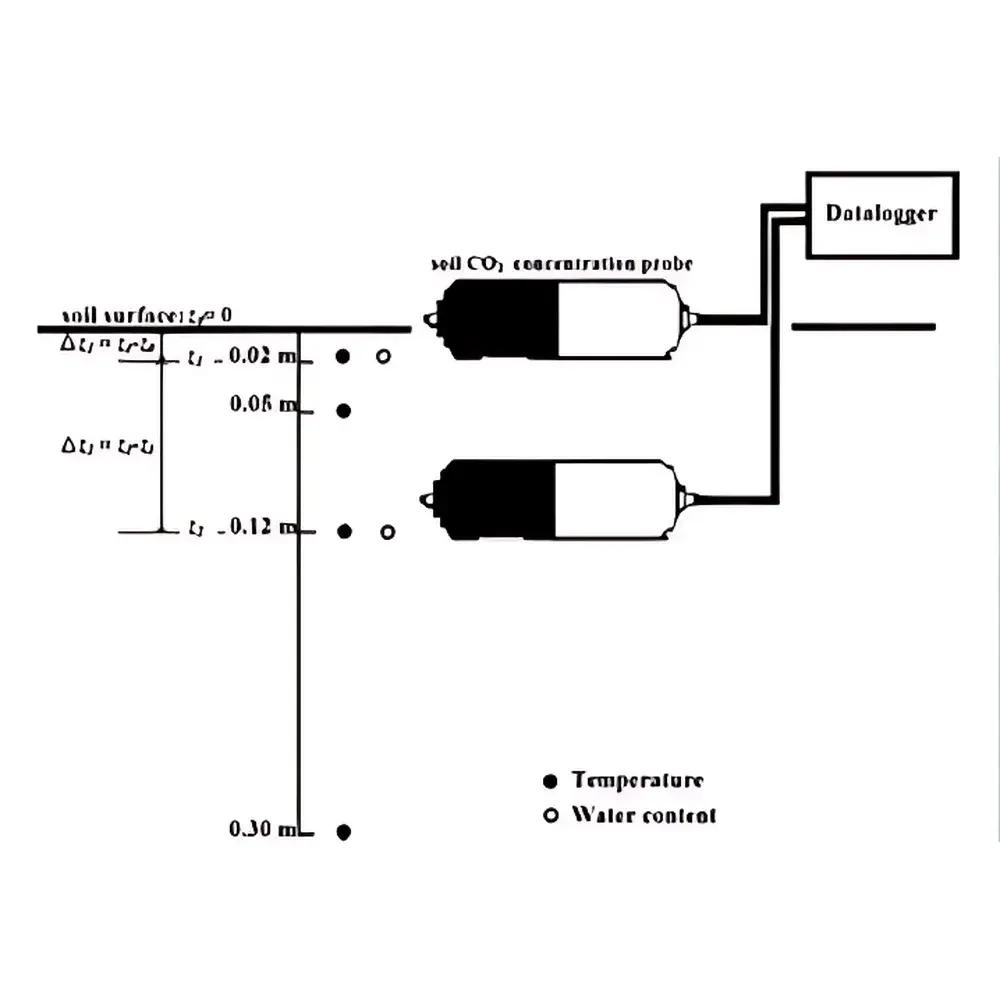
The SoilCO2 Flux Auto-Monitoring Station SCF-3000 is a field-deployable, multi-layer soil carbon flux observation system engineered for high-temporal-resolution, non-invasive quantification of soil-atmosphere CO₂ exchange. It integrates two core modules: the open-chamber SoilBox unit for surface CO₂ efflux measurement and the SCG-3 subsurface CO₂ profiling unit for vertical gradient-based flux estimation via Fick’s first law of diffusion. Unlike closed static chambers or single-point IR probes, the SCF-3000 implements differential, real-time NDIR spectroscopy across multiple depths and surface microsites—enabling concurrent analysis of biogenic CO₂ production, transport dynamics, and boundary-layer exchange. Designed for long-term ecological research, eddy covariance validation, and soil respiration modeling, the system operates autonomously under variable field conditions—including freeze-thaw cycles, rainfall events, and diurnal temperature shifts—while maintaining traceable calibration integrity per ISO 17025-aligned maintenance protocols.
Key Features
- Open-design SoilBox chamber eliminates pressure differentials between chamber headspace and ambient atmosphere, minimizing artificial drawdown artifacts during dynamic CO₂ efflux measurement.
- Dual-wavelength NDIR sensors (surface and subsurface) deliver stable, drift-compensated CO₂ concentration readings with automatic temperature, pressure, and relative humidity compensation—critical for cross-site comparability in multi-climate studies.
- Modular SCG-3 probe supports up to three standard depth levels (e.g., 5, 15, and 30 cm) with optional expansion to five layers; each node integrates TRIME-PICO32 dielectric sensors for simultaneous volumetric water content, soil temperature, and bulk electrical conductivity.
- Configurable environmental monitoring suite includes air temperature/humidity (±0.2 °C, ±2% RH), PAR or total solar radiation (±5%), and integrated GPS-stamped timestamping synchronized to the onboard RTC (real-time clock).
- 12-channel, 16-bit data logger enables synchronous acquisition across all analog and digital inputs; programmable sampling intervals (3 seconds to 4 hours) support both high-frequency pulse detection and seasonal trend analysis.
- Gas handling subsystem features a low-pulsation diaphragm pump and calibrated thermal mass flow meter (0–2000 mL/min, ±2% full scale), ensuring repeatable flow rates essential for diffusion-based flux calculations and sensor response stability.
Sample Compatibility & Compliance
The SCF-3000 is validated for use across diverse pedological contexts—including loam, clay, sandy, and organic-rich soils—as well as managed (agricultural, afforested) and natural (tundra, grassland, forest floor) ecosystems. Its non-intrusive deployment minimizes soil disturbance, satisfying ASTM D6912-22 requirements for in situ soil gas monitoring. All sensor firmware and data logging routines comply with GLP principles, supporting audit trails, user-access controls, and electronic signature capability when paired with optional FDA 21 CFR Part 11–compliant software extensions. Calibration certificates for NDIR sensors are traceable to NIST-standard gas mixtures; TRIME-PICO32 units carry factory calibration reports aligned with ISO/IEC 17025 standards.
Software & Data Management
The station ships with SoilFlux Pro™ v4.x—a Windows-based desktop application enabling full system configuration, remote diagnostics, and post-processing of raw time-series datasets. Key capabilities include: automated flux calculation using linear/nonlinear regression of concentration vs. time curves (Hutchinson & Mosier, 1981); vertical CO₂ gradient integration via Fickian diffusion modeling; co-registration of soil moisture/temperature anomalies with CO₂ pulses; and export to CSV, NetCDF, or MATLAB-compatible formats. Optional cloud synchronization (via LTE/GPRS modem add-on) supports near-real-time dashboard visualization and alerting for threshold breaches (e.g., >5000 ppm subsurface CO₂). All data files embed embedded metadata tags (sensor ID, depth, calibration date, operator ID), facilitating FAIR (Findable, Accessible, Interoperable, Reusable) data management practices.
Applications
- Quantifying seasonal and diurnal patterns of soil respiration in response to climate drivers (soil temperature, moisture, snow cover).
- Validating and parameterizing terrestrial biosphere models (e.g., CLM, ORCHIDEE) through high-resolution CO₂ gradient profiles.
- Assessing carbon sequestration potential in restored wetlands, biochar-amended fields, or no-till agricultural systems.
- Integrating with minirhizotron (BTC-100) root imaging data to correlate fine-root turnover, exudation rates, and rhizosphere CO₂ hotspots.
- Supporting eddy covariance tower networks by providing ground-truthed footprint-weighted soil flux estimates at sub-hourly resolution.
- Monitoring CO₂ accumulation risk in landfill caps, geologic CO₂ storage sites, or volcanic soils where subsurface gas migration is a regulatory concern.
FAQ
How does the SCF-3000 differentiate between autotrophic and heterotrophic soil respiration?
It does not directly partition respiration sources. However, when deployed alongside root exclusion treatments (e.g., trenching, mesh barriers) or combined with minirhizotron root phenology data, users can infer contributions using established subtraction or isotopic (δ¹³C) methodologies.
Can the system operate unattended for over six months?
Yes—when powered by a 20 Ah deep-cycle battery + 40 W solar panel (recommended configuration), the SCF-3000 achieves continuous operation for ≥180 days in temperate zones with ≥3 h daily insolation.
Is the NDIR sensor susceptible to cross-sensitivity from water vapor or methane?
No. The dual-wavelength architecture and proprietary optical filtering eliminate interference from H₂O (up to 100% RH) and CH₄ (≤10,000 ppm), as verified per IEC 60770-1 interference testing protocols.
What level of technical support is provided for data interpretation?
Standard warranty includes access to the SoilFlux Knowledge Base, quarterly webinars on flux modeling best practices, and priority email consultation with application scientists holding PhDs in soil biogeochemistry.
Are replacement sensors and calibration gases available globally?
Yes—NDIR modules, TRIME-PICO32 probes, and certified CO₂/N₂ calibration blends (0–10,000 ppm) are stocked in regional distribution hubs across North America, EU, and APAC, with lead times ≤10 business days.







