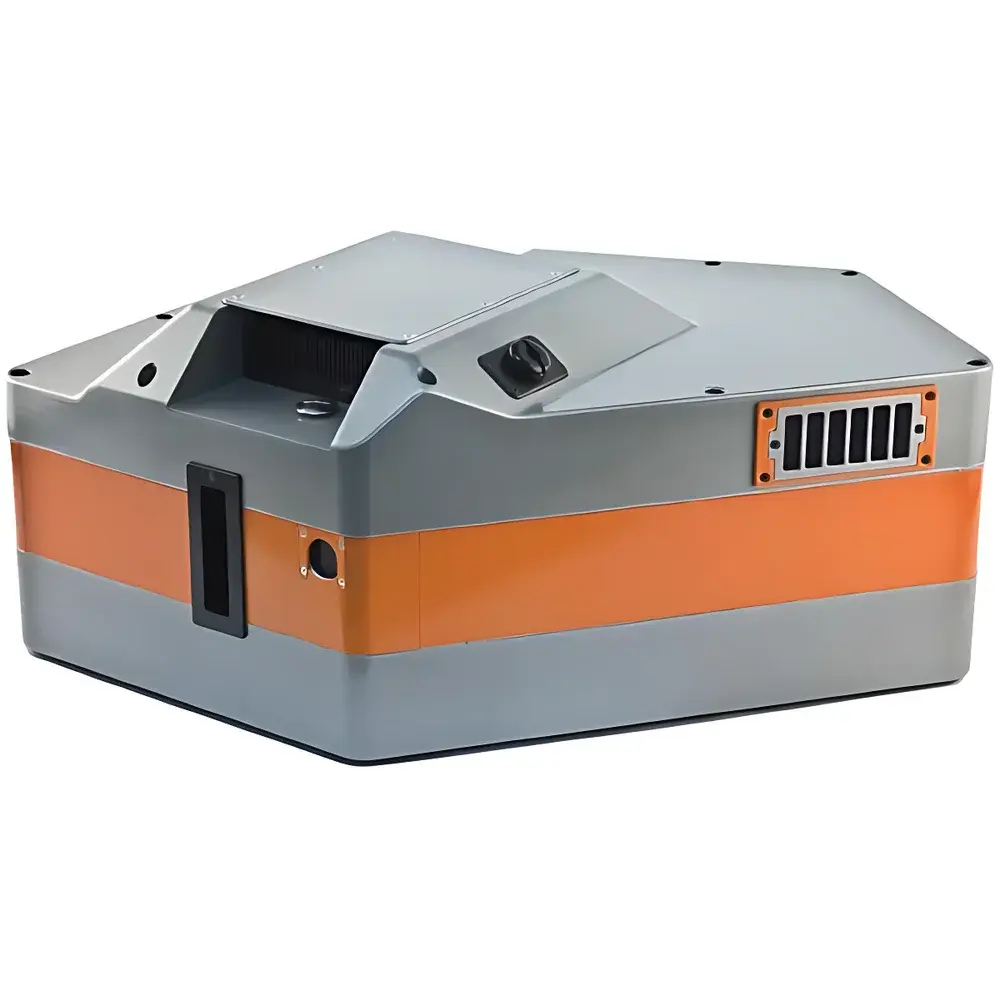
Specim AisaFENIX Short-Wave Infrared (SWIR) and Visible-Near-Infrared (VNIR) Full-Spectrum Hyperspectral Imaging System
| Brand | Specim |
|---|---|
| Origin | Czech Republic |
| Model | AisaFENIX |
| Spectral Range | 380–2500 nm |
| Optical Throughput | >65% |
| SNR (VNIR) | 600–1000:1 |
| SNR (SWIR) | ≥1050:1 |
| Spectral Sampling | up to 620 bands |
| Spatial Resolution | 384 pixels |
| Frame Rate | up to 100 Hz |
| F-number | F/2.4 |
| Smile/Keystone Distortion | <0.2 pixels |
| Polarization Sensitivity | Negligible |
| Data Interface | CameraLink (12-bit VNIR, 16-bit SWIR) |
| Power Consumption | <150 W typical, <500 W peak |
| Operating Temperature | +5°C to +40°C (non-condensing) |
| Storage Temperature | −20°C to +50°C |
| Detector Technology | CMOS (VNIR), Stirling-cooled MCT (SWIR) |
| Spectral Resolution | 3.5 nm (VNIR), 12 nm (SWIR) |
| FOV | 32.3° |
| IFOV | 0.084° |
| Spectral Binning Options | 2×, 4×, 8× (VNIR) |
Overview
The Specim AisaFENIX is a field-deployable, full-spectrum hyperspectral imaging system engineered for simultaneous acquisition of high-fidelity spectral data across the visible–near-infrared (VNIR: 380–970 nm) and short-wave infrared (SWIR: 970–2500 nm) domains. Unlike conventional multi-sensor architectures requiring complex geometric co-registration and radiometric cross-calibration, the AisaFENIX implements Specim’s proprietary “single-optics dual-spectrometer” architecture. This design utilizes one shared fore-optic and a single entrance slit, with two independent diffraction gratings—optimized respectively for VNIR and SWIR—and two physically separate, spectrally matched focal plane arrays (CMOS for VNIR; Stirling-cooled HgCdTe for SWIR). As a result, all spectral bands are spatially registered at the pixel level without dependence on target distance or post-acquisition alignment correction—a critical advantage for airborne, turret-mounted, or mobile ground-based applications where platform stability and real-time georeferencing are constrained.
Key Features
- Single-optics dual-spectrometer architecture ensuring intrinsic spatial-spectral co-registration across 380–2500 nm
- High optical throughput (>65%) and low optical distortion (<0.2 pixels smile/keystone)
- Two independently optimized detectors: high-speed CMOS (VNIR) and cryogenically stabilized MCT (SWIR)
- Independent exposure control per spectral region enables adaptive integration under variable illumination conditions
- Compact, lightweight mechanical design—75% reduction in volume and mass versus legacy dual-sensor systems—enabling integration on medium UAVs, gimbal turrets, and vehicle-mounted platforms
- Real-time frame rates up to 100 Hz with programmable integration time synchronized across both spectral arms
- Flexible spectral binning (2×, 4×, 8×) in VNIR for trade-off between SNR, spectral resolution, and data volume
- Polarization-insensitive throughput ensures radiometric consistency regardless of surface reflectance polarization state
Sample Compatibility & Compliance
The AisaFENIX is designed for non-contact, standoff spectroscopic analysis of heterogeneous natural and anthropogenic surfaces—including vegetation canopies, mineral outcrops, soil substrates, water bodies, man-made materials, and concealed substances. Its spectral coverage aligns with key absorption features of chlorophyll, cellulose, lignin, nitrogenous compounds, hydrocarbons, carbonates, clays, and trace organic volatiles. The system complies with international standards for airborne remote sensing instrumentation, including ASTM E2799 (Standard Guide for Airborne Hyperspectral Imaging Systems), ISO 17289 (Remote sensing—Calibration and validation of hyperspectral sensors), and supports GLP/GMP-aligned data workflows when integrated with validated acquisition and processing software. Radiometric calibration is traceable to NIST-certified standards; geometric calibration includes factory-measured boresight offsets and lens distortion models for direct integration into photogrammetric and GIS pipelines.
Software & Data Management
Data acquisition is managed via Specim’s proprietary IQ software suite, supporting real-time preview, hardware-triggered capture, and metadata-embedded raw data export (12-bit VNIR, 16-bit SWIR) in standard formats including ENVI-compatible BIL and HDF5. The system interfaces seamlessly with third-party processing environments such as MATLAB, Python (with hyperspy, scikit-image, and GDAL), and commercial platforms like ENVI, ERDAS IMAGINE, and PCI Geomatica. All acquired data include embedded GPS/IMU timestamps, attitude quaternions, and sensor telemetry—enabling rigorous georeferencing and orthorectification. Audit trails, user access logs, and immutable metadata recording satisfy requirements for FDA 21 CFR Part 11–compliant environments where data integrity and chain-of-custody are mandated, particularly in forensic, defense, and regulatory monitoring applications.
Applications
- Environmental Monitoring: Quantitative assessment of chlorophyll-a concentration, turbidity, CDOM, and hydrocarbon contamination in inland and coastal waters; detection of cyanobacterial blooms and submerged aquatic vegetation
- Agriculture & Forestry: Early stress detection in crops (water deficit, nutrient deficiency, pest infestation); species-level classification of invasive flora (e.g., Phragmites, emerald ash borer–damaged ash); forest health mapping using biochemical indices (NDVI, PRI, MCARI)
- Geological Surveying: Lithological mapping, alteration zone identification (e.g., kaolinite, alunite), mine waste characterization, and geothermal feature delineation via thermal emissivity contrast in SWIR
- Defense & Law Enforcement: Camouflage material discrimination, detection of improvised explosive device (IED) precursors (e.g., ammonium nitrate, urea nitrate), illicit crop identification (cannabis, opium poppy, coca), and concealed object detection beneath foliage or thin cover
- Disaster Risk Assessment: Fuel load estimation in wildland–urban interface zones; post-fire burn severity mapping; floodplain delineation and sediment transport modeling via spectral unmixing of inundated vs. dry surfaces
FAQ
Does the AisaFENIX require external calibration sources during operation?
No—factory calibration includes absolute radiometric, spectral, and geometric coefficients. Field verification may be performed using portable reflectance panels or calibrated light sources, but routine recalibration is not required between missions.
Can VNIR and SWIR data be acquired simultaneously with identical ground sampling distance (GSD)?
Yes—the shared fore-optic and co-registered detector geometry ensure identical instantaneous field of view (IFOV) and spatial sampling across both spectral ranges, eliminating resampling artifacts common in fused multi-sensor systems.
Is the system compatible with RTK-GNSS and high-accuracy IMUs?
Yes—AisaFENIX provides dedicated synchronization I/O (TTL triggers, PPS input) and supports industry-standard GNSS/IMU protocols (e.g., NovAtel SPAN, Applanix POS AV) for centimeter-level geopositioning and sub-degree attitude resolution.
What is the maximum operational altitude for UAV deployment?
The system has been validated for stable operation at altitudes up to 5,000 m ASL, provided ambient temperature remains within the specified operating range (+5°C to +40°C) and vibration levels comply with MIL-STD-810G Class 3 shock/vibration profiles.
How is spectral data validated for quantitative analysis?
Each unit ships with NIST-traceable radiometric calibration certificates, spectral response function (SRF) files, and laboratory-measured linearity curves. Validation datasets—including standardized reflectance targets and controlled illumination scenarios—are available upon request for method development and QA/QC protocol implementation.