
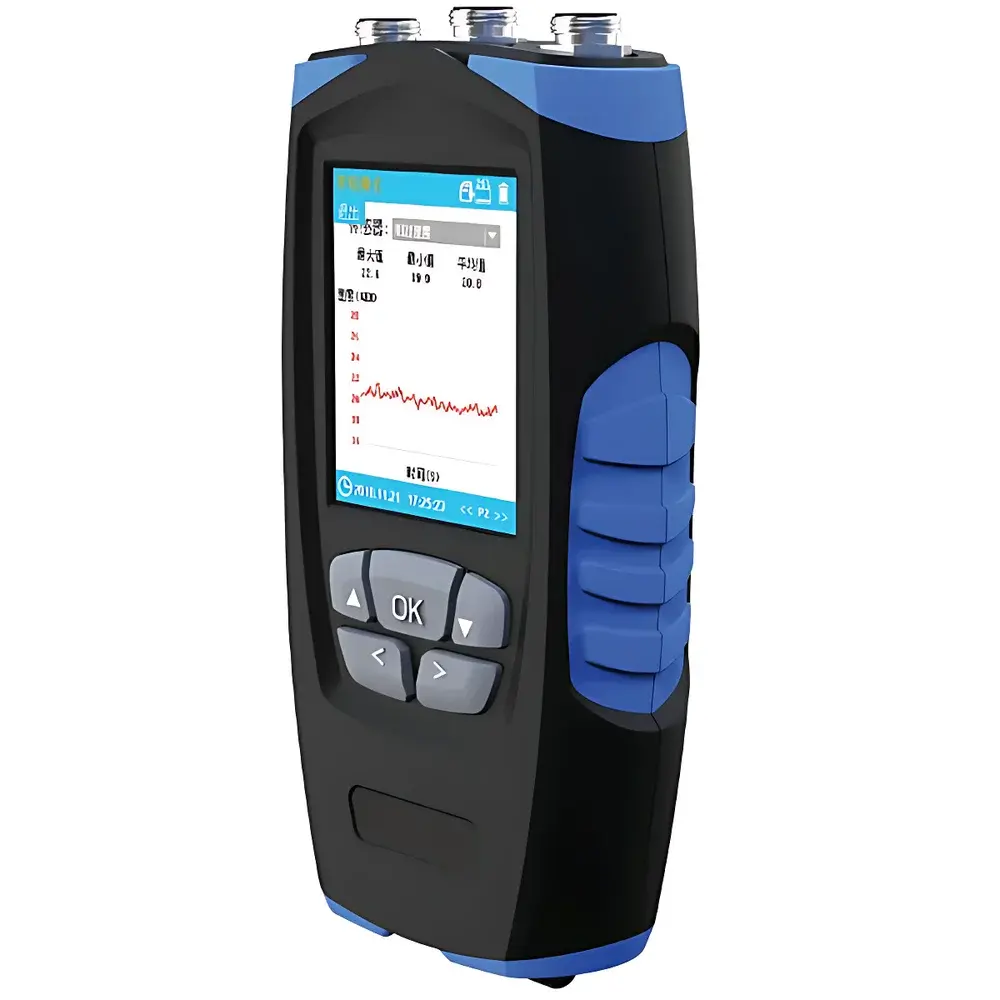
BJBY BY-2020-2 WBGT Index Meter
| Brand | BJBY |
|---|---|
| Origin | Beijing, China |
| Model | BY-2020-2 |
| Black Globe Temp. Range | 0–120 °C, ±0.5 °C |
| Wet-Bulb Temp. Range | 0–50 °C, ±0.5 °C |
| Ambient Temp./RH Sensor | −20–120 °C / 0–100% RH, ±0.5 °C / ±3% RH |
| Display | 3.5″ color touch LCD |
| Power | 5000 mAh Li-ion, ≥96 h standby |
| Enclosure | ABS + overmolded TPE, IP30 |
| Mounting | 1/4″ tripod thread |
| Connectivity | M12 digital ports (3×), K-type thermocouple (2×), analog inputs (2×, 0–2 V), Bluetooth 5.0 (≥20 devices), USB-C, Wi-Fi, microSD slot |
Overview
The BJBY BY-2020-2 WBGT Index Meter is a field-deployable, multi-sensor environmental monitoring instrument engineered for quantitative thermal stress assessment in occupational and industrial settings. It implements the internationally standardized Wet-Bulb Globe Temperature (WBGT) index calculation per ISO 7243:2017, ACGIH TLV® guidelines, and GBZ/T 189.7–2007. The device integrates three independent, calibrated physical measurements—dry-bulb temperature (Tdb), natural wet-bulb temperature (Twb), and black-globe temperature (Tg)—to compute real-time WBGT values under both indoor and outdoor conditions. Unlike ambient-only thermometers, the BY-2020-2 accounts for radiant heat load via its 50 mm stainless-steel black globe sensor, enabling accurate characterization of thermal environments dominated by infrared emission from furnaces, molten metal, glass kilns, or solar exposure. Its architecture supports concurrent acquisition from up to seven sensor types—including K-type thermocouples, RS485-enabled anemometers, and analog radiation heat flux sensors—making it suitable for comprehensive heat stress audits compliant with OSHA 29 CFR 1910.137 and EU Directive 89/654/EEC.
Key Features
- Triple-sensor thermal core: Simultaneous high-accuracy measurement of dry-bulb (−20–120 °C), wet-bulb (0–50 °C), and black-globe (0–120 °C) temperatures, all with ±0.5 °C uncertainty and 0.1 °C resolution
- Digital sensor interface: Three 6-pin M12 connectors supporting daisy-chained digital sensors (e.g., PT100, DS18B20, RS485 anemometers) with automatic ID recognition and calibration data retention
- Modular analog & thermocouple inputs: Dual K-type thermocouple channels and dual 0–2 V analog inputs (0.01 mV resolution, ±0.5% full scale) for integration with heat flux plates, pyranometers, or custom radiation detectors
- Field-rugged design: IP30-rated enclosure with ABS/TPE overmold, integrated 1/4″ tripod mount, detachable anti-slip wrist strap, and 175 × 92 × 38 mm compact footprint optimized for handheld or fixed-mount operation
- Extended autonomy: 5000 mAh rechargeable lithium battery delivering ≥96 hours of standby time (no active sensors) and ≥12 hours of continuous multi-channel logging at 10-second intervals
- Multi-protocol connectivity: Onboard Wi-Fi (802.11 b/g/n), Bluetooth 5.0 (supporting >20 concurrent BLE sensors), USB-C host/device mode, and microSD card (up to 512 GB) for offline data archiving
Sample Compatibility & Compliance
The BY-2020-2 is validated for use across occupational hygiene, foundry safety, power generation, construction, and military training environments where radiant heat exposure exceeds 500 W/m². It meets the physical and metrological requirements of ISO 7243:2017 (Ergonomics of the thermal environment — Estimation of the heat stress on working individuals based on the WBGT index), ISO 7730:2005 (Ergonomics of the thermal environment — Analytical determination and interpretation of thermal comfort using calculation of the PMV and PPD indices), and corresponding national standards GB/T 18049–2000 and GBZ/T 189.7–2007. Sensor configurations comply with ASTM E1957–22 for black globe geometry and airflow specifications. Data logging workflows support GLP-aligned audit trails when used with Soft-DM software under Windows 10/11; raw CSV exports include timestamp, sensor ID, raw ADC counts, and applied calibration coefficients—enabling traceability to NIST-traceable reference standards.
Software & Data Management
The included Soft-DM desktop application (Windows 7–11 compatible) provides full configuration, real-time telemetry visualization, post-processing, and regulatory reporting. Users may define custom sampling intervals (10 s to 90 min 50 s), apply sensor-specific linear or polynomial calibration curves, and generate WBGT time-series plots overlaid with ACGIH TLV® thresholds. PMV and PPD indices are computed dynamically when wind speed, relative humidity, air temperature, and black-globe temperature are simultaneously available—adhering strictly to the Fanger equation framework in ISO 7730. All stored datasets include embedded metadata (GPS coordinates if external module attached, operator ID, site name, sensor serial numbers), and export as ISO-compliant CSV files with UTF-8 encoding. The system supports FDA 21 CFR Part 11–ready optional user authentication and electronic signature modules for regulated industries.
Applications
- Occupational heat stress surveillance in steel mills, aluminum smelters, and glass manufacturing facilities
- Validation of engineering controls (e.g., radiant shields, local exhaust ventilation) per AIHA RP-1 guidance
- Construction site thermal risk mapping during summer operations or confined-space work
- Military and firefighting training scenario evaluation under simulated radiant load conditions
- Validation of HVAC performance in data centers and cleanrooms where radiant asymmetry affects occupant comfort
- Academic research in environmental ergonomics, climate adaptation physiology, and urban heat island mitigation studies
FAQ
What standards does the BY-2020-2 comply with for WBGT measurement?
It conforms to ISO 7243:2017, ACGIH TLV® for Heat Stress, OSHA Technical Manual Chapter 3, and Chinese national standards GBZ/T 189.7–2007 and GB/T 934–2008.
Can the instrument calculate PMV/PPD without external wind speed input?
No. PMV and PPD calculations require concurrent measurements of air temperature, mean radiant temperature (derived from black globe), relative humidity, air velocity, metabolic rate, and clothing insulation—per ISO 7730 Annex B.
Is the black globe sensor interchangeable with other diameters?
The standard 50 mm stainless-steel globe meets ISO 7243 geometric requirements; alternative sizes (e.g., 150 mm) are not supported due to thermal mass and response time constraints defined in the standard.
Does the device support calibration certificate traceability to national metrology institutes?
Yes—factory calibration reports include uncertainties referenced to CNAS-accredited laboratories; end users may perform field verification using NIST-traceable dry-well calibrators and humidity generators.
How is data integrity ensured during long-term unattended logging?
MicroSD writes use journaling file system (FAT32 with wear leveling); each record includes CRC32 checksums, and Soft-DM validates file integrity upon import.







