
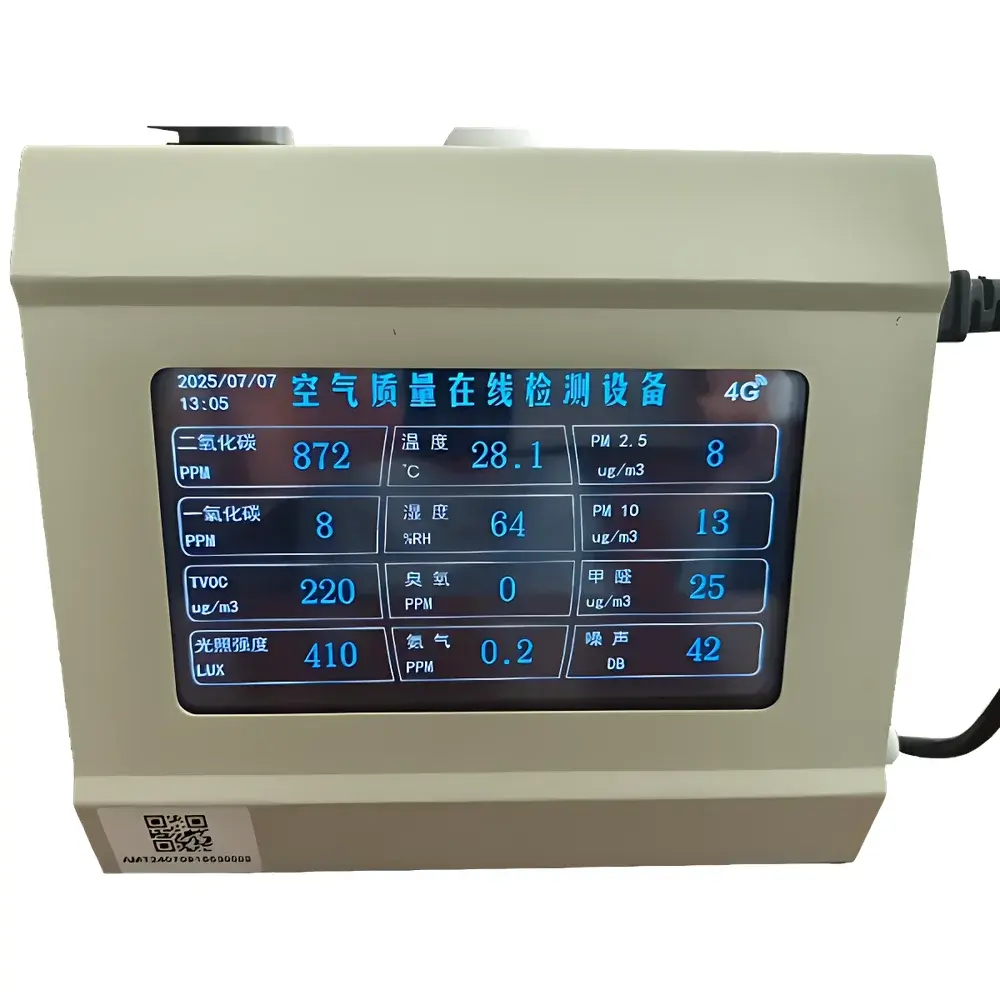
BJBY BY-AQ Series Indoor Air Quality Online Monitoring System
| Brand | BJBY |
|---|---|
| Origin | Beijing, China |
| Manufacturer Type | Authorized Distributor |
| Country of Origin | China |
| Model | BY-AQ |
| Pricing | Available Upon Request |
| Communication | Wi-Fi or 4G (Optional) |
| Display | LCD |
| Dimensions | 240 × 216 × 78 mm (L×W×H) |
| Housing | Anodized Aluminum + ABS Engineering Plastic |
| Weight | ~205 g |
| Sensor Types | NDIR (CO₂), Laser Scattering (PM2.5/PM10), Electrochemical (HCHO, NH₃, CO, O₃), Semiconductor (TVOC), Capacitive (RH), Thermistor (Temp), Photodiode (Illuminance), MEMS Microphone (Noise) |
Overview
The BJBY BY-AQ Series Indoor Air Quality Online Monitoring System is an embedded, real-time environmental sensing platform engineered for continuous, unattended measurement of critical indoor air parameters in commercial buildings, educational facilities, healthcare environments, and smart office spaces. Operating on a modular sensor architecture, the system integrates multiple high-stability transducers—including non-dispersive infrared (NDIR) for carbon dioxide, laser scattering photometry for particulate matter (PM2.5 and PM10), electrochemical cells for formaldehyde, ammonia, carbon monoxide, and ozone, semiconductor-based detection for total volatile organic compounds (TVOC), capacitive humidity sensors, precision thermistors, photodiodes for illuminance, and MEMS microphones for sound pressure level—within a single compact enclosure. All measurements adhere to fundamental physical principles defined in ISO 16000-23 (indoor air — determination of formaldehyde), ISO 7726 (ergonomics of the thermal environment — instruments for measuring physical quantities), and ASTM D6245 (standard guide for using indoor carbon dioxide concentrations to evaluate building ventilation). Data acquisition occurs at user-configurable intervals (default: 1-minute sampling), with onboard buffering ensuring continuity during transient network outages.
Key Features
- Modular sensor configuration: Select from up to 12 standardized parameters—CO₂ (0–5000 ppm), PM2.5/PM10 (0–999 µg/m³), temperature (−40 to +70 °C), relative humidity (0–100 %RH), formaldehyde (0–3 mg/m³), illuminance (0–1000 lx), noise (30–130 dB), CO (0–1000 ppm), O₃ (0–10 ppm), NH₃ (0–100 ppm), TVOC (0–100 ppm)—with optional expansion for custom gas channels.
- High-fidelity signal conditioning: Each sensor channel features analog front-end filtering, 16-bit ADC resolution, and factory-calibrated linearization to ensure repeatability ≤ ±5 % FS across operating temperature ranges.
- Dual-mode connectivity: Integrated Wi-Fi (IEEE 802.11 b/g/n) and optional LTE Cat-1 4G module support TLS 1.2-secured MQTT or HTTP(S) data transmission to cloud platforms or on-premise SCADA systems.
- Embedded Linux-based controller: ARM Cortex-A7 processor running real-time firmware with watchdog supervision, automatic self-diagnostic routines, and over-the-air (OTA) update capability.
- Robust mechanical design: Enclosure combines anodized aluminum (IP54-rated front panel) with flame-retardant ABS (UL94 V-0), optimized for wall-mount or desktop deployment in HVAC-adjacent zones without airflow obstruction.
Sample Compatibility & Compliance
The BY-AQ system is validated for use in occupied indoor environments compliant with ASHRAE Standard 62.1 (Ventilation for Acceptable Indoor Air Quality), WHO Air Quality Guidelines (2021), and China’s GB/T 18883-2022 (Indoor Air Quality Standard). Sensor response characteristics meet ISO 8573-1 requirements for low-flow sampling integrity; particulate measurement conforms to ISO 29463-1 for aerosol counting efficiency. The device supports GLP-compliant operation via timestamped audit logs, sensor calibration history tracking, and configurable data retention policies. It is compatible with third-party BMS integrations via Modbus RTU/TCP and BACnet/IP protocols. No radioactive sources or hazardous consumables are employed; all electrochemical cells carry CE marking per Directive 2014/30/EU (EMC) and 2011/65/EU (RoHS).
Software & Data Management
Data output is delivered in structured JSON format with UTC timestamps, sensor status flags (e.g., “calibrating”, “out_of_range”, “sensor_fault”), and raw/digitalized values. Local storage retains ≥72 hours of buffered readings (microSD slot optional). Cloud synchronization supports time-series databases such as InfluxDB and TimescaleDB, with RESTful API endpoints enabling integration into enterprise analytics stacks (e.g., Grafana dashboards, Power BI). Firmware includes built-in data validation rules—e.g., cross-parameter plausibility checks (e.g., CO₂ vs. occupancy proxy logic), outlier suppression using Hampel identifiers—and supports 21 CFR Part 11–compliant electronic signatures when deployed with authorized identity providers. Calibration certificates (traceable to NIM, China) are digitally embedded and exportable in PDF/X-1a format.
Applications
- Real-time IAQ verification in LEED- or WELL-certified buildings during commissioning and ongoing operations.
- Occupancy-driven HVAC control feedback loops, where CO₂ and VOC levels trigger demand-controlled ventilation (DCV) setpoint adjustments.
- Post-renovation off-gassing monitoring in schools and hospitals, with automated alerts triggered upon HCHO or TVOC exceedance of GB/T 18883-2022 thresholds.
- Acoustic comfort assessment in open-plan offices, correlating noise events with concurrent PM and CO₂ trends to identify behavioral or mechanical root causes.
- Long-term trend analysis for preventive maintenance scheduling—e.g., detecting gradual PM sensor drift or RH hysteresis indicative of filter saturation or duct leakage.
FAQ
What is the recommended calibration interval for electrochemical gas sensors?
Electrochemical sensors require functional verification every 6 months and full recalibration annually, per IEC 62040-2 guidelines; NDIR CO₂ modules maintain stability for ≥2 years without field recalibration.
Can the BY-AQ system operate independently without cloud connectivity?
Yes—the device logs data locally to internal flash memory and resumes transmission automatically upon network recovery; no data loss occurs during outages lasting <72 hours.
Is the system compatible with existing building management systems (BMS)?
It supports native Modbus TCP and BACnet/IP communication protocols; BACnet object lists include standardized AI/AO points per BACnet Standard Addendum 135a-2020.
How is sensor cross-interference mitigated in multi-gas configurations?
Hardware-level compensation algorithms are preloaded for known interferences (e.g., ethanol on electrochemical HCHO sensors); firmware applies dynamic correction coefficients derived from co-located reference measurements during factory characterization.
Does the device meet cybersecurity requirements for institutional deployment?
Firmware implements TLS 1.2 encryption, certificate pinning, secure boot with signed firmware images, and disabled default credentials—all aligned with NIST SP 800-82 Rev. 3 for industrial IoT devices.
Related Products







