
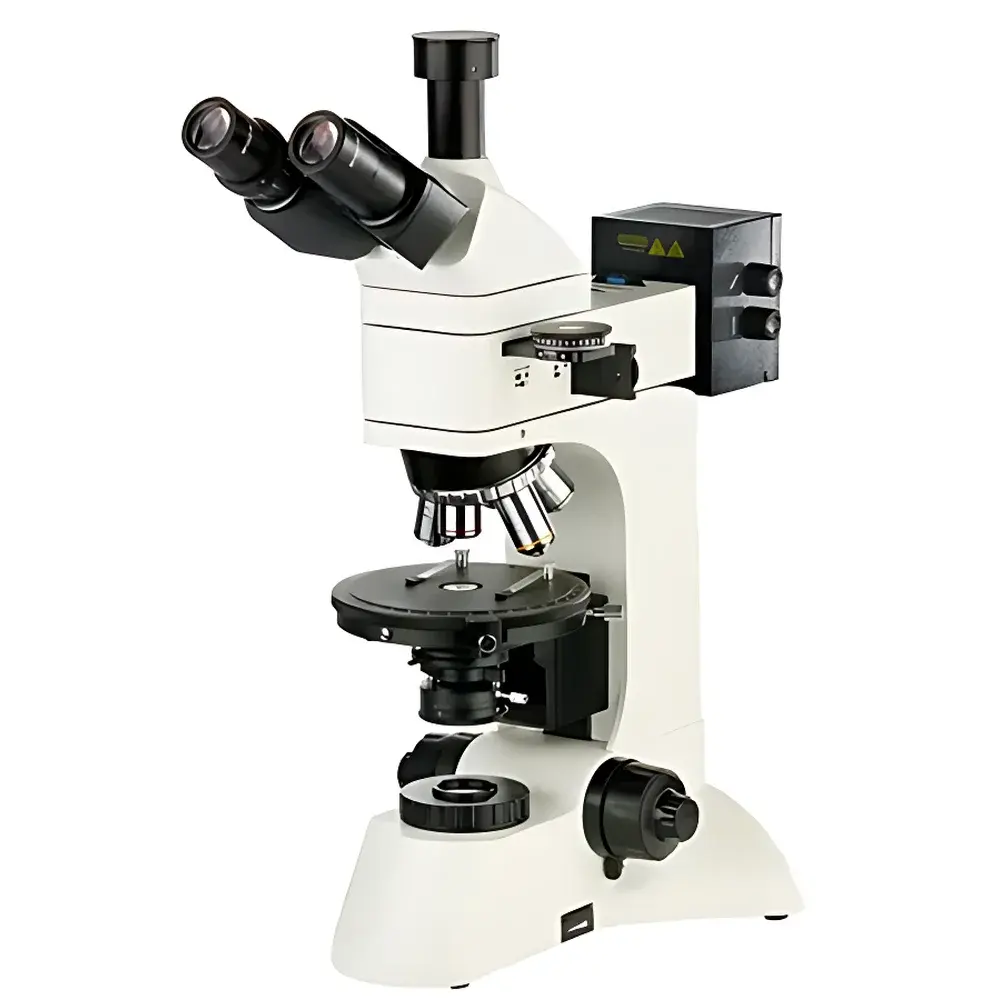
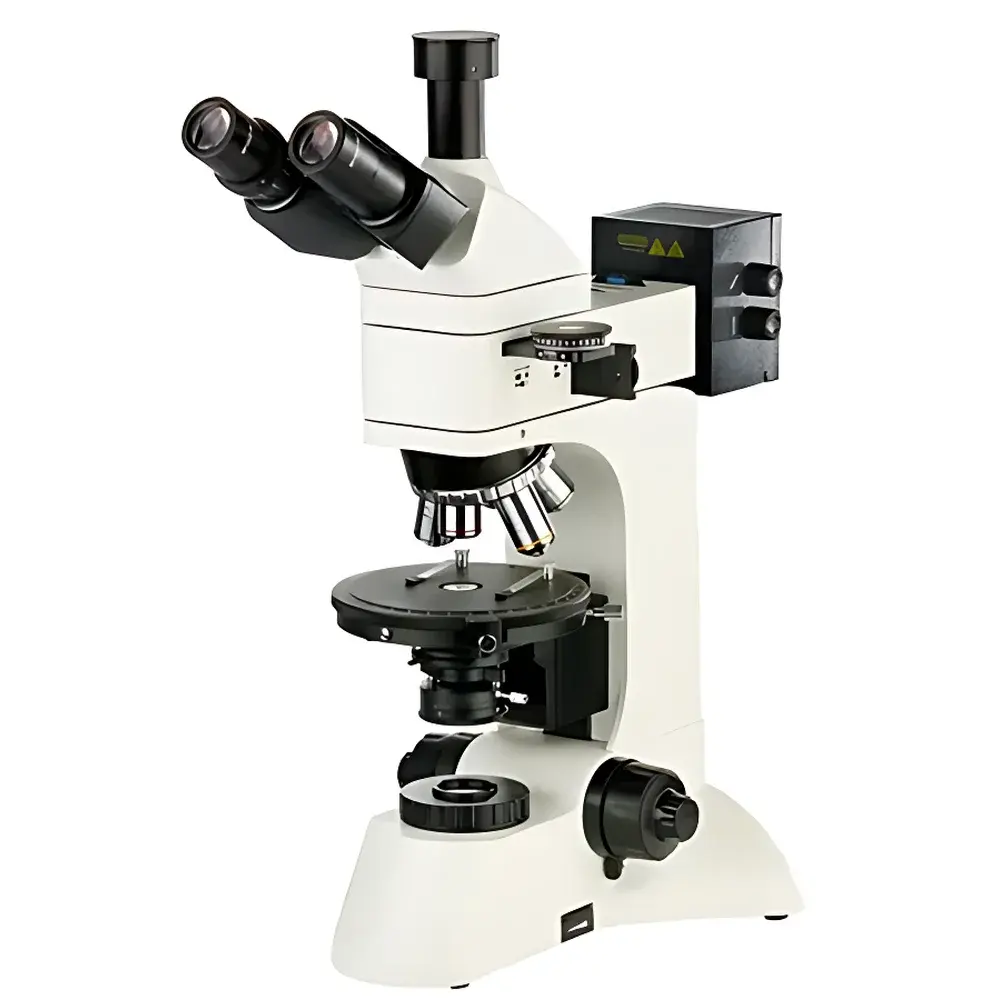
BK-POL Polarizing Microscope
| Origin | Guangdong, China |
|---|---|
| Manufacturer Type | Authorized Distributor |
| Origin Category | Domestic (China-made) |
| Model | BK-POL |
| Price | USD 2,100 (FOB Guangdong) |
| Optical System | Infinity-Corrected |
| Eyepieces | Wide-Field 10× (FN 22 mm), Graticule 10× (0.10 mm/div) |
| Objectives | PL 4×/0.10 (W.D. 19.8 mm), PL 10×/0.25 (W.D. 5.0 mm), PL 40×/0.65 (spring-loaded, W.D. 0.66 mm), PL 60×/0.80 (spring-loaded, W.D. 0.45 mm) |
| Transmitted Illumination | 6 V / 30 W halogen lamp with continuous brightness control and 360° rotatable polarizer (calibrated at 0°, 90°, 180°, 270°) |
| Condenser | Abbe type, NA 1.25, adjustable iris diaphragm |
| Stage | Rotating mechanical stage, Ø150 mm, 360° vernier scale (6′ resolution), center-adjustable & lockable |
| Nosepiece | Quadruple, centering-adjustable |
| Analyzer | Built-in, switchable between brightfield and polarized modes, 90° rotation (12′ vernier scale) |
| Bertrand Lens | Push-in type, center-adjustable |
| Compensators | λ (full-wave), λ/4 (quarter-wave), and quartz wedge |
| Tube | Trinocular, 30° inclination, 100% light path to camera port |
| Focus | Coaxial coarse/fine focus with tension adjustment, locking mechanism, and limit stop |
| fine focus graduation | 2 µm |
| Optional Accessories | 20× and 100× oil immersion objectives (coverslip thickness 0.17 mm), mechanical stage with 30 × 25 mm travel, C-mount adapters (0.5×, 1×), USB digital cameras (1.3 / 2.0 / 3.0 MP), analog video output (380 / 520 TV lines), Canon EF & Nikon F lens mounts |
Overview
The BK-POL Polarizing Microscope is an infinity-corrected, research-grade optical instrument engineered for quantitative birefringence analysis of anisotropic materials. It operates on the fundamental principles of polarized light microscopy—utilizing orthogonal linear polarization states (polarizer and analyzer) to detect and characterize double refraction, optical retardation, extinction angles, and interference colors in crystalline, polymeric, biological, and metallurgical specimens. Its optical architecture integrates stress-free optics, high-precision rotational mechanics, and calibrated compensator systems to support both qualitative identification and semi-quantitative measurement of optical path differences (OPD) down to sub-wavelength resolution. Designed for compliance with ISO 10934-1 (optical microscopy — terminology) and aligned with ASTM D4125 (standard practice for polarized light microscopy of coal and coke), the BK-POL serves as a foundational tool in laboratories requiring reproducible microstructural characterization under controlled polarization conditions.
Key Features
- Infinity-corrected optical pathway ensures chromatic and spherical aberration correction across all magnifications, enabling stable image formation with optional accessories such as CCD adapters and compensators.
- Stress-free plan achromat objectives (PL series) minimize intrinsic birefringence in lens elements—critical for eliminating background artifacts during sensitive retardation measurements.
- Rotatable 360° polarizer and analyzer assemblies feature precision vernier scales (6′ and 12′ resolution respectively), allowing accurate angular alignment of vibration directions essential for crystallographic orientation mapping.
- Integrated Bertrand lens and push-in design facilitate rapid switching between conoscopic and orthoscopic observation modes—supporting full-field interference pattern analysis of uniaxial and biaxial crystals.
- Quadruple objective nosepiece with centering adjustment ensures parfocality and coaxial alignment across magnifications, while spring-loaded high-NA objectives maintain consistent working distance and specimen safety.
- Trinocular tube provides 100% light diversion to imaging ports without compromising eyepiece viewing—enabling simultaneous visual inspection and digital documentation under identical optical conditions.
Sample Compatibility & Compliance
The BK-POL accommodates standard 24 × 50 mm and 26 × 76 mm petrographic slides, as well as metallurgical mounts up to 30 mm in height. Its long-working-distance objectives and adjustable stage accommodate thick-section geological thin sections (up to 30 µm), polished metallographic samples, polymer films, pharmaceutical crystals, and liquid crystal cells. The system supports ISO/IEC 17025-compliant calibration workflows when used with NIST-traceable retardation standards. While not certified for GMP-regulated environments out-of-the-box, its mechanical stability, repeatable stage positioning, and audit-ready manual recording protocols make it suitable for GLP-aligned quality control labs in geoscience, materials science, and pre-formulation development. All optical components comply with RoHS Directive 2011/65/EU regarding hazardous substance restrictions.
Software & Data Management
The BK-POL does not include proprietary acquisition software but interfaces seamlessly with industry-standard platforms via universal C-mount or F-mount adapters. Compatible third-party solutions include ToupView (for live USB camera streaming and measurement annotation), ImageJ/Fiji (with Polarization Plugin for retardation quantification), and Olympus cellSens (via analog video capture). When paired with calibrated λ/4 and quartz wedge compensators, users can generate retardation maps using open-source MATLAB-based algorithms compliant with USP guidelines for birefringence assessment in injectable suspensions. Metadata logging—including polarizer/analyzer angles, objective ID, and exposure settings—is preserved in TIFF and AVI export formats, supporting traceability in regulated documentation workflows.
Applications
- Geological Petrography: Identification of mineral species (e.g., quartz vs. feldspar), determination of optic sign and axial angle in thin sections, and strain analysis in deformed rocks.
- Metallurgy & Materials Science: Grain boundary delineation in aluminum alloys, phase distribution mapping in Ti-6Al-4V, and detection of residual stress-induced birefringence in tempered glass.
- Pharmaceutical Development: Polymorph screening of active pharmaceutical ingredients (APIs), crystallinity assessment of lyophilized formulations, and evaluation of excipient compatibility via birefringent domain morphology.
- Polymer Characterization: Spherulite size distribution in polypropylene, draw ratio analysis in oriented PET films, and degradation monitoring through changes in extinction cross patterns.
- Forensic & Textile Analysis: Fiber identification (e.g., distinguishing cotton from rayon), contaminant particle classification in cleanroom environments, and adhesive curing state evaluation.
FAQ
Is the BK-POL compatible with fluorescence observation?
No—the BK-POL lacks excitation filter cubes, dichroic mirrors, and high-intensity LED/laser illumination required for fluorescence microscopy. It is optimized exclusively for transmitted and reflected polarized light contrast methods.
Can I use oil immersion objectives with this microscope?
Yes—optional 100× oil immersion objectives (NA 1.25, coverslip thickness 0.17 mm) are supported and mechanically compatible with the quadruple nosepiece; however, immersion oil must be non-birefringent (e.g., cedarwood oil or synthetic substitutes meeting ISO 8577 specifications).
Does the system meet FDA 21 CFR Part 11 requirements?
The BK-POL itself is not Part 11–validated; however, when integrated with validated third-party imaging software (e.g., HALO Imaging Platform or Olympus Stream), electronic records generated from its camera outputs may satisfy ALCOA+ data integrity principles under appropriate procedural controls.
What is the maximum specimen height clearance?
With the PL 4× objective engaged and condenser fully lowered, vertical clearance between the top of the stage and the objective front lens exceeds 28 mm—sufficient for most standard metallurgical mounts and thick-section rock samples.
How is calibration verified for quantitative retardation measurements?
Users perform periodic verification using NIST-traceable quartz wedge standards (e.g., Berek or Brace-Köhler wedges) and reference slides containing known retardation values (e.g., 530 nm gypsum plate); angular alignment accuracy is confirmed via interference fringe counting in conoscopic mode.




