
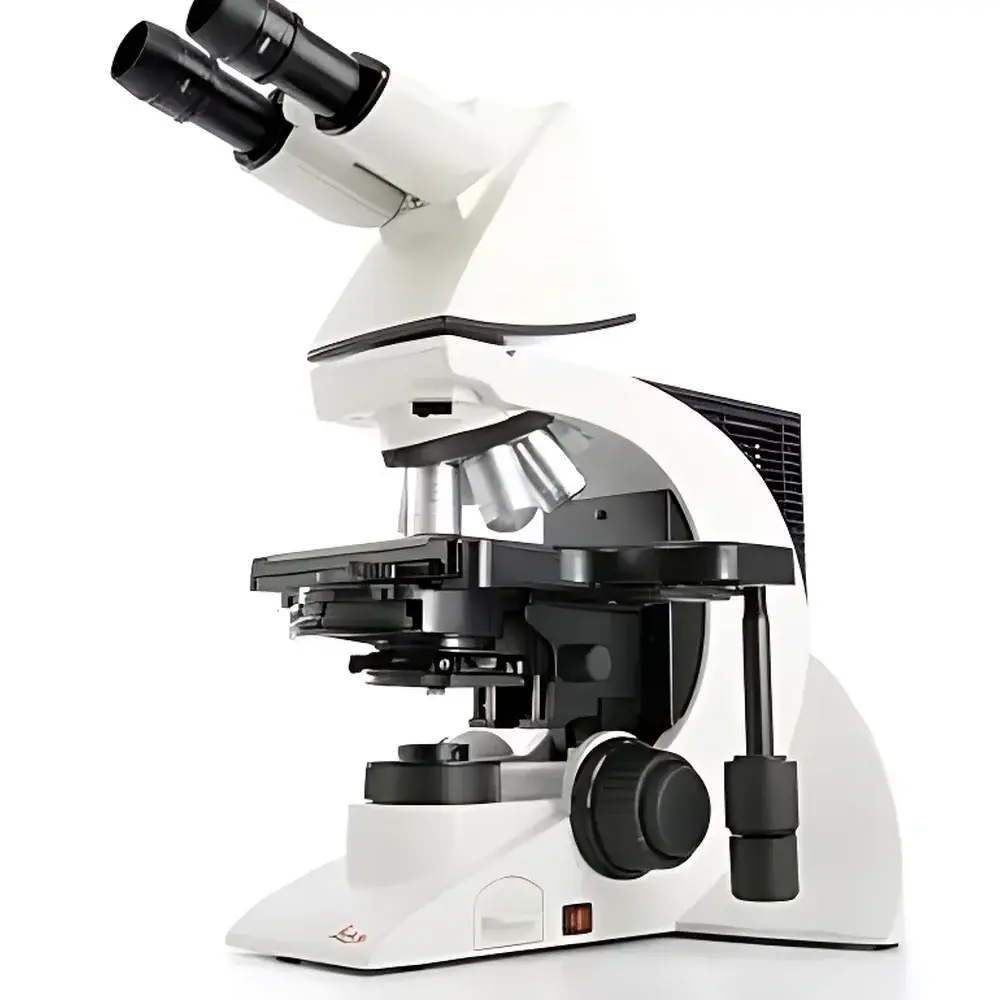
Leica DM2000 Biological Microscope
| Brand | Leica |
|---|---|
| Origin | Germany |
| Model | DM2000 |
| Type | Upright Biological Microscope |
| Illumination | 12 V / 30 W Halogen Lamp (Köhler-optimized) |
| Objective Turret | 6-position or 7-position motorized/manual |
| Eyepieces | 10× widefield (20–25 mm field number), optional high-eyepoint or compensating variants |
| Observation Tube | Binocular or trinocular, inclinable (0–35°), height-adjustable interpupillary distance |
| Fluorescence Module | 5-position filter cube turret with zero-pixel-shift technology |
| Contrast Methods | Brightfield, Darkfield, Phase Contrast, Polarization, Fluorescence |
| Optional Accessories | Digital camera interface (C-mount), drawing tube, teaching head, macro module, zoom optics, ergonomic focus knobs with patented height adjustment |
Overview
The Leica DM2000 is a high-performance upright biological microscope engineered for routine and advanced life science applications in clinical diagnostics, pathology, cytology, and academic research laboratories. Built on Leica Microsystems’ legacy of precision optical engineering, the DM2000 employs a modular, rigid mechanical platform optimized for Köhler illumination and long-term stability. Its optical path supports simultaneous multi-contrast imaging—including brightfield, darkfield, phase contrast, polarization, and fluorescence—enabling comprehensive morphological and functional analysis of fixed and live biological specimens. The system’s design prioritizes user ergonomics and workflow efficiency without compromising optical fidelity, making it suitable for extended daily use in GLP-compliant environments and ISO 15189-accredited medical laboratories.
Key Features
- Modular upright platform with interchangeable contrast modules—no realignment required when switching between brightfield, phase contrast, or fluorescence configurations.
- Patented height-adjustable focusing knobs allow personalized ergonomic positioning to reduce operator fatigue during prolonged observation sessions.
- 6- or 7-position objective turret compatible with Leica’s full range of plan achromat, plan semi-apochromat, and plan apochromat objectives (4× to 100×, oil immersion supported).
- 5-position fluorescence filter cube turret featuring Leica’s zero-pixel-shift technology—ensures precise alignment across excitation/emission bands and eliminates image registration drift between channels.
- Ergonomic inclined binocular or trinocular observation tube (0–35° tilt), adjustable interpupillary distance (55–75 mm), and optional high-eyepoint eyepieces (20–25 mm field number) for users wearing corrective lenses.
- Integrated 12 V / 30 W halogen illuminator with built-in Köhler condenser and centering controls—delivers uniform, glare-free illumination across the entire field of view.
- Tool-free lamp replacement via drawer-style housing—minimizes downtime during routine maintenance and complies with laboratory safety protocols for hot-component handling.
- Synchronized focus and stage control layout—reduces hand movement and enhances operational consistency during slide screening or multi-location imaging tasks.
Sample Compatibility & Compliance
The Leica DM2000 accommodates standard glass microscope slides (76 × 26 mm), petri dishes, culture flasks, and custom specimen holders via optional stage adapters. It supports both fixed tissue sections (paraffin-embedded, frozen) and live-cell preparations (e.g., adherent cultures in chambered coverslips). All optical components meet DIN/ISO 8578 standards for microscope mechanical tube length and parfocality. The system is compatible with ASTM E2191 (standard practice for calibration of microscopes) and supports documentation workflows aligned with FDA 21 CFR Part 11 requirements when integrated with validated digital imaging software (e.g., Leica LAS X). Its construction adheres to IEC 61000-6-3 (EMC emission limits) and IEC 61000-6-2 (immunity), ensuring stable operation in shared laboratory infrastructure.
Software & Data Management
The DM2000 interfaces seamlessly with Leica LAS X Core and LAS X Life Science Edition via C-mount adapter and USB 3.0 or GigE camera coupling. LAS X provides audit-trail-enabled acquisition, multi-channel fluorescence overlay, Z-stack reconstruction, and region-of-interest (ROI) intensity profiling—all compliant with ALCOA+ data integrity principles. Export formats include TIFF (16-bit), OME-TIFF, and JPEG2000 for integration into LIMS or PACS environments. When paired with third-party hardware (e.g., Hamamatsu ORCA-Fusion BT), the system supports time-lapse acquisition with hardware-triggered synchronization and metadata embedding per frame (including objective ID, filter position, exposure time, and stage coordinates).
Applications
- Clinical histopathology: Routine H&E staining evaluation, immunohistochemistry (IHC) scoring, and mitotic index quantification.
- Hematology and cytology: Peripheral blood smear analysis, bone marrow aspirate assessment, and Pap smear screening.
- Cell biology: Live-cell phase contrast monitoring, fluorescent protein localization (e.g., GFP-tagged organelles), and calcium flux imaging using ratiometric dyes.
- Microbiology: Gram staining interpretation, fungal morphology characterization, and acid-fast bacilli detection.
- Academic teaching: Multi-user instruction via optional teaching head or HDMI output; compatible with Leica’s digital classroom solutions for remote annotation and real-time collaboration.
FAQ
Is the Leica DM2000 compatible with LED illumination upgrades?
Yes—Leica offers the DM2000 LED conversion kit (part no. 11506025), which replaces the halogen unit with a 3,500 K white LED source delivering equivalent brightness at lower thermal load and extended lifetime (>25,000 h).
Can the DM2000 be configured for DIC (Differential Interference Contrast)?
No—DIC is not supported on the base DM2000 platform. For DIC capability, Leica recommends the DM2500 or DM6 B series, which feature dedicated Nomarski prism sliders and strain-free optics.
What is the maximum usable magnification with the standard 10× eyepieces and 100× oil objective?
The theoretical maximum useful magnification is ~1,000×, consistent with Abbe diffraction limits for visible light (λ ≈ 550 nm) and numerical aperture constraints of standard 100×/1.25 NA objectives.
Does the DM2000 support motorized Z-focus or stage automation?
Not natively—the DM2000 is manually operated. Motorized focus and XY stage control are available only on the DM2500 and DM6 B platforms.
Are all Leica objective lenses compatible with the DM2000 turret?
Yes—any Leica objective with RMS (Royal Microscopical Society) thread (M25 × 0.75) and designed for finite-conjugate 160 mm tube length or infinity-corrected systems (with appropriate tube lens) will mount and function correctly.
Related Products




