
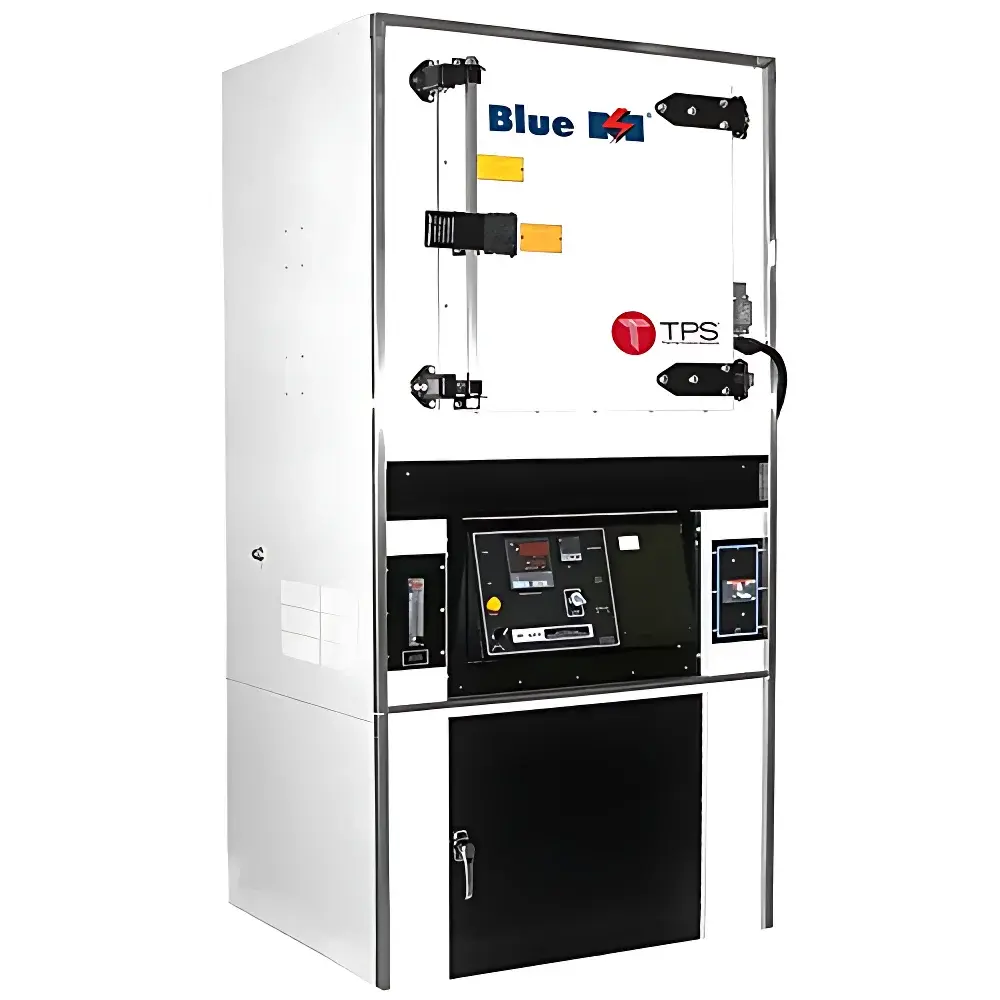
Blue M DCC1406 Anaerobic Drying Oven
| Brand | Blue M |
|---|---|
| Origin | USA |
| Model | DCC1406 |
| Temperature Range | Ambient +15°C to 250°C (482°F) |
| Temperature Uniformity | ±1% (empty chamber, rated voltage) |
| Temperature Stability | ±0.5°C |
| Resolution | ±0.1°C |
| Chamber Dimensions (W×D×H) | 43.8 × 23.7 × 35.7 in (1113 × 602 × 907 mm) |
| External Dimensions (W×D×H) | 63 × 38.6 × 75.2 in (1600 × 980 × 1910 mm) |
| Chamber Volume | 21.6 cu.ft |
| Interior Material | Reinforced 304 Stainless Steel |
| Insulation | 4-inch fiberglass |
| Heating Method | Forced-air convection |
| Door Seal | High-integrity silicone gasket |
| Gas Management | Inert gas recirculation system with top-mounted exhaust valve and adjustable flowmeter |
| Electrical Options | 208–480 VAC, 1- or 3-phase, 50/60 Hz |
Overview
The Blue M DCC1406 Anaerobic Drying Oven is an engineered solution for thermal processing under controlled inert atmospheres—specifically designed for applications requiring oxygen exclusion during drying, curing, aging, or moisture removal. Unlike standard forced-air ovens, the DCC1406 integrates a sealed recirculation path for inert gases (e.g., nitrogen or argon), enabling stable low-oxygen environments (<100 ppm O₂ achievable with proper purge protocols). Its operational principle relies on precision-controlled convection heating combined with hermetic chamber integrity, ensuring uniform thermal distribution while minimizing atmospheric ingress. This architecture supports critical processes in semiconductor packaging, battery electrode drying, pharmaceutical stability testing, and advanced material synthesis—where oxidation sensitivity, residual solvent management, or trace moisture control dictates process fidelity.
Key Features
- Reinforced 304 stainless steel interior chamber—welded construction with removable floor pan for full accessibility and residue-free cleaning.
- 4-inch thick high-density fiberglass insulation—reduces thermal loss and improves energy efficiency across extended dwell cycles.
- Heavy-gauge 16-gauge (1.5 mm) cold-rolled steel exterior housing—powder-coated for long-term corrosion resistance in laboratory and pilot-scale environments.
- Patented Blue M silicone door gasket—designed for repeated compression cycling without degradation, maintaining leak rates <1.0 × 10⁻³ atm·cc/sec helium equivalent per ASTM E493.
- Top-mounted adjustable exhaust valve and calibrated inert gas flowmeter—enabling dynamic atmosphere management during ramp-hold-cool sequences.
- Dual-wall construction with airflow baffling—ensures laminar, uniform air velocity across all chamber zones, validated per ISO 14644-1 Class 8 cleanroom-compatible operation.
Sample Compatibility & Compliance
The DCC1406 accommodates a broad range of sample formats—including trays, crucibles, wafers, pouches, and custom fixtures—without compromising inert integrity. Its chamber geometry permits vertical stacking of multiple racks while preserving gas exchange homogeneity. The oven complies with UL 61010-1 (Safety Requirements for Electrical Equipment for Measurement, Control, and Laboratory Use) and meets CE marking requirements for electromagnetic compatibility (EMC Directive 2014/30/EU). For regulated environments, it supports validation documentation packages aligned with IQ/OQ/PQ protocols per ASTM E2500 and FDA guidance on equipment qualification. Optional data logging modules provide audit-ready temperature history compliant with 21 CFR Part 11 when paired with validated software platforms.
Software & Data Management
The DCC1406 operates via a microprocessor-based digital controller with programmable ramp-soak profiles (up to 16 segments), real-time deviation alarms, and password-protected parameter locking. Optional Ethernet or RS-485 interfaces enable integration into centralized lab monitoring systems (e.g., LabVantage, Siemens Desigo, or custom SCADA). All temperature setpoints, actual readings, alarm events, and door-open durations are timestamped and exportable as CSV files. When configured with optional validation-grade firmware, the system maintains electronic audit trails—including user ID, timestamp, value change, and reason-for-change fields—fully traceable for GLP/GMP audits.
Applications
- Electrode drying for lithium-ion battery manufacturing—preventing transition metal oxidation and SEI layer instability.
- Moisture-sensitive polymer curing—eliminating hydrolysis pathways in polyimide, epoxy, and fluoropolymer coatings.
- Pharmaceutical excipient conditioning—meeting USP packaging stability criteria under inert headspace conditions.
- Microelectronics substrate baking—removing physisorbed water from silicon wafers prior to thin-film deposition.
- Calibration standard storage—maintaining certified reference materials at defined humidity- and oxygen-free conditions.
- Accelerated aging studies—per ASTM D5870 and ISO 188—where oxidative degradation must be decoupled from thermal effects.
FAQ
What inert gases are compatible with the DCC1406?
Nitrogen (N₂), argon (Ar), and forming gas (N₂/H₂) are routinely used; compatibility with other gases depends on chemical reactivity with 304 SS and seal elastomers—consult factory technical bulletin TBN-027 for material compatibility charts.
Can the DCC1406 operate under vacuum?
No—the chamber is not rated for vacuum service; it is engineered for positive-pressure inert gas environments only.
Is third-party calibration support available?
Yes—Blue M-certified field service engineers provide NIST-traceable thermocouple calibration and uniformity mapping per ASTM E2203, with full certification reports.
How is oxygen level monitored inside the chamber?
The DCC1406 does not include an integrated O₂ sensor; users typically integrate external analyzers (e.g., Michell XDT or Systech UV-100) via the auxiliary port on the rear panel.
What maintenance intervals are recommended?
Door gasket inspection every 6 months; airflow filter replacement annually; thermocouple verification semiannually—detailed schedule included in Operation & Maintenance Manual OM-DCC1406 Rev. C.
Related Products



