
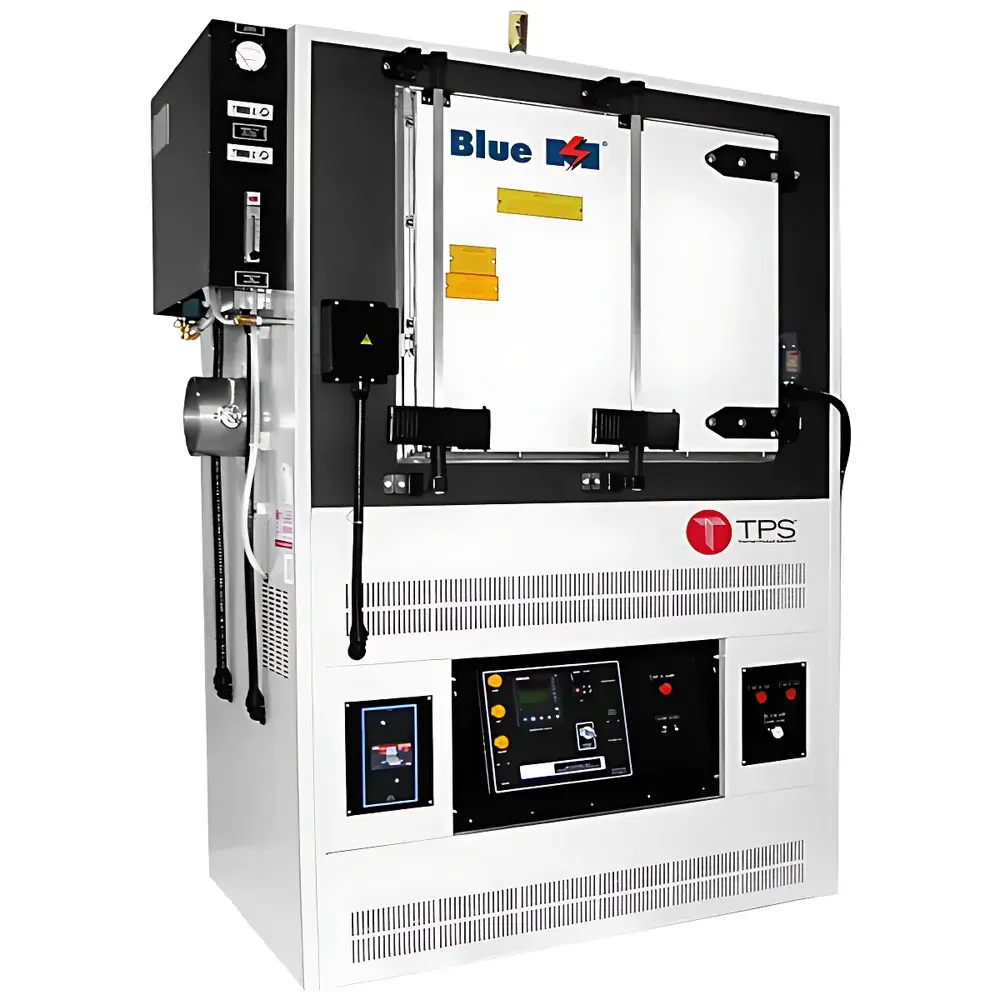
Blue M IGF 8880 Anaerobic High-Temperature Atmosphere Furnace
| Brand | Blue M |
|---|---|
| Origin | USA |
| Model | IGF 8880 |
| Type | Benchtop/Industrial Box-Type Atmosphere Furnace |
| Max Temperature | 593°C (1099°F) |
| Temperature Uniformity | ±2% of setpoint |
| Control Accuracy | ±0.5°C |
| Resolution | ±0.1°C |
| Heating Method | Forced-Air Convection with Incoloy® Sheathed Heating Elements |
| Internal Dimensions | 122 × 61 × 91 cm (W×D×H) |
| Power Rating | 30.0 kW (at 240 VAC, 3-Phase) |
| Insulation | 6-inch mineral wool |
| Door Seal | Fiberglass-reinforced silicone gasket |
| Cooling | Water-cooled door (IGF 8880 & IGF 9980 models) |
| Gas Compatibility | N₂, Ar, He, CO₂, and forming gas (4% H₂ / 96% N₂) |
| Safety Compliance | NFPA 86 Class B |
Overview
The Blue M IGF 8880 Anaerobic High-Temperature Atmosphere Furnace is an engineered solution for thermal processing under controlled inert or reducing atmospheres—designed specifically for applications requiring strict oxygen exclusion, such as sintering of reactive metals, annealing of specialty alloys, ceramic co-firing, catalyst activation, and high-purity semiconductor component conditioning. Unlike standard muffle furnaces, the IGF 8880 integrates a fully welded, leak-tested internal chamber constructed from high-alloy stainless steel, ensuring structural integrity under positive pressure and continuous gas flow. Its forced-air convection system circulates heated inert gas uniformly across the workload, minimizing thermal gradients while maintaining atmospheric stability. The furnace operates within a validated temperature range of ambient +15°C to 593°C (1099°F), with digital PID control delivering ±0.5°C accuracy and ±0.1°C resolution—critical for repeatable process qualification in regulated environments.
Key Features
- Hermetically sealed, fully welded inner chamber prevents gas infiltration into insulation layers—eliminating oxidation pathways and extending furnace service life.
- Water-cooled door assembly (standard on IGF 8880 and IGF 9980) maintains safe surface temperatures during extended high-temperature operation and enables rapid cooldown cycles.
- Integrated gas management system includes dual-stage pressure monitoring, mass-flow-controlled inlet regulation, and automatic purge timing—programmable via front-panel interface.
- Fail-safe interlocks: door switch de-energizes heaters and blower upon opening; over-pressure relief valve activates at preset thresholds; gas leak detection triggers audible/visual alarm and heater shutdown.
- Heavy-duty Incoloy®-sheathed heating elements mounted externally on the chamber walls ensure uniform heat distribution and eliminate contamination risk from element degradation.
- 6-inch mineral wool insulation combined with double-wall construction achieves low external surface temperatures (<45°C at 593°C internal) and minimizes energy consumption.
Sample Compatibility & Compliance
The IGF 8880 accommodates diverse sample geometries—including crucibles, boats, trays, and custom fixtures—within its 11.0 ft³ (0.31 m³) working volume. It supports continuous operation under nitrogen, argon, helium, carbon dioxide, and certified forming gas (4% H₂ / 96% N₂), all verified per ASTM E29–22 for gas purity verification protocols. The furnace complies with NFPA 86 Standard for Ovens and Furnaces (Class B), addressing design, construction, and operational safety requirements for atmosphere-controlled thermal equipment. Optional documentation packages support IQ/OQ validation, including traceable calibration certificates (NIST-traceable thermocouples), pressure decay test reports, and chamber leak-rate verification (≤1.0 × 10⁻³ mbar·L/s at 500°C). For laboratories operating under GLP or GMP frameworks, the system supports audit-ready configuration logs and event-driven data capture aligned with FDA 21 CFR Part 11 principles when integrated with compliant software platforms.
Software & Data Management
While the base IGF 8880 features a dedicated microprocessor-based controller with local setpoint programming, optional Ethernet-enabled controllers (e.g., Watlow F4T or Eurotherm 3508) provide remote monitoring, recipe management, and real-time data logging. These interfaces support Modbus TCP or BACnet/IP protocols for integration into centralized SCADA or MES systems. All temperature, pressure, gas flow, and alarm events are timestamped and stored internally for ≥30 days. Exportable CSV files include full thermocouple channel readings, ramp/soak profiles, and interlock status histories—enabling retrospective analysis per ISO/IEC 17025 clause 7.7 on result reporting. Optional PDF report generation includes operator ID, batch number, and signature fields for electronic record retention.
Applications
- Controlled-atmosphere brazing and diffusion bonding of titanium, aluminum-lithium, and nickel-based superalloys.
- Debinding and sintering of metal injection molded (MIM) components without carbon residue or dimensional distortion.
- Thermal treatment of battery electrode materials (e.g., LiFePO₄, NMC cathodes) under inert conditions to preserve stoichiometry.
- High-temperature annealing of optical fibers and photonic crystal preforms under ultra-low-oxygen nitrogen environments.
- Calibration and aging of high-stability reference resistors and precision strain gauges requiring stable thermal soak conditions.
- Pre-conditioning of catalyst substrates prior to noble-metal impregnation—ensuring reproducible surface area and pore structure.
FAQ
What inert gases are compatible with the IGF 8880?
Nitrogen (N₂), argon (Ar), helium (He), carbon dioxide (CO₂), and forming gas (4% H₂ / 96% N₂) are fully supported. Hydrogen concentrations exceeding 4% require consultation with Blue M engineering for modified safety certification.
Is the furnace suitable for vacuum operation?
No—the IGF series is designed exclusively for positive-pressure inert gas environments. Vacuum capability requires separate vacuum furnace architecture with reinforced chamber design and specialized sealing.
Can the IGF 8880 be validated for GMP production use?
Yes. With optional IQ/OQ documentation, calibrated Class 1 thermocouples, and configurable audit trails, the system meets baseline requirements for pharmaceutical and medical device thermal process validation per USP and ISO 13485 Annex C.
What maintenance intervals are recommended for the water-cooled door?
Coolant level and pH should be verified weekly; closed-loop deionized water systems require biocide replenishment every 6 months and full fluid replacement annually. Heat exchanger fouling inspection is advised quarterly in high-dust environments.
How is temperature uniformity verified across the work chamber?
Uniformity is validated using a 9-point thermocouple mapping procedure per AMS 2750E, conducted at three temperature setpoints (200°C, 400°C, and 593°C) with load simulation. Reports include deviation envelopes and hot/cold zone identification.



