
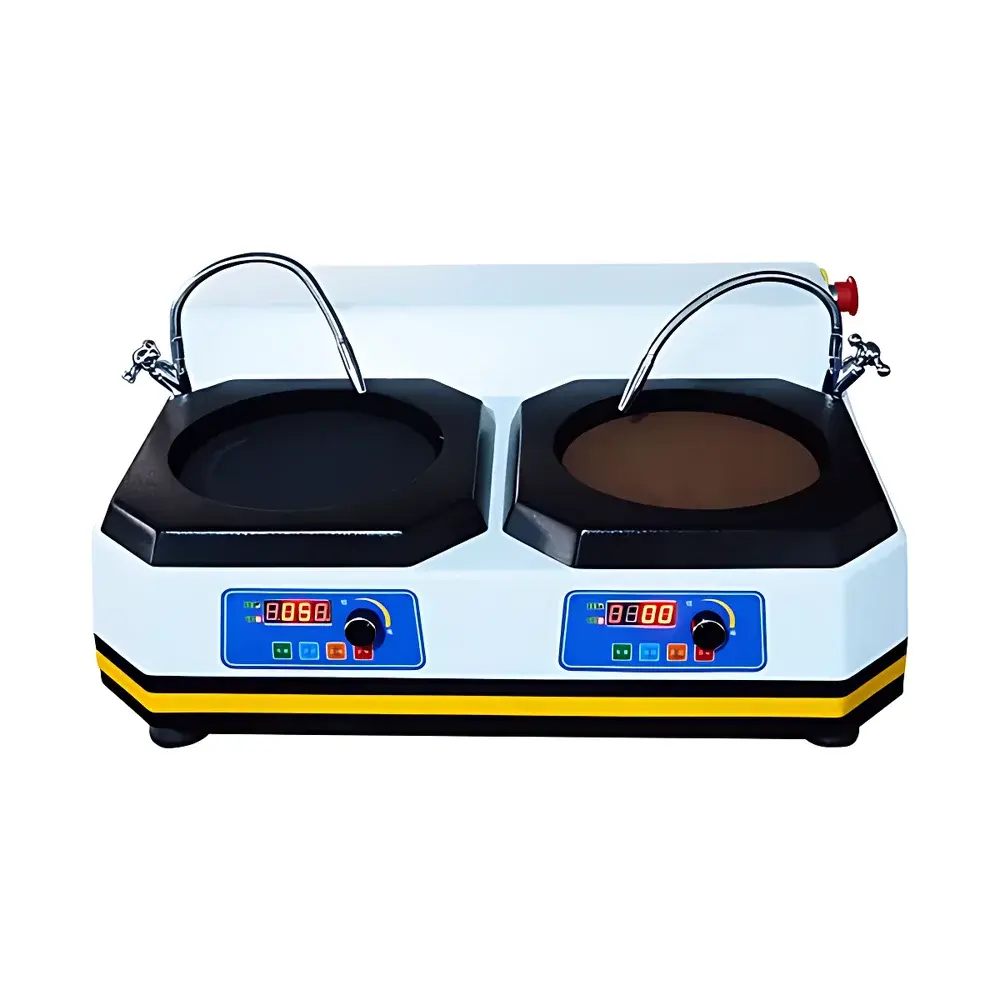
YANRUN MPD-2J Dual-Disk Precision Metallographic Grinding and Polishing System
| Brand | YANRUN |
|---|---|
| Origin | Shanghai, China |
| Manufacturer Type | Direct Manufacturer |
| Region of Origin | Domestic (China) |
| Model | MPD-2J |
| Speed Control | Infinitely Variable 50–1500 rpm + Preset Speed Steps |
| Grinding/Polishing Plate Diameter | φ230 mm (optional: φ200 / φ250 / φ300 mm) |
| Number of Plates | 2 |
| Dimensions (L×W×D) | 650 × 520 × 250 mm |
| Power Supply | 220 V AC |
| Motor Power | 550–750 W per station |
| Drive System | Servo-Controlled Dual-Independent Drives |
| Rotation Direction | Bidirectional (Forward/Reverse selectable per plate) |
| Water Delivery | Adjustable Multi-Directional Nozzle |
Overview
The YANRUN MPD-2J is a dual-disk, benchtop metallographic grinding and polishing system engineered for precision sample preparation in metallurgical, materials science, and quality assurance laboratories. It operates on the principle of controlled mechanical abrasion—using sequentially finer abrasive media (silicon carbide papers, diamond suspensions, and colloidal silica) on rotating plates to progressively remove surface deformation and reveal true microstructural features. Designed for reproducible, operator-independent results, the MPD-2J supports standardized preparation protocols aligned with ASTM E3, ISO 14489, and GB/T 13298–2015 for metallographic specimen preparation. Its dual-plate architecture enables simultaneous or independent operation—e.g., coarse grinding on one disk while fine polishing occurs on the other—reducing cycle time and minimizing cross-contamination risk between preparation stages.
Key Features
- Dual independent servo-driven grinding/polishing stations with fully decoupled speed and direction control—each plate supports forward/reverse rotation and real-time rpm adjustment from 50 to 1500 rpm.
- Infinitely variable speed regulation complemented by programmable preset speed steps, ensuring repeatable adherence to standardized preparation methods (e.g., 150 rpm for final polishing, 600 rpm for intermediate grinding).
- Standard φ230 mm platen with optional interchangeable platens (φ200 mm, φ250 mm, φ300 mm) to accommodate diverse specimen holders, consumable formats, and lab space constraints.
- Adjustable multi-axis water nozzle delivering consistent coolant flow across the entire platen surface—critical for thermal management, debris removal, and abrasive suspension delivery.
- Robust cast-aluminum frame with vibration-damped base and IP54-rated electrical enclosure, supporting continuous operation under routine laboratory conditions.
- Integrated safety interlocks including automatic motor cutoff upon lid opening and overload protection per drive circuit.
Sample Compatibility & Compliance
The MPD-2J accommodates specimens up to 40 mm in diameter (standard mounting cups) and is compatible with hot-pressed resin mounts, cold-cure acrylics, and conductive epoxy mounts. It supports preparation of ferrous and non-ferrous metals (steels, aluminum alloys, titanium, copper), sintered carbides, technical ceramics, and composite materials. All operational parameters—including speed profiles, dwell time, and coolant flow—can be documented manually to support GLP-compliant reporting. While the system itself does not include electronic audit trails, its mechanical repeatability and deterministic control architecture facilitate validation against ISO/IEC 17025 requirements for testing laboratories. Optional mounting fixtures enable preparation of irregular or fragile samples, including thin foils and coated substrates.
Software & Data Management
The MPD-2J operates via hardware-based dual-channel control without embedded software or touchscreen interface—intentionally designed for reliability, electromagnetic compatibility, and long-term serviceability in industrial QA environments. Speed settings and directional commands are executed through tactile rotary dials and momentary push-button switches, eliminating firmware dependencies and cybersecurity exposure. For labs requiring traceability, external process logs (e.g., lab notebooks or LIMS-integrated forms) may record platen rpm, duration per step, abrasive type, and coolant usage per specimen batch. This analog-first architecture aligns with facilities maintaining strict validation protocols where software qualification (per FDA 21 CFR Part 11 or EU Annex 11) would otherwise introduce compliance overhead.
Applications
- Metallurgical research: Preparation of polished cross-sections for optical microscopy (OM), scanning electron microscopy (SEM), and electron backscatter diffraction (EBSD) analysis.
- Failure analysis laboratories: Reproducible removal of machining artifacts to expose fatigue cracks, inclusion networks, or interfacial delamination in turbine blades, weld joints, and bearing components.
- Manufacturing QA/QC: Routine preparation of incoming raw material coupons and finished parts for grain size evaluation (ASTM E112), inclusion rating (ASTM E45), and coating thickness verification.
- Academic teaching labs: Structured training in standardized metallographic techniques—emphasizing parameter control, contamination avoidance, and artifact recognition.
- Ceramic and hardmetal R&D: Low-vibration polishing of brittle phases (e.g., Al₂O₃, SiC, WC-Co) using soft cloth pads and pH-stabilized colloidal silica.
FAQ
What is the maximum recommended specimen diameter for use with the standard φ230 mm platen?
For optimal uniformity and edge retention, specimens ≤40 mm in diameter are recommended. Larger mounted specimens require optional φ250 mm or φ300 mm platens.
Can the MPD-2J be integrated into an automated sample prep line?
No—the MPD-2J is a standalone manual/semi-automated system. It lacks robotic interface ports, PLC inputs, or digital communication protocols (e.g., Modbus, Ethernet/IP).
Is the water delivery system compatible with recirculating coolant systems?
Yes—the outlet port accepts standard 8 mm OD tubing; users may connect external filtration and temperature-controlled recirculation units.
Does the unit comply with CE or UL safety standards?
It meets GB 4706.1–2005 (Chinese national safety standard for electrical appliances) and carries CCC certification. CE/UL certification is available upon request for export configurations with modified power supplies and labeling.
What maintenance intervals are recommended for the servo drives and bearings?
Servo motors require no scheduled lubrication. Platen shaft bearings are sealed-for-life; annual visual inspection for play or abnormal noise is advised. Clean coolant channels every 200 operating hours.



