
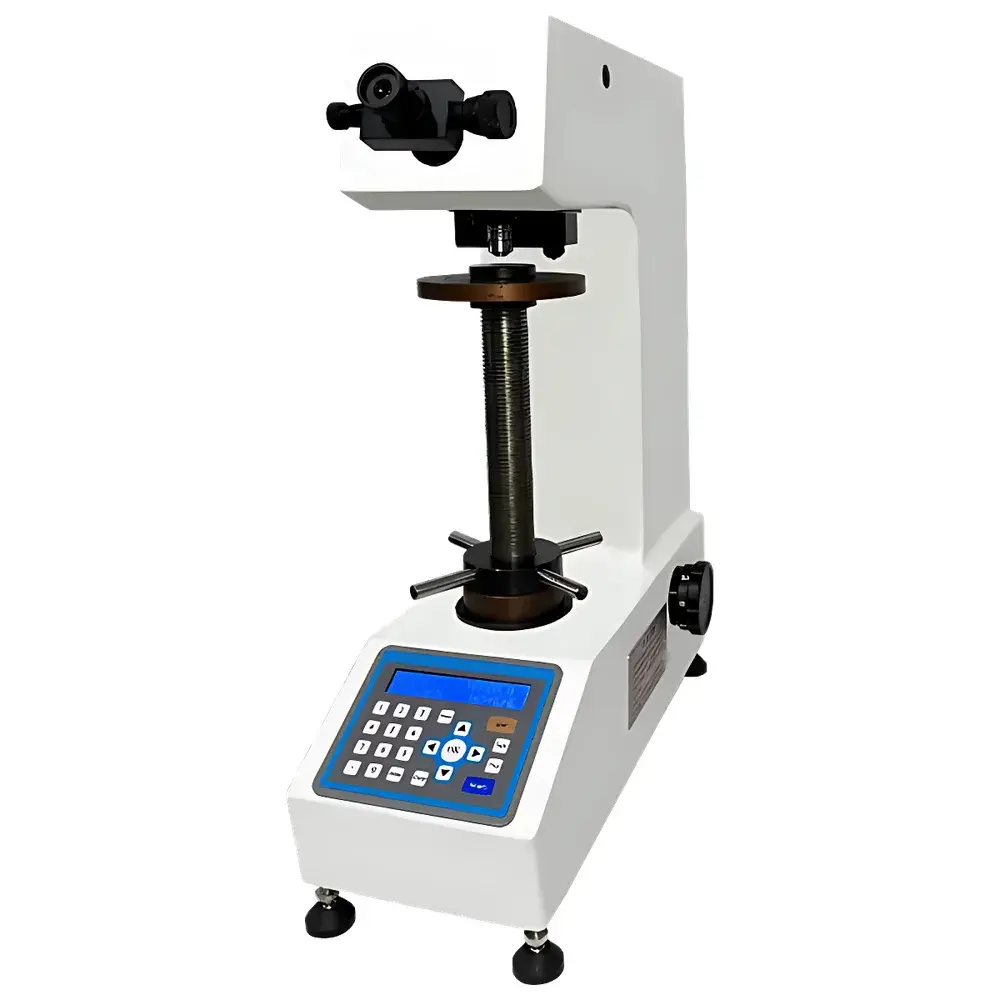
YANRUN HV-5 Vickers Hardness Tester
| Brand | YANRUN |
|---|---|
| Origin | Shanghai, China |
| Manufacturer Type | Direct Manufacturer |
| Model | HV-5 |
| Test Force Range | 0.2–50 kgf (1.96–490.3 N) |
| Hardness Range | 8–3000 HV |
| Minimum Detection | 0.06 µm (at 20× objective) |
| Standards Compliance | GB/T 4340, ISO 6507 |
| Loading Method | Fully Automatic (Load-Hold-Unload) |
| Hold Time | 0–60 s (1 s increments) |
| Max Specimen Height | 235 mm |
| Depth from Indenter to Chamber Wall | 130 mm |
| Power Supply | AC 220 V / 50 Hz |
| Dimensions (L×W×H) | 570 × 220 × 680 mm |
| Net Weight | 46.0 kg |
Overview
The YANRUN HV-5 Vickers Hardness Tester is a fully automated benchtop microhardness and macrohardness testing system engineered for precision, repeatability, and compliance with international metallurgical testing standards. It operates on the Vickers hardness principle—applying a precisely controlled diamond pyramid indenter (136° apex angle) under defined test forces, followed by optical measurement of the resulting diagonal impressions in the specimen surface. The instrument supports both microhardness (0.2–5 kgf) and macrohardness (up to 50 kgf) regimes, enabling consistent evaluation across a broad spectrum of materials—from thin coatings and IC substrates to bulk alloys and ceramics. Its dual-magnification optical path (10× observation / 20× measurement for low-force configurations; 10× unified for high-force modes) and sub-micron resolution (down to 0.06 µm with 20× objective) ensure traceable, high-fidelity indentation metrology aligned with ASTM E384, ISO 6507-1, and GB/T 4340.1 requirements.
Key Features
- Fully automatic loading, dwell, and unloading sequence—eliminates operator-induced variability and ensures strict adherence to standardized force application profiles.
- Dual-system hardness evaluation: real-time LCD display with manual diagonal entry via keypad, plus optional PC-based image analysis software for automated impression detection and statistical reporting.
- Modular test force selection spanning six calibrated ranges: 0.2–5 kgf (5 kgf model), 0.3–10 kgf (10 kgf model), 1–30 kgf (30 kgf model), and 1–50 kgf (50 kgf model), each configured with discrete gear-driven force generation and verified traceability.
- Robust cast-aluminum monocoque frame with automotive-grade baked enamel finish—designed for long-term dimensional stability, vibration damping, and resistance to mechanical wear in QC lab or production floor environments.
- Integrated dual-objective turret (10× for observation, 20× for measurement at ≤10 kgf) delivering total magnifications of 100× (observation) and 200× (measurement), with calibrated eyepiece micrometer (10× ocular) and minimum resolution of 0.12 µm (10×) or 0.06 µm (20×).
- Adjustable dwell time (0–60 s in 1 s increments), programmable hardness scale selection (HV or HK), and built-in hardness conversion tables per ASTM E140 and ISO 18265 for cross-standard correlation.
Sample Compatibility & Compliance
The HV-5 accommodates specimens up to 235 mm in height and 130 mm laterally from the indenter axis—supporting irregularly shaped components, coated wafers, layered metallic composites, brittle ceramics, and polymer films. Its low-force capability (as low as 0.2 kgf) enables reliable testing of thin-film coatings (<1 µm), diffusion layers, and semiconductor substrates without substrate interference. All mechanical and metrological performance parameters conform to ISO 6507-2 (verification of hardness testers) and GB/T 4340.2 (Chinese national verification regulation). The system supports GLP-compliant documentation when paired with validated software—providing audit trails, user access control, electronic signatures, and data integrity features aligned with FDA 21 CFR Part 11 expectations for regulated manufacturing environments.
Software & Data Management
While the HV-5 operates autonomously via its integrated LCD interface, it is compatible with optional Windows-based analysis software that captures high-resolution indentation images through a C-mount USB camera. The software performs edge-detection-based diagonal measurement, calculates HV values using standard formulae (HV = 1.8544 × F/d²), and generates exportable reports in CSV, PDF, or XML formats—including histograms, trend charts, and statistical summaries (mean, SD, Cp/Cpk). Calibration certificates for force sensors and optical scales are stored digitally within the software environment. All measurement logs include timestamps, operator IDs, environmental metadata (if external sensors are connected), and full traceability to NIST-traceable reference blocks.
Applications
- Quality control of heat-treated steels, aluminum alloys, and titanium components in aerospace and automotive supply chains.
- Characterization of PVD/CVD coating hardness (e.g., TiN, CrN, DLC) on cutting tools and biomedical implants.
- Mechanical property mapping of weld zones, case-hardened surfaces, and gradient materials via grid-based microhardness profiling.
- R&D validation of ceramic matrix composites (CMCs), sintered carbides, and optical crystals where fracture resistance correlates with Vickers hardness.
- Failure analysis labs performing cross-sectional hardness surveys on delaminated or corroded interfaces.
- Educational laboratories requiring ISO-compliant instrumentation for metallurgy and materials science curricula.
FAQ
Does the HV-5 comply with ISO 6507 and GB/T 4340 verification requirements?
Yes—the instrument undergoes factory verification per ISO 6507-2 Annex A and GB/T 4340.2, including force error ≤ ±1.0%, indenter geometry certification, and optical measurement uncertainty ≤ ±0.5% of measured diagonal length.
Can the system be integrated into a networked LIMS or MES environment?
When used with the optional software package, raw data and reports can be exported via secure FTP or ODBC-compatible databases; full API integration requires custom middleware development per client IT architecture.
What maintenance intervals are recommended for long-term accuracy?
Annual recalibration of force transducers and optical calibration using certified reference blocks is advised; routine cleaning of the indenter and objective lenses should occur after every 500 tests or daily in high-throughput labs.
Is the 20× objective suitable for all test forces?
No—the 20× objective is optimized for test forces ≤10 kgf; at ≥30 kgf, the 10× objective is used for both observation and measurement to maintain depth-of-field and reduce parallax error.
Does the HV-5 support HK (Knoop) hardness testing?
Yes—HK mode is selectable via the front panel; the same diamond indenter is used, with software applying the Knoop-specific calculation (HK = 14.229 × F/L²) and referencing ASTM E384 Annex A1 for anisotropic materials.





