
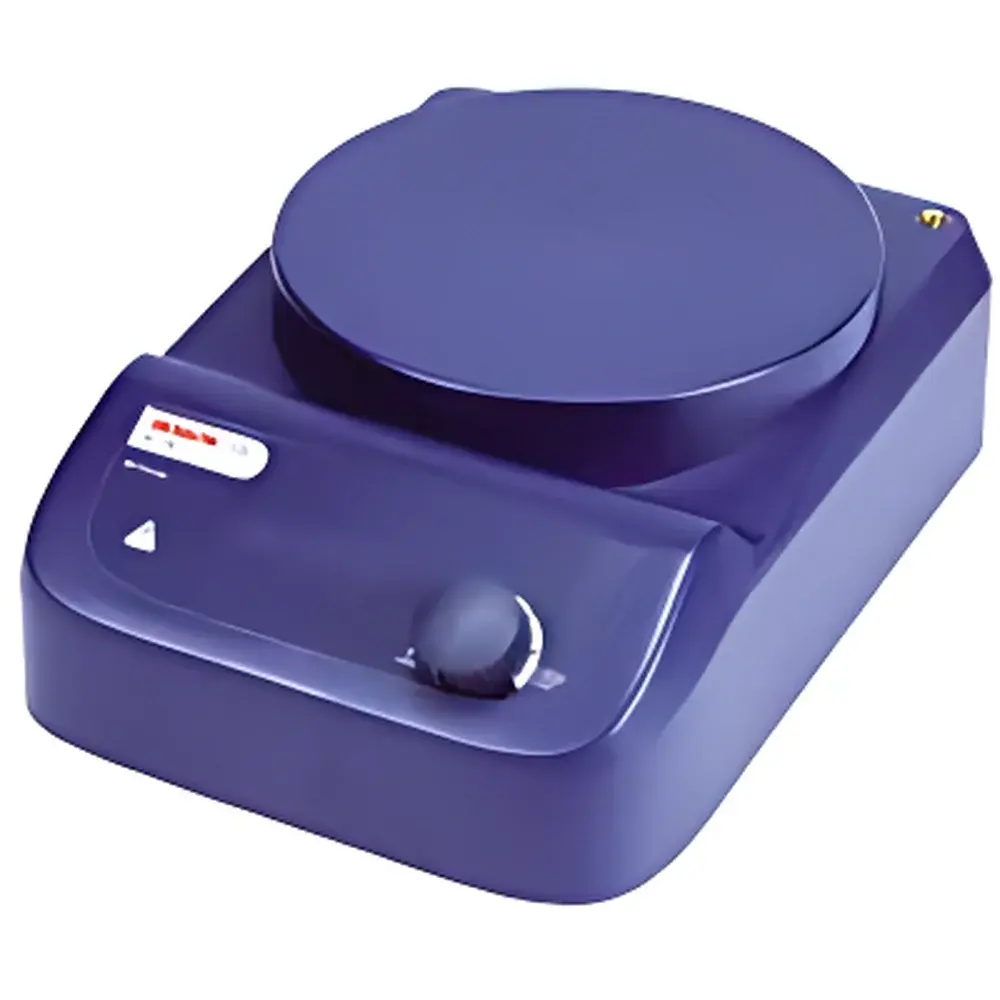
BlueSpin MS-PB Standard Magnetic Stirrer
| Brand | DLAB |
|---|---|
| Origin | Beijing, China |
| Model | MS-PB |
| Motor Type | DC |
| Input Power | 10 W |
| Output Power | 3 W |
| Voltage | 100–240 VAC, 50/60 Hz |
| Speed Range | 0–1500 rpm |
| Speed Display | Analog Scale |
| Max. Stirring Volume (H₂O) | 3 L |
| Max. Stir Bar Length | 50 mm |
| Plate Diameter | φ135 mm (5") |
| Plate Material | Flame-Retardant Plastic |
| Enclosure | Fully Enclosed Flame-Retardant Housing |
| IP Rating | IP42 |
| Dimensions (W×D×H) | 150 × 260 × 80 mm |
| Weight | 1.8 kg |
| Operating Temperature | 5–40 °C |
| Max. Relative Humidity | 80 % RH |
| Stirring Positions | 1 |
| Compliance | DIN EN 60529 |
Overview
The BlueSpin MS-PB Standard Magnetic Stirrer is an entry-level, single-position benchtop instrument engineered for reliable and consistent mixing of low-viscosity aqueous and organic solutions in routine laboratory workflows. Based on the proven principle of magnetic coupling—where a rotating permanent magnet beneath a non-magnetic plate induces synchronous rotation of a magnetic stir bar immersed in the sample—the MS-PB delivers stable agitation without mechanical shaft penetration, eliminating seal wear and contamination risks. Designed for general-purpose use in teaching labs, QC environments, and preparatory chemistry workflows, it features a microprocessor-based feedback control system that actively monitors motor load and dynamically adjusts drive current to maintain set speed across varying viscosity and volume conditions. Its compact footprint (150 × 260 × 80 mm), lightweight construction (1.8 kg), and universal input voltage range (100–240 VAC, 50/60 Hz) ensure operational flexibility across global laboratory infrastructures.
Key Features
- Microprocessor-controlled speed regulation with real-time feedback loop, ensuring ±3% speed stability across the full 0–1500 rpm range under typical load conditions
- Single-position stirring platform with 135 mm diameter flame-retardant plastic plate (UL94 V-0 rated), optimized for thermal insulation and chemical resistance
- DC motor architecture delivering 3 W mechanical output from a 10 W total power draw, enabling efficient operation with minimal heat generation
- Analog speed scale calibrated to ISO 8573-1 traceable reference standards, providing intuitive visual speed estimation without digital interface dependency
- IP42-rated enclosure compliant with DIN EN 60529, offering protection against solid objects ≥1 mm and vertically falling water droplets—suitable for standard dry-lab environments
- No external cooling fan or moving ventilation grilles, minimizing airborne particulate generation and simplifying cleaning protocols per GLP-compliant lab hygiene requirements
Sample Compatibility & Compliance
The MS-PB is validated for use with standard PTFE- or glass-coated magnetic stir bars up to 50 mm in length and accommodates vessels ranging from 10 mL test tubes to 3 L beakers (with appropriate stir bar selection and vessel geometry). It is not intended for high-viscosity media (>500 mPa·s), abrasive suspensions, or pressurized/vacuum-sealed systems. The device conforms to electromagnetic compatibility (EMC) requirements per EN 61326-1 and safety standards per EN 61010-1 for electrical equipment used in laboratory environments. While not certified for GMP manufacturing execution, its design supports audit-ready documentation practices including logbook-integrated speed verification and operator-defined operating parameters per internal SOPs.
Software & Data Management
The MS-PB operates as a standalone analog instrument with no embedded firmware, network interface, or data logging capability. This architecture eliminates cybersecurity vulnerabilities, reduces validation overhead, and ensures deterministic behavior under continuous operation—critical in regulated educational and industrial support labs where reproducibility depends on hardware-level consistency rather than software abstraction layers. All operational parameters are manually set and visually verified; no electronic records are generated, aligning with laboratories maintaining paper-based or hybrid record-keeping systems compliant with FDA 21 CFR Part 11 Annex 11 interpretation for non-critical process equipment.
Applications
- Preparation of buffer solutions, reagent dilutions, and standard calibration mixtures in analytical chemistry and life science labs
- Homogenization of cell culture media prior to sterilization or dispensing
- Supporting dissolution testing in pharmaceutical development where gentle, non-aerating agitation is required
- Student experiments in undergraduate chemistry curricula involving reaction kinetics, solubility studies, and titration setup
- QC sampling preparation in food, environmental, and materials testing laboratories requiring repeatable dispersion of particulates in liquid matrices
FAQ
Is the MS-PB suitable for use with corrosive solvents such as concentrated acids or halogenated organics?
The flame-retardant plastic plate and housing exhibit moderate resistance to alcohols, acetone, and dilute aqueous acids/bases; however, prolonged exposure to strong oxidizers (e.g., HNO₃, H₂O₂ >30%), chlorinated solvents, or molten salts is not recommended. Always consult the material compatibility chart for polypropylene and ABS resins before deployment.
Can multiple MS-PB units be operated simultaneously on the same circuit without interference?
Yes—each unit draws ≤0.1 A at 100 VAC and contains no switching-mode power supply, resulting in negligible harmonic distortion and cross-unit electromagnetic crosstalk when deployed in multi-station configurations.
Does the analog speed scale correspond directly to actual rotational speed?
The scale is factory-calibrated using a NIST-traceable optical tachometer; deviation remains within ±3% across the 200–1200 rpm range under standard 1 L water load at 25 °C.
What maintenance is required for long-term reliability?
No scheduled maintenance is specified. Periodic inspection of stir bar integrity and plate surface cleanliness—per ISO 15190 laboratory equipment hygiene guidelines—is sufficient. Avoid immersion cleaning or solvent wiping of the housing.



