
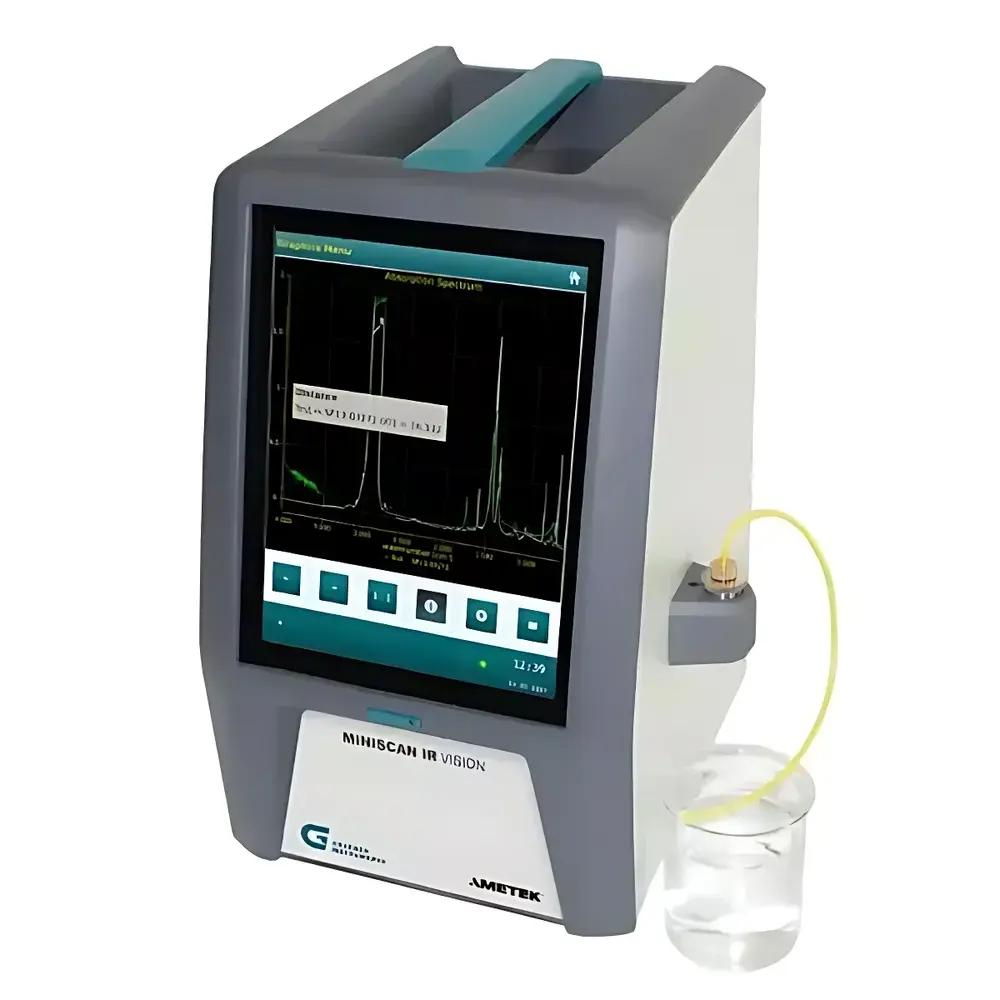
GRABNER MINISCAN IR Vision Professional Portable Mid-IR Fuel Analyzer for Gasoline Octane Number, Diesel Cetane Number, and Aviation Turbine Fuel Analysis
| Brand | GRABNER |
|---|---|
| Origin | Austria |
| Model | MINISCAN IR Vision Professional |
| Portability | Portable |
| Measurement Parameters | Gasoline Research Octane Number (RON), Motor Octane Number (MON), Diesel Cetane Number (CN) |
| Measurement Range | RON/MON 70–110 |
| Accuracy | ±0.5 ON/CN units |
| Analysis Time | <80 s per sample |
| Sample Volume | 6 mL |
| Spectral Range | Mid-IR (typically 4000–600 cm⁻¹) |
| Detector | High-stability DTGS or MCT (model-dependent) |
| Interferometer | Dual-mirror, laser-controlled, auto-alignment with thermal stabilization |
| Beam Splitter | Ge-coated KBr |
| Density Measurement | Integrated Peltier-regulated oscillating U-tube densitometer, resolution ±0.0001 g/cm³ |
| Data Processing | PLS regression with >100 validated chemometric models compliant with ASTM E1655 and GB/T 29858 |
| Compliance | Fully aligned with GB/T 33648–2017, ASTM D5845, ASTM D6277, EN 238, SH/T 0797, EN 14078, ASTM D7806, USP <857>, FDA 21 CFR Part 11 (audit trail & electronic signature ready) |
| Interface | 2× USB 3.0, 2× Gigabit Ethernet, optional Wi-Fi/4G module |
| Display | 10″ industrial-grade capacitive touchscreen (1280×800), glove-compatible UI |
| Operating Temperature | 10–40 °C |
| Power | 100–264 V AC, 47–63 Hz, 130 W |
| Field Power Option | 12 V DC automotive adapter |
| Dimensions | 293 × 390 × 280 mm |
| Weight | 12 kg |
Overview
The GRABNER MINISCAN IR Vision Professional is a field-deployable, mid-infrared (MIR) spectrometer engineered for quantitative hydrocarbon fuel analysis across gasoline, diesel, and aviation turbine fuel (Jet A/A-1) matrices. It operates on the principle of Fourier-transform infrared (FT-IR) spectroscopy, capturing full-range absorbance spectra (4000–600 cm⁻¹) from liquid fuel samples to enable multivariate calibration using Partial Least Squares (PLS) regression. Unlike conventional single-parameter analyzers, this instrument delivers simultaneous quantification of over 100 physicochemical parameters—including Research and Motor Octane Numbers (RON/MON), Cetane Number (CN), total aromatics, total olefins, oxygenates (MTBE, ethanol, methanol), benzene, fatty acid methyl esters (FAME), and illicit additives such as dimethoxymethane (DMM) and dimethyl carbonate (DMC). Its optical architecture integrates a dual-mirror interferometer with laser-based path-length stabilization and automatic mirror alignment—ensuring spectral fidelity after mechanical shock or thermal drift. The system is thermally managed at three critical points: sample cell, density measurement module, and optical bench—minimizing volumetric and mass-based errors induced by temperature fluctuations in field environments.
Key Features
- Portable, ruggedized design certified to MIL-STD-810G for shock and vibration resistance—suitable for refinery perimeters, marine terminals, and roadside inspection sites.
- Integrated Peltier-regulated oscillating U-tube densitometer with ±0.0001 g/cm³ resolution, enabling precise correction of concentration units (v/v %, m/m %) in real time.
- Patented 2+1 stainless-steel sample cell configuration: two identical flow cells for redundant validation and one reference cell for baseline drift compensation.
- Automated air bubble elimination via positive-displacement metal syringe pump and pressure-regulated inlet manifold—eliminating operator-induced variability in viscosity-sensitive fuels.
- 10″ industrial capacitive touchscreen with high-brightness, anti-glare coating and oversized UI elements—operable with gloves under ambient sunlight or low-light conditions.
- Fully embedded chemometric engine supporting >100 pre-validated models traceable to ASTM, EN, ISO, and GB standards—including ASTM D5845 (oxygen content), EN 14078 (FAME), and GB/T 33648–2017 (non-conventional additives).
- Onboard spectral library built from >15,000 real-world fuel samples analyzed by SGS-certified laboratories—ensuring robustness across regional blending variations and seasonal formulations.
Sample Compatibility & Compliance
The MINISCAN IR Vision Professional accepts undiluted, unfiltered gasoline (including E10–E85), diesel (EN 590, ASTM D975), and aviation turbine fuels (ASTM D1655, DEF STAN 91-91) with minimal sample preparation. Its chemometric models are trained and verified against primary reference methods: ASTM D2699/D2700 for octane rating, ASTM D613 for cetane number, and ISO 5164/ISO 4298 for knock characteristics. All calibrations comply with ASTM E1655 guidelines for multivariate spectroscopic analysis and meet GLP/GMP data integrity requirements when configured with audit trail, user access control, and electronic signature modules per FDA 21 CFR Part 11. Instrument qualification includes IQ/OQ documentation packages aligned with ISO/IEC 17025 and ASTM D7467 for field-deployable analytical systems.
Software & Data Management
The embedded GRABNER FuelSoft™ v5.2 platform provides intuitive workflow navigation, real-time spectral visualization, and automated report generation in PDF/XLSX formats. All raw interferograms, processed spectra, and prediction residuals are stored with timestamp, operator ID, GPS coordinates (optional), and environmental metadata (ambient T/P, humidity). Data export supports direct integration into LIMS via HL7, ASTM E1394, or custom API endpoints. Remote diagnostics and firmware updates are enabled through secure TLS 1.3 connections. Audit trails record every parameter change, model revalidation, and result override—fully compliant with regulatory review cycles during inspections by CNCA, EPA, or EU Notified Bodies.
Applications
This analyzer serves as a primary tool for quality assurance in petroleum logistics: verifying blendstock conformity prior to pipeline injection; performing rapid turnaround checks at bulk terminals; validating compliance of imported fuels against national specifications; and conducting forensic screening for adulteration in commercial distribution networks. It is widely deployed by national oil companies (NOCs), independent refiners, third-party inspection agencies (e.g., SGS, Bureau Veritas), and government metrology institutes for routine surveillance testing. In automotive R&D, it supports fuel formulation optimization and emissions correlation studies by delivering high-frequency compositional snapshots correlated to engine performance metrics.
FAQ
Does the MINISCAN IR Vision Professional require daily calibration with reference standards?
No. Its dual-interferometer architecture and internal reference cell enable continuous self-referencing; only periodic verification (e.g., weekly) with NIST-traceable fuel standards is recommended per ASTM D7467.
Can the instrument be used in explosive atmospheres (ATEX Zone 1)?
Not inherently. It is rated IP54 for dust/moisture resistance but requires external explosion-proof enclosures or purge systems for hazardous area deployment.
Is method transfer possible between different MINISCAN IR Vision units?
Yes. Chemometric models and spectral libraries are fully portable across instruments of the same generation via encrypted USB key or network sync—ensuring inter-unit reproducibility within ±0.3 ON/CN units.
What is the minimum sample volume required for density + spectroscopy analysis?
Exactly 6 mL is sufficient to fill the integrated densitometer and optical cell simultaneously—no splitting or dilution needed.
How is temperature stability maintained during extended field operation?
All thermally sensitive components (interferometer, detector, sample cell, densitometer) employ independent Peltier elements with PID-controlled feedback loops, maintaining ±0.1 °C setpoint accuracy even under ambient swings from 10–40 °C.





