
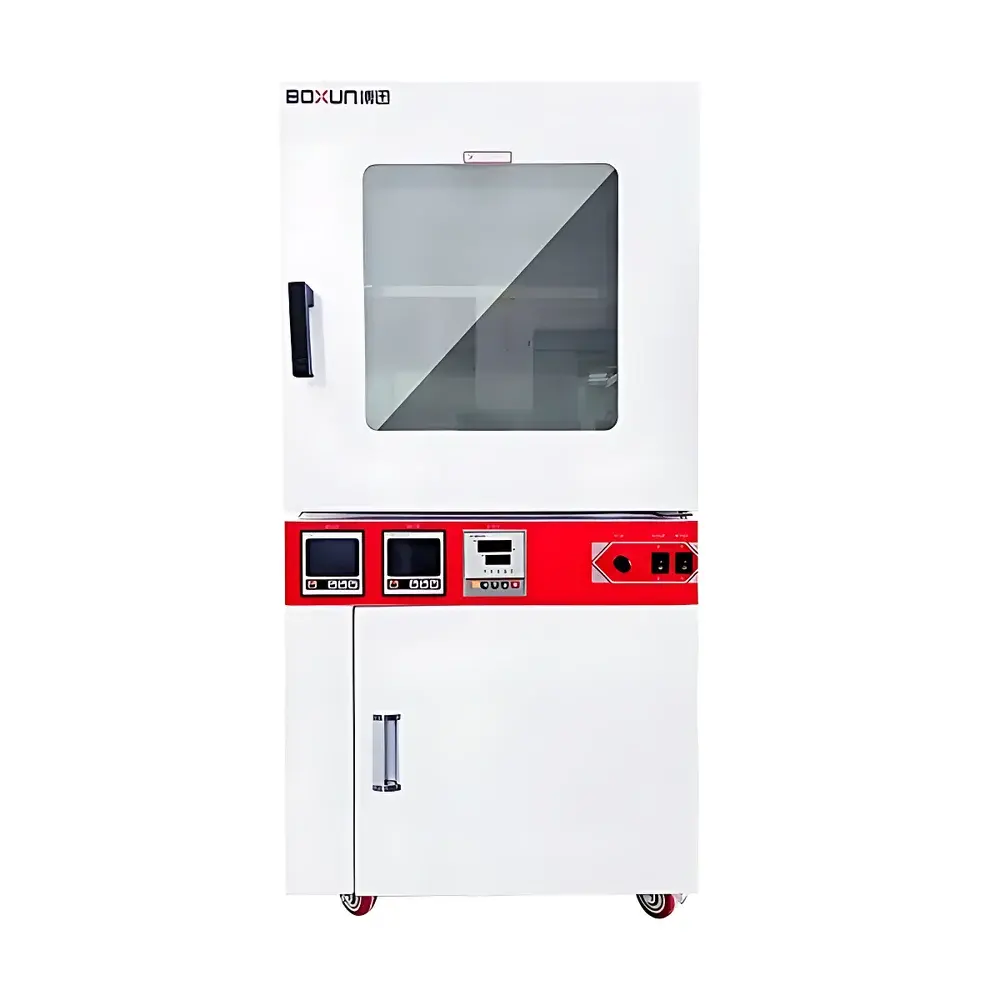
BOXUN BGK-100S Vacuum Drying Oven
| Brand | BOXUN |
|---|---|
| Origin | Shanghai, China |
| Manufacturer Type | Direct Manufacturer |
| Instrument Type | Vacuum Oven |
| Temperature Range | Ambient +10°C to 250°C |
| Temperature Uniformity | ±1°C |
| Chamber Dimensions (W×D×H) | 450 × 500 × 450 mm |
| External Dimensions (W×D×H) | 620 × 640 × 1165 mm |
| Chamber Material | Stainless Steel (SUS304) |
| Heating Method | Bottom-mounted Heated Shelf System |
| Ultimate Vacuum | 133 Pa |
| Power Supply | 220 V ±10%, 50/60 Hz |
| Rated Power | 1400 W |
| Shelf Quantity | 2 (Independently Controlled) |
| Timer Range | 0–9999 min |
| Surface Temperature (at max operating temp) | ≤65°C |
| Vacuum Pump Speed | 2 L/s |
| Compliance | GB/T 29251–2012 |
Overview
The BOXUN BGK-100S Vacuum Drying Oven is an engineered solution for moisture-sensitive, thermolabile, or oxidation-prone sample processing in research laboratories, pharmaceutical QC environments, and materials science facilities. Operating on the principle of reduced-pressure thermal drying, it removes volatile components—including water, solvents, and residual monomers—by lowering the boiling point of liquids via vacuum application while maintaining precise, uniform temperature control across the chamber volume. Unlike conventional forced-air ovens, the BGK-100S eliminates convective heat transfer limitations and oxygen exposure, significantly reducing degradation risk during drying, baking, or degassing protocols. Its stainless steel chamber (SUS304), semi-circular internal corners, and double-layer tempered glass door support both contamination control and visual monitoring under operational vacuum conditions.
Key Features
- Double-layer tempered & bulletproof observation window with high-seal silicone gasket ensures structural integrity and vacuum retention up to 133 Pa.
- Microprocessor-based PID temperature controller with LCD interface provides real-time display of setpoint, actual chamber temperature, timer status, and alarm indicators.
- Two independently heated shelves with embedded heating elements—each with dedicated temperature sensors and closed-loop feedback—enable layer-specific thermal management and optimized energy use.
- Integrated noise-dampened cabinet houses a 2 L/s vacuum pump, minimizing footprint, eliminating external hose clutter, and reducing operational noise by ~40 dB(A) versus benchtop pump configurations.
- Digital vacuum regulation system continuously monitors chamber pressure and automatically initiates pump compensation upon detected leakage or vapor-induced pressure rise.
- Power failure recovery function retains all user-defined parameters and runtime data; system resumes operation at pre-interruption settings after power restoration.
- Front-accessible door with infinitely adjustable tension mechanism ensures consistent sealing force across the full gasket perimeter, critical for long-duration vacuum stability.
Sample Compatibility & Compliance
The BGK-100S accommodates standard laboratory containers including glass Petri dishes, aluminum weighing pans, ceramic crucibles, and polymer trays—compatible with samples ranging from lyophilized biologics and active pharmaceutical ingredients (APIs) to nanocomposite precursors and battery electrode slurries. Its chamber geometry (450 × 500 × 450 mm) supports stacked configurations without compromising thermal uniformity. The unit complies with GB/T 29251–2012 (“Vacuum Drying Ovens — Technical Requirements and Test Methods”), and its construction meets general requirements for ISO/IEC 17025-accredited testing laboratories regarding equipment traceability, calibration readiness, and environmental stability. While not inherently 21 CFR Part 11 compliant, its parameter logging capability supports audit-ready documentation when integrated with validated third-party data acquisition systems.
Software & Data Management
The BGK-100S operates via embedded firmware with no external PC dependency. All operational parameters—including temperature setpoints per shelf, vacuum setpoint, timer duration, and alarm thresholds—are stored in non-volatile memory. Event logs (e.g., over-temperature alerts, vacuum loss incidents, power interruptions) are timestamped and retained for up to 100 entries. Optional RS485 communication port enables integration into centralized lab equipment monitoring networks using Modbus RTU protocol. For GxP environments, external data loggers with electronic signature and audit trail functionality may be deployed to satisfy FDA or EMA regulatory expectations for raw data integrity.
Applications
- Residual solvent removal from synthesized organic compounds prior to NMR or HPLC analysis.
- Drying of hygroscopic standards (e.g., potassium hydrogen phthalate, sodium chloride) in analytical chemistry calibration workflows.
- Pre-conditioning of polymer films and composite laminates before tensile or dielectric testing.
- Stabilization of enzyme powders and vaccine intermediates under inert, low-oxygen conditions.
- Outgassing of optical components and vacuum chamber subassemblies in photonics R&D.
- Moisture equilibration studies of porous ceramics and MOF materials under controlled partial pressure profiles.
FAQ
What is the maximum allowable load per shelf?
Each shelf is rated for a static load of 15 kg. Total chamber loading must not exceed 30 kg to maintain thermal uniformity and mechanical stability under vacuum.
Can the vacuum pump be replaced with an external model?
Yes—the internal pump module is mechanically and electrically isolated; users may disconnect the internal pump and route the vacuum line to an external unit via the rear-mounted KF16 flange.
Is the chamber suitable for acidic vapor applications?
The SUS304 stainless steel interior offers moderate resistance to weak organic acids; prolonged exposure to halogenated or strong mineral acid vapors requires optional electropolished or Hastelloy-lined chamber variants.
Does the unit support ramp-soak temperature profiling?
No—the BGK-100S implements single-setpoint PID control only; multi-stage thermal programs require external programmable controllers interfaced via analog I/O.
How often does the vacuum seal require maintenance?
Under normal use (≤8 hrs/day, 5 days/week), the silicone door gasket maintains integrity for ≥24 months; visual inspection and light silicone grease application every 6 months are recommended.
Related Products



