
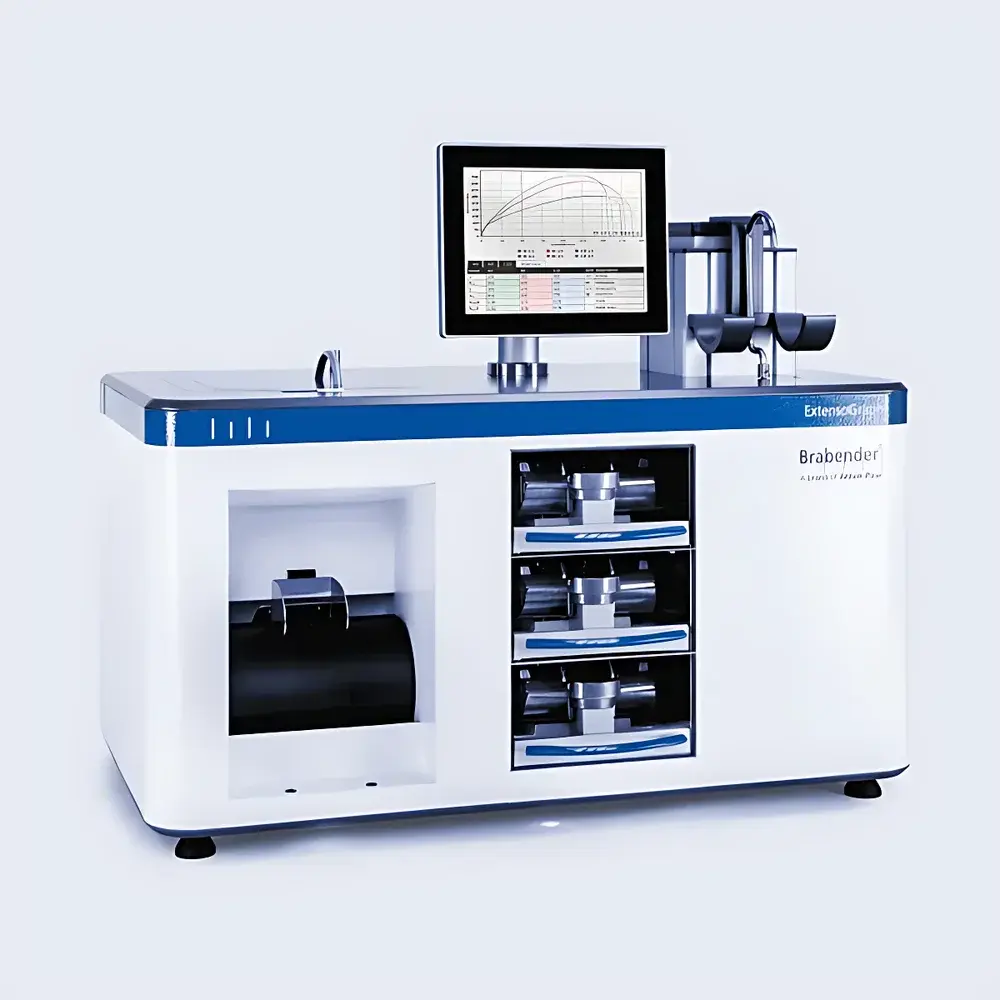
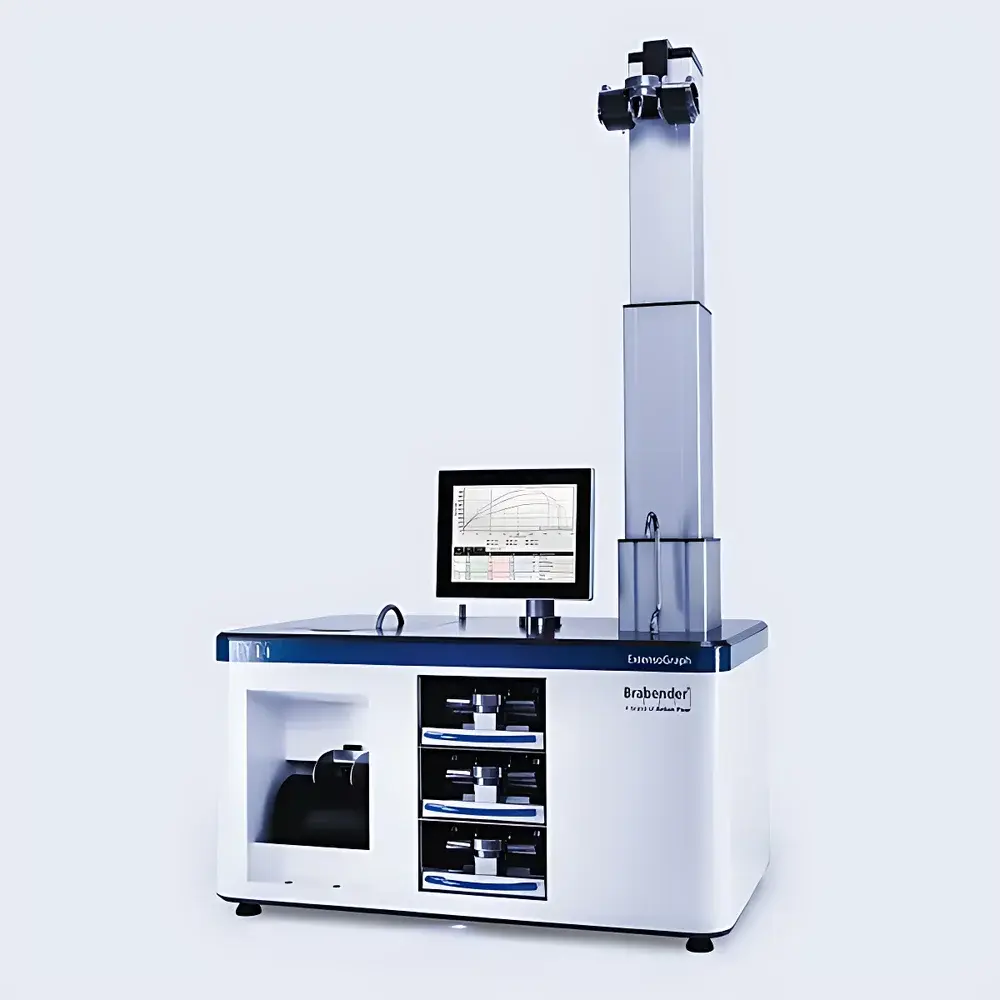
Brabender Extensograph by Anton Paar
| Brand | Anton Paar |
|---|---|
| Origin | Germany |
| Model | Extensograph |
| Sample Mass | 300 g flour + 6 g salt + distilled water |
| Dough Kneading Speed | 83 ±3 rpm |
| Resting Time | 15 ±1 min |
| Stretching Speed | 14.5 ±0.5 mm/s |
| Maximum Extension Length | 680 mm |
| Measurement Range | 0–2,000 EU/BU |
| Fermentation Temperature Control | 30 °C (adjustable, with ambient compensation up to 40 °C) |
| Humidity Control | Ultrasonic humidification system |
| Dimensions (W × H × D) | 840 × 720 × 500 mm |
| Weight | ~115 kg |
| Power Supply | 100–240 V, 50/60 Hz, 0.24 kW |
| Interfaces | USB (4), LAN/Ethernet (2), HDMI (1) |
| Compliance Standards | ISO 5530-2, DIN EN ISO 5530-2, CEN EN ISO 5530-2, AACC 54-10.01, ICC Standard 114/1, GB/T 14615, GB/T 35994, NF V03-717-2, OENORM EN ISO 5530-2, SN EN ISO 5530-2, BS EN ISO 5530-2, UNE-EN ISO 5530-2, IRAM 15856, TCVN 7848-2, AGSA 06-01, CCAT 03 & 16 |
Overview
The Brabender Extensograph by Anton Paar is a precision-engineered instrument for standardized dough extensibility analysis in cereal science and industrial baking laboratories. Based on the fundamental principle of uniaxial tensile deformation under controlled rheological conditions, the Extensograph quantifies dough resistance (R, in EU or BU) and extensibility (E, in mm) — two critical parameters defined in ISO 5530-2 and harmonized across global standards including AACC 54-10.01, ICC Standard 114/1, and GB/T 14615. Unlike empirical texture analyzers, the Extensograph replicates the mechanical elongation behavior experienced by dough during sheeting, molding, and oven spring — enabling predictive evaluation of processing tolerance and final product quality. As the second module in the Brabender Flour Testing Triad (following the Farinograph and preceding the Amylograph or Viscoamylograph), it delivers traceable, inter-laboratory comparable data essential for flour specification, blend optimization, and QC/QA compliance in high-volume bakery and pasta production.
Key Features
- Integrated modular architecture: ExtensoPrep (dough rounding and bar formation), ExtensoFerm (temperature- and humidity-controlled fermentation chamber), and ExtensoBase (motorized stretching unit with load cell and optical encoder)
- Ultrasonic humidification system ensures stable relative humidity (RH) within the fermentation cabinet — eliminating condensation, minimizing maintenance, and enhancing repeatability across seasonal ambient variations
- Active temperature compensation algorithm adjusts fermentation setpoint dynamically based on room temperature (range: 10–40 °C), guaranteeing consistent 30 °C incubation regardless of lab environment
- Motorized vertical lifting column (680 mm travel) enables safe, obstruction-free operation and compact footprint; designed for integration into regulated laboratory workflows
- Pre-programmed method library with one-click selection for ISO, AACC, ICC, GB/T, and regional standards — reducing operator dependency and training time
- Direct parameter transfer from Brabender Farinograph via MetaBridge software eliminates manual entry errors and synchronizes hydration, mixing, and resting protocols
- High-torque actuation system supports measurement of both extremely stiff doughs (up to 2000 EU) and highly extensible systems (up to 68 cm extension), covering specialty flours, gluten-free formulations, and ancient grain blends
Sample Compatibility & Compliance
The Extensograph accommodates doughs prepared from wheat, rye, spelt, durum, barley, oat, and composite flours — including enzymatically modified, pre-hydrated, or sourdough-leavened systems. Its mechanical design and firmware adhere strictly to the procedural requirements of ISO 5530-2:2017, which defines sample mass (300 g flour + 6 g NaCl + distilled water), kneading speed (83 ±3 rpm), resting duration (15 ±1 min), and stretching velocity (14.5 ±0.5 mm/s). All firmware-calibrated force and displacement outputs are traceable to NIST-traceable reference standards. The system supports full audit trail generation per FDA 21 CFR Part 11 when operated in validated MetaBridge mode — making it suitable for GLP-compliant food safety labs and GMP-certified ingredient manufacturing facilities.
Software & Data Management
MetaBridge is a browser-based, cross-platform software suite that unifies control, acquisition, and reporting across the Brabender portfolio. It provides real-time visualization of force–extension curves, automatic peak detection (Rmax, Emax, area under curve), and statistical comparison against historical baselines or specification limits. Data export is natively supported in CSV, PDF, and XML formats, with direct API-level integration into LIMS (e.g., LabWare, Thermo Fisher SampleManager), ERP (SAP S/4HANA, Oracle Cloud), and enterprise document management systems. Role-based user permissions, electronic signatures, and immutable audit logs ensure regulatory readiness. Remote access allows supervisors to review ongoing tests or approve reports from any network-connected device — without compromising data integrity or cybersecurity posture.
Applications
- Flour mill quality assurance: Routine verification of gluten strength and extensibility for grade classification and customer specifications
- Bakery R&D: Formulation screening for novel ingredients (e.g., hydrocolloids, enzymes, protein isolates) and process adjustments (hydration, mixing time, fermentation profile)
- Pasta and noodle production: Evaluation of dough elasticity and resistance to die extrusion, correlating directly with cooking loss and texture stability
- Academic cereal science: Mechanistic studies of gluten polymer network development, starch gelatinization interference, and protease activity kinetics
- Contract testing laboratories: Accredited method delivery (ISO/IEC 17025) for third-party certification of flour batches prior to shipment
- Regulatory submissions: Generation of standardized datasets required for national food standards compliance (e.g., China’s GB/T series, India’s FSSAI guidelines)
FAQ
What standards does the Extensograph comply with?
It fully implements ISO 5530-2:2017, AACC Method 54-10.01, ICC Standard 114/1, GB/T 14615, and 15+ additional national and regional standards listed in the technical documentation.
Can the Extensograph be used for gluten-free dough analysis?
Yes — its wide dynamic range (0–2000 EU) and programmable stretching profiles support non-wheat systems, though interpretation requires correlation with application-specific performance metrics.
Is MetaBridge software validated for 21 CFR Part 11 compliance?
When deployed in locked-down network environments with configured electronic signatures and audit trails, MetaBridge meets all functional requirements for Part 11 compliance; validation documentation is available upon request.
How is temperature and humidity stability ensured during fermentation?
Via dual-control: PID-regulated heating elements combined with ultrasonic humidification and real-time RH feedback — maintaining ±0.5 °C and ±3% RH over 45-minute fermentation cycles.
Does the system require external calibration services?
No — built-in self-diagnostics, factory-traceable load cell calibration, and user-performed verification using certified reference weights satisfy ISO/IEC 17025 internal calibration requirements.






