
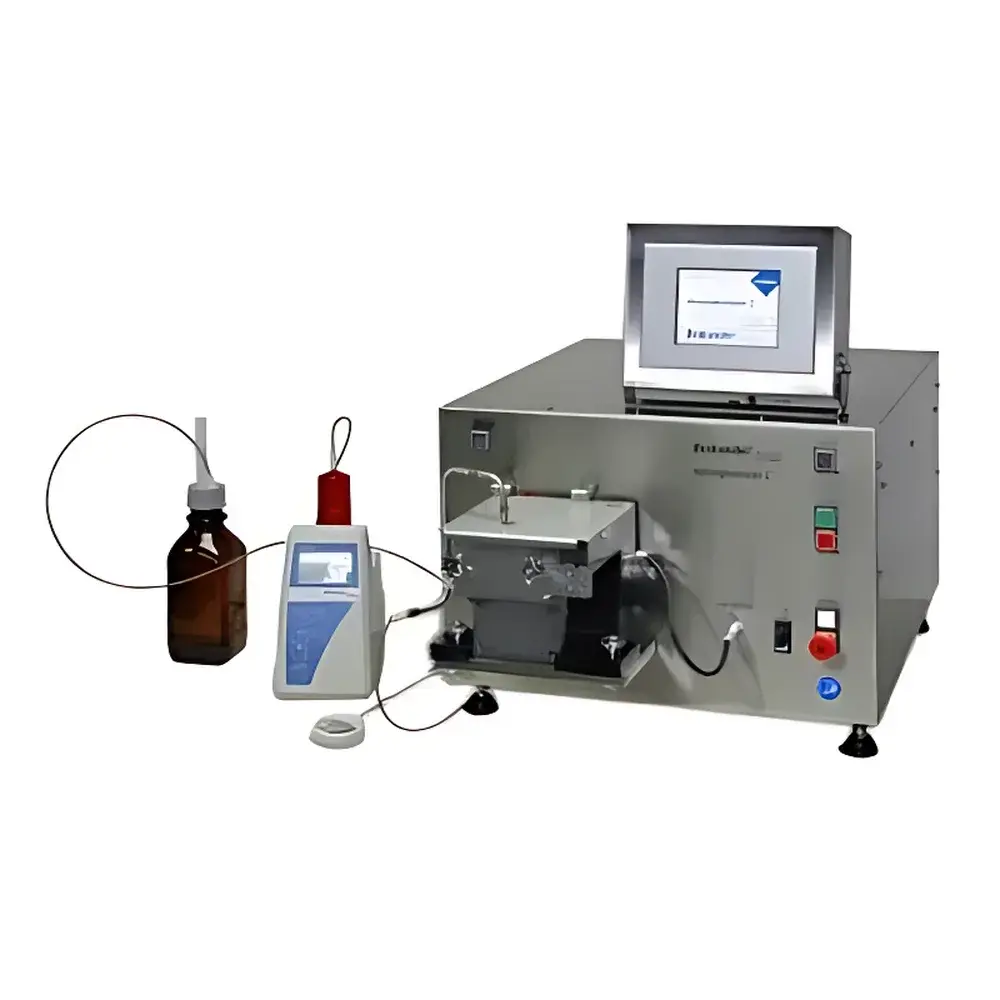
Brabender C-Type Carbon Black Oil Absorption Meter
| Brand | Brabender |
|---|---|
| Origin | Germany |
| Model | C-Type Oil Absorption Meter |
| Measurement Principle | Torque-based dynamic oil absorption analysis during controlled liquid addition to carbon black or silica powder under rotational shear |
| Compliance | ASTM D2414, ISO 8506, DIN 53601, GB/T 3780.2 |
| Temperature Control Option | Optional jacketed mixing chamber (±0.5 °C stability) |
| Data Output | Real-time torque vs. volume curve, automatic phase transition detection, OAN (Oil Absorption Number) calculation |
| Software | Brabender LabStation v5.x with 21 CFR Part 11-compliant audit trail, GLP/GMP-ready reporting |
Overview
The Brabender C-Type Carbon Black Oil Absorption Meter is a precision-engineered instrument designed for the quantitative determination of oil absorption number (OAN) in carbon black and precipitated silica—critical parameters directly correlated with compound processability, dispersion efficiency, and vulcanizate performance in rubber and elastomer formulations. Operating on the principle of dynamic torque rheometry, the system continuously monitors resistance torque generated by a rotating impeller as standardized paraffinic oil is incrementally dosed into a precisely weighed powder sample within a thermostatically controlled mixing chamber. The resulting torque–volume curve exhibits three physically distinct phases: free-flowing (liquid-dominated), coagulation (solid network formation), and termination (paste-like saturation). The inflection point corresponding to the onset of rapid torque rise—indicating the transition from wetting to structural agglomeration—is algorithmically identified to compute OAN in mL/100 g, fully compliant with ASTM D2414 and ISO 8506 methodologies.
Key Features
- Torque-sensing mechanism with <0.02 mN·m resolution and ±0.5% full-scale accuracy over 0–500 mN·m range, enabling reproducible detection of phase transitions
- High-precision glass syringe burette (10 mL, Class A, ±0.02 mL tolerance) for gravimetrically verified oil delivery
- Interchangeable mixing chambers (standard 50 mL and optional 100 mL) fabricated from chemically inert borosilicate glass with PTFE-sealed shafts
- Integrated temperature control interface supporting external recirculating chillers or heating baths; optional jacketed chamber maintains ±0.5 °C stability across 20–80 °C
- Motor-driven impeller operating at fixed 60 rpm (ISO-specified shear rate) with real-time angular position feedback for torque synchronization
- Self-calibrating torque zeroing routine prior to each test, eliminating manual drift compensation
Sample Compatibility & Compliance
The C-Type meter accommodates standard carbon black grades (N110–N990), fumed and precipitated silica (e.g., Ultrasil VN3, Zeosil 1165MP), and specialty fillers including surface-modified silicas and hybrid nano-fillers. Sample mass is user-defined (typically 5.000 g ±0.002 g) and automatically validated via integrated balance interface. All measurement protocols adhere to ASTM D2414 (Standard Test Method for Oil Absorption of Pigments), ISO 8506 (Rubber compounding ingredients — Carbon blacks — Determination of oil absorption number), and DIN 53601 (Determination of oil absorption capacity of carbon black). Instrument validation documentation supports GLP audits and FDA 21 CFR Part 11 requirements through electronic signature-capable software workflows and immutable audit trails.
Software & Data Management
Brabender LabStation v5.x provides full instrument control, real-time visualization of torque–volume curves, and automated OAN calculation using derivative-based phase detection algorithms. Each test generates a timestamped .brd data file containing raw torque, volume, temperature, and motor current streams at 10 Hz sampling. Reports are exportable in PDF (with digital signature fields), CSV (for LIMS integration), and XML (for ERP systems). Audit trail functionality logs all user actions—including method edits, calibration events, and result approvals—with operator ID, timestamp, and reason-for-change metadata. Multi-user role management enforces SOP compliance via configurable access levels (Operator, Supervisor, Administrator).
Applications
- Quality control of incoming carbon black and silica batches against supplier specifications and internal OAN tolerances (±1.5 mL/100 g)
- R&D screening of surface-treated silicas to correlate OAN shifts with silane coupling agent dosage and condensation efficiency
- Correlation studies between OAN and Mooney viscosity, scorch time, and tensile modulus in sulfur-cured NR/SBR compounds
- Process optimization of high-silica tread compounds where OAN deviations >3 mL/100 g correlate with mill sheeting instability and extruder surging
- Regulatory submission support for REACH dossiers requiring documented filler characterization per ECHA guidance R.7a
FAQ
What standards does the C-Type Oil Absorption Meter comply with?
ASTM D2414, ISO 8506, DIN 53601, and GB/T 3780.2 — all implemented with traceable calibration protocols and documented uncertainty budgets.
Can the instrument measure both carbon black and silica without hardware modification?
Yes. The same mixing chamber, impeller geometry, and torque calibration apply to both material classes; only sample mass and oil type (paraffinic vs. naphthenic) require method-level configuration.
Is temperature control mandatory for OAN testing?
Not mandatory per ASTM D2414 (room temperature specified), but optional jacketed operation is recommended for inter-laboratory reproducibility when ambient fluctuations exceed ±2 °C.
How is the OAN endpoint determined algorithmically?
The software computes the second derivative of the torque–volume curve and identifies the local maximum in d²τ/dV², corresponding to the steepest slope change during coagulation phase onset.
Does the system support multi-language UI and report generation?
LabStation v5.x offers English, German, Chinese, and Japanese language packs; PDF reports default to English but support localized terminology via configurable templates.






