
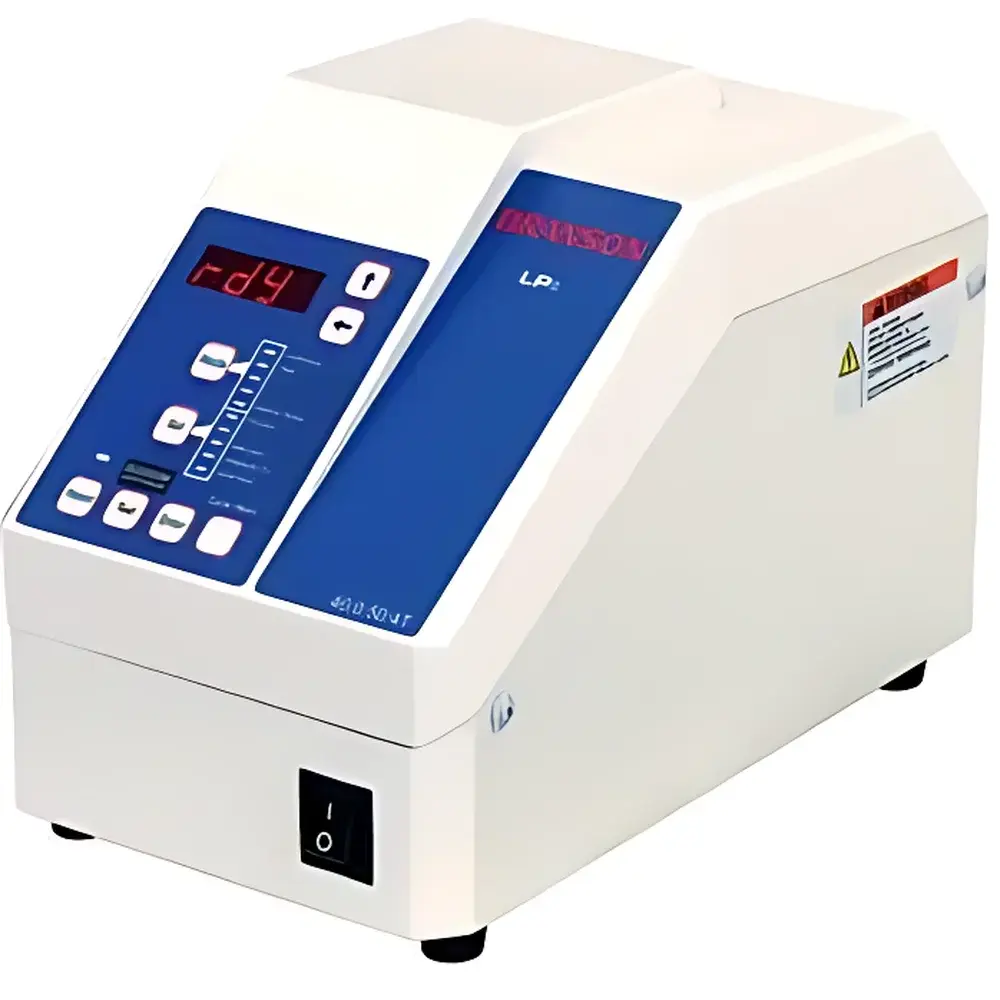
Branson Sonifier® SLPt Ultrasonic Cell Disruptor
| Brand | Branson |
|---|---|
| Origin | USA |
| Model | SLPt |
| Instrument Type | Ultrasonic Cell Disruptor |
| Operating Frequency | 40 kHz |
| Output Power | 150 W (continuously adjustable) |
| Amplitude Control | 10–100% in 1% increments |
| Pulse Duration | 0.1–9.9 s |
| Total Time Setting | 1 s – 99 h |
| Energy Range | 1–10,000 J |
| Standard Probe | 1/8″ (3 mm) microtip |
| Sample Volume Capacity | 0.25–10 mL |
| Input Voltage | 230 V AC, 50/60 Hz |
| Max Current | 4 A |
| Weight | 7.71 kg |
| Auto-Tuning & Memory (AT/M) | Yes |
| Diagnostic Self-Test | On power-up |
| Compliance | Designed for GLP-compliant labs |
Overview
The Branson Sonifier® SLPt Ultrasonic Cell Disruptor is a precision-engineered benchtop instrument designed for controlled, reproducible lysis of biological samples via high-intensity ultrasonic cavitation. Operating at a fixed frequency of 40 kHz, the system converts electrical energy into mechanical vibrations through a piezoelectric transducer, which are then transmitted to liquid media via a titanium alloy probe. This generates transient microbubbles that collapse violently—producing localized shockwaves, shear forces, and extreme temperature gradients—resulting in efficient disruption of cell membranes, organelles, bacterial walls, viral envelopes, spores, and subcellular structures. Unlike thermal or enzymatic methods, sonication offers rapid, non-chemical, and scalable sample preparation without introducing exogenous reagents or altering native biomolecular conformations. The SLPt is optimized for low-volume applications (0.25–10 mL), making it especially suitable for precious clinical isolates, primary cell cultures, CRISPR-edited clones, and nanoscale formulation development.
Key Features
- Digital amplitude control (10–100% in 1% increments) enables precise energy delivery calibrated to sample viscosity, cell type, and downstream assay requirements.
- Programmable pulse mode (0.1–9.9 s on/off intervals) minimizes thermal buildup—critical for heat-sensitive proteins, nucleic acids, and extracellular vesicles.
- Auto-Tuning & Memory (AT/M) function automatically adjusts resonant frequency at the start of each cycle and stores the last-used parameters—even after power loss—ensuring experimental continuity and protocol fidelity.
- Real-time LED display shows setpoint and operational values (amplitude %, elapsed time, pulse status, energy delivered in joules), facilitating visual verification during operation.
- Integrated self-diagnostic routine executes upon power-up, verifying transducer integrity, generator stability, and probe coupling—reducing operator-dependent error and downtime.
- Modular architecture supports interchangeable probes (standard 3 mm microtip included) and optional accessories including high-efficiency acoustic enclosures and non-contact cup-horn systems for biosafety-critical applications such as viral lysis.
Sample Compatibility & Compliance
The SLPt accommodates diverse biological matrices—including mammalian tissues, Gram-positive/negative bacteria, yeast, algae, plant protoplasts, and enveloped/non-enveloped viruses—without requiring chemical lysis buffers or centrifugation steps. Its compact probe geometry ensures uniform energy distribution in small volumes, minimizing foaming and aerosol generation. The instrument is engineered to support Good Laboratory Practice (GLP) workflows: all parameter inputs, run logs, and alarm events can be exported via I/O ports for traceability. When paired with validated third-party data acquisition software, the system meets documentation requirements aligned with FDA 21 CFR Part 11 for electronic records and signatures. It conforms to IEC 61000-6-3 (EMC emissions) and IEC 61010-1 (safety standards for laboratory equipment).
Software & Data Management
While the SLPt operates as a standalone unit with embedded firmware, its rear-panel I/O interface allows integration with external controllers or PC-based platforms for automated batch processing and centralized logging. Parameter settings—including amplitude, total duration, pulse profile, and cumulative energy—are stored locally and recalled instantly. Optional software modules (sold separately) provide timestamped run histories, user-access controls, electronic signature capture, and export in CSV or XML formats compatible with LIMS environments. Audit trails include operator ID, date/time stamps, parameter changes, and fault codes—enabling full compliance with ISO/IEC 17025 and USP <1058> analytical instrument qualification guidelines.
Applications
- Preparation of whole-cell lysates for Western blotting, ELISA, and mass spectrometry.
- Chromatin shearing in ChIP-seq and ATAC-seq library construction.
- Extraction of intracellular metabolites and lipids under non-denaturing conditions.
- Disruption of biofilms and microbial aggregates for antimicrobial susceptibility testing.
- Nanoparticle dispersion in drug delivery formulations (e.g., liposomes, polymeric micelles).
- Cleaning and decontamination of microfluidic channels and capillary electrophoresis systems.
- Accelerated solvent extraction of phytochemicals from botanical matrices.
FAQ
What is the maximum recommended sample volume for the standard 3 mm probe?
The optimal working range is 0.25–10 mL. Volumes below 0.25 mL risk insufficient coupling and overheating; volumes above 10 mL require larger probes or alternative homogenization strategies.
Can the SLPt be used for viral inactivation studies?
Yes—when configured with a non-contact cup-horn accessory, the system enables closed-vessel sonication, eliminating cross-contamination risks and supporting BSL-2/3 containment protocols.
Does the instrument support regulatory-compliant data archiving?
The built-in memory retains last-run parameters, but full audit-trail functionality requires integration with validated external software compliant with 21 CFR Part 11 or Annex 11.
How often should the titanium probe tip be inspected or replaced?
Visual inspection before each use is recommended. Tip erosion becomes evident as pitting or diameter reduction >10%; replacement is advised after ~200 hours of cumulative operation or if amplitude drift exceeds ±3% at fixed settings.
Is calibration traceable to NIST standards?
Amplitude calibration is performed using laser vibrometry against manufacturer-certified reference transducers. Full metrological traceability documentation is available upon request for IQ/OQ/PQ validation packages.
Related Products




